


If you, like me, think of musical synthesizers as an artifact of 1970s rock and disco, then you, like me, will be surprised to learn that the first electronic synthesizer predates those genres by several decades
In 1945, Hugh Le Caine, a physicist at Canada’s National Research Council, began working in his spare time on a single-channel musical instrument he dubbed the Electronic Sackbut. He was intrigued by the fact that the three auditory sensations associated with music—namely, pitch, loudness, and timbre—had counterparts in electronics—namely, frequency, amplitude, and the harmonic spectrum obtained by Fourier analysis. To demonstrate those qualities, Le Caine created a synthesizer that mimicked, among other things, a brass horn known as the sackbut. It could also synthesize other horns, as well as string and reed instruments. He envisioned using the electronic sackbut in live performances, to play orchestral, big band, and experimental jazz music.
Here’s a recording of one Le Caine composition, “The Sackbut Blues”:
Short presentation of the 1948 sackbut: the sackbut blueswww.youtube.com
What is a sackbut?
All of my friends who are into Renaissance music love the 2004 Coen brothers film The Ladykillers because it contains one of the few modern references to the sackbut. The original sackbut emerged in the 15th century, and it had a telescopic slide used to change pitch. It fell out of favor by the 18th century, only to be reborn as the modern-day trombone.
Le Caine chose to name his synthesizer after a thoroughly obsolete instrument to “afford the designer a certain measure of immunity from criticism.” That is, the electronic sackbut was its own invention, not an imitation of a known sound.
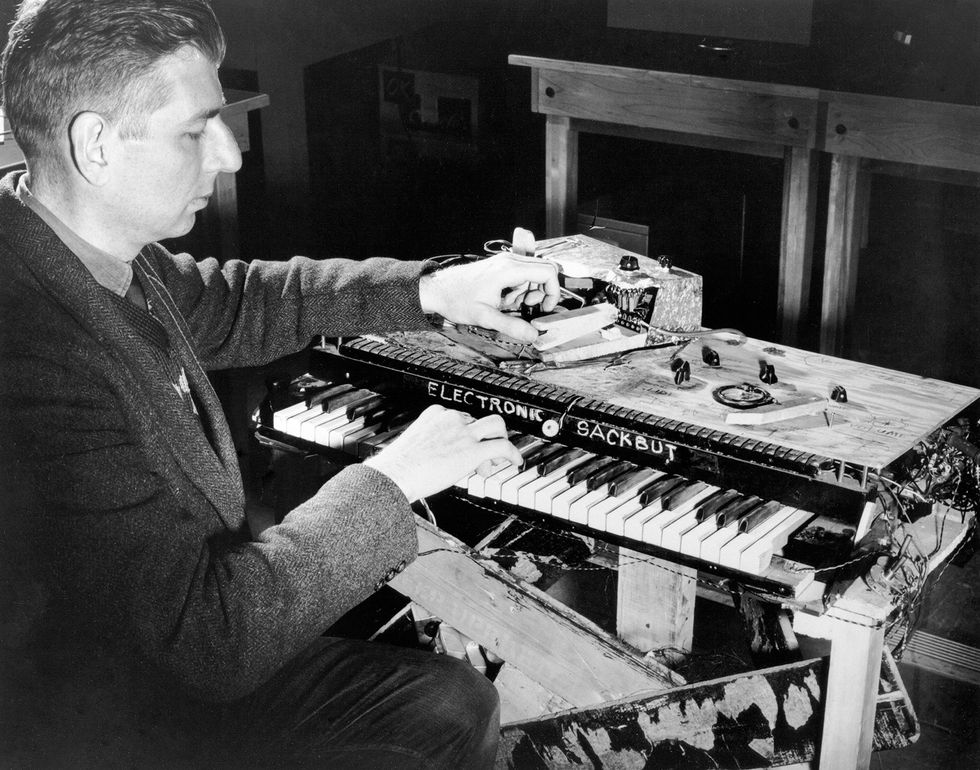 Hugh Le Caine demonstrates the left-hand control for timbre and the right-hand control for pitch and volume.National Research Council Canada Archives
Le Caine’s first electronic sackbut [shown at top] had all of the aesthetic roughness of an experimental prototype. He built it himself with whatever was on hand, valuing functionality over appearance. He constructed the stand out of pieces of packing crates, not bothering to remove staples or bits of cloth. The boards weren’t measured and cut to fit at nice, neat right angles. The result was a haphazard contraption that looked like it could collapse at any moment. Pencil marks with the inventor’s notations and directions remain scribbled across the top.
He also winged it with the prototype’s electronics. In a 1955 letter, Le Caine admitted, “Confidentially, I have never made a complete drawing of the sackbut and have only drawn parts of it when people have asked about it.” This, of course, makes it difficult to describe the prototype’s electronics, especially considering that he kept changing them as his ideas evolved. Because it was a prototype, Le Caine would just clip wires and resolder components without always cleaning up after himself. Bill Keen,