


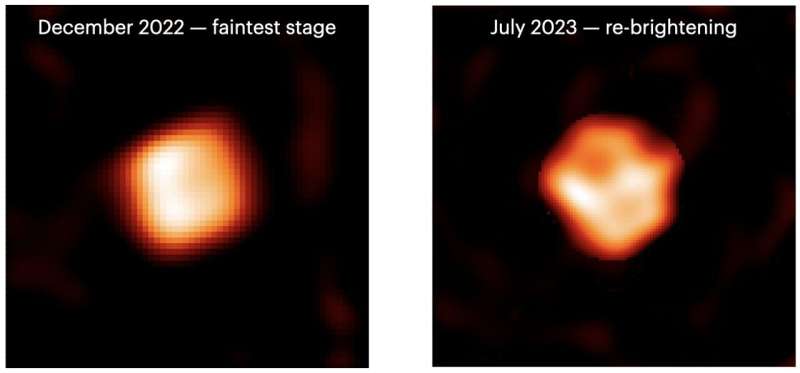
CHARA Array false-color images of RW Cephei from December 2022 (left) and Jul 2023 (right). The patchy appearance results from dust created by a huge ejection from the star. The star is huge but it is so far away that it appears about one million times smaller than the full moon in the sky. Credit: Georgia State University / The CHARA Array
Witness the first-ever close-up images of RW Cephei, one of the most massive stars in the Milky Way, as scientists from Georgia State University’s CHARA Array uncover new clues about its recent mysterious fading event, all of which happened approximately 16,000 light years away from Earth.
With riveting images and groundbreaking observations, the team of scientists reveals the grand eruption that ejected a spectacular gas cloud from RW Cephei, leading to a substantial blockage of starlight from view. The researchers presented their astonishing findings at the 243rd meeting of the American Astronomical Society in New Orleans and have since published their discoveries in The Astronomical Journal.
The unanticipated dimming event of RW Cephei last year was quite a surprise to scientists. As an example of a “cool hypergiant,” this colossal star has expanded to such immense dimensions, reaching near the end of its life. The sheer size of RW Cephei is enough to astound anyone, as its outer layers would extend beyond the orbit of Jupiter if it were positioned at the sun’s location.
According to Georgia State University astronomer Narsireddy Anugu, the team’s first observations took place just before a winter weather shutdown, but the remarkable results of their initial images prompted them to continue their exploration once the star was accessible once again. Their quest? To capture the first close-up pictures of RW Cephei and investigate the source of its fading.
This particular star’s enormous distance from Earth makes it appear as a mere pinpoint to conventional telescopes. However, the incredible imaging capabilities of the Center for High Angular Resolution Astronomy (CHARA) Array telescopes were able to provide close-up visuals of RW Cephei.
The CHARA Array, located at the historic Mount Wilson Observatory in California, is a six-telescope facility. Using intelligent algorithms and advanced imaging technology, the CHARA Array precisely captured details of the star about 30 times smaller than any conventional telescopes, and even smaller than the view of a human on the moon as seen from Earth. If you want to dive deeper into the details, you can read the full article here.