

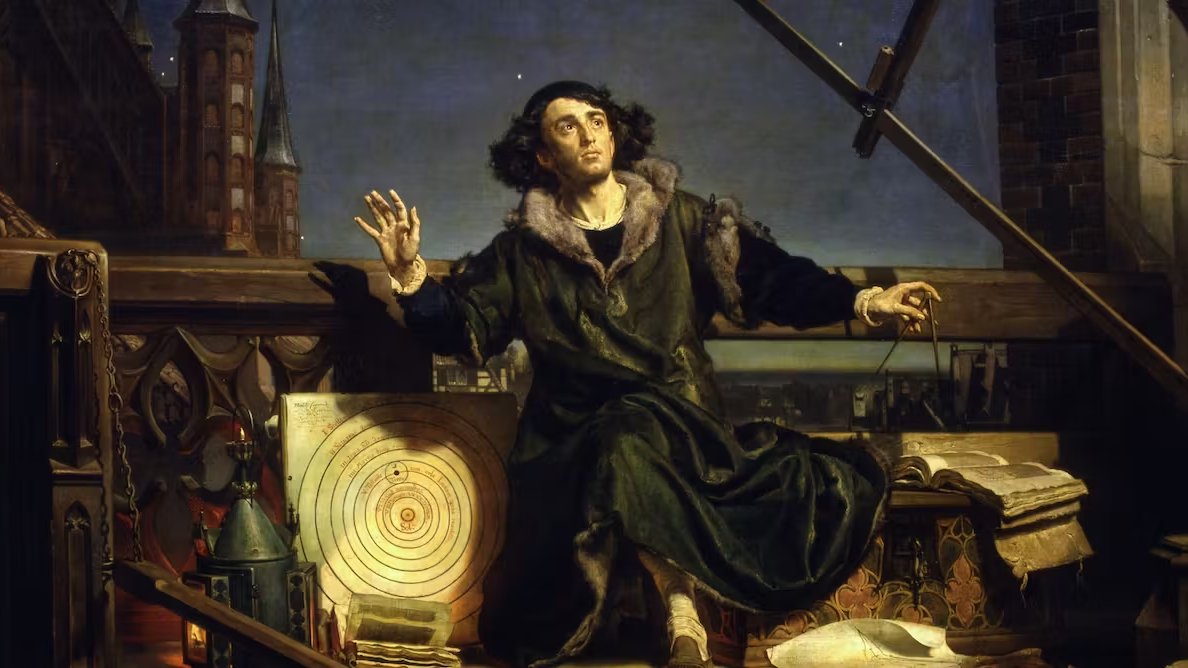

Astronomer Copernicus, or Conversations with God (1873)
(Image credit: Jan Matejko / Wikimedia Commons)
Nicholas Copernicus was the astronomer who, five centuries ago, explained that Earth revolves around the Sun, rather than vice versa. A true Renaissance man, he also practised as a mathematician, engineer, author, economic theorist and medical doctor.
Upon his death in 1543 in Frombork, Poland, Copernicus was buried in the local cathedral. Over the subsequent centuries, the location of his grave was lost to history.
Who was Copernicus?
Nicholas Copernicus, or Mikołaj Kopernik in Polish, was born in Toruń in 1473. He was the youngest of four children born to a local merchant.
After his father’s death, Copernicus’s uncle assumed responsibility for his education. The young scholar initially studied at the University of Kraków between 1491 and 1494, and later at Italian universities in Bologna, Padua and Ferrara.
After studying medicine, canon law, mathematical astronomy, and astrology, Copernicus returned home in 1503. He then worked for his influential uncle, Lucas Watzenrode the Younger, who was the Prince-Bishop of Warmia.
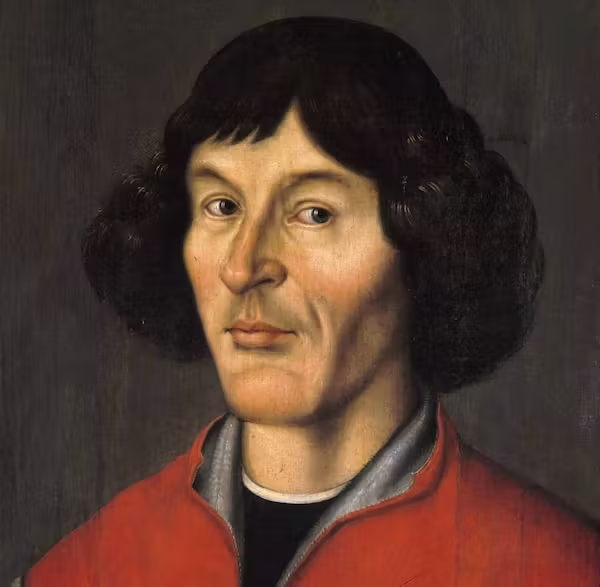
A portrait of Nicolaus Copernicus from the town hall of Toruń (circa 1580). (Image credit: Unknown artist / Wikimedia)
Copernicus worked as a physician while continuing his research in mathematics. At that time, both astronomy and music were considered branches of mathematics.
During this period, he formulated two influential economic theories. In 1517, he developed the quantity theory of money, which was later re-articulated by John Locke and David Hume, and popularised by Milton Friedman in the 1960s. In 1519, Copernicus also introduced the concept now known as Gresham’s law, a monetary principle addressing the circulation and valuation of money.
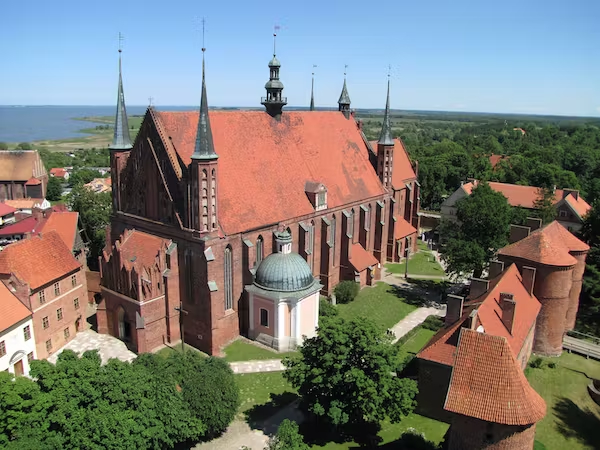
Nicholas Copernicus was buried in Frombork Cathedral. (Image credit: Holger Weinant / Wikimedia, CC BY-SA)The Copernican model of the universe
The cornerstone of Copernicus’s contributions to science was his revolutionary model of the universe. Contrary to the prevailing Ptolemaic model, which maintained that Earth was the stationary centre of the universe, Copernicus argued that Earth and other planets revolve around the Sun.
Copernicus was further able to compare the sizes of the planetary orbits by expressing them in terms of the distance between the Sun and Earth.
Copernicus feared how his work would be received by the church and fellow scholars. His magnum opus, “De Revolutionibus Orbium Coelestium” (On the Movement of the Celestial Spheres), was only published just before his death in 1543.
The publication of this work set the stage for groundbreaking shifts in our understanding of the universe, paving the way for future astronomers such as Galileo, who was born more than 20 years after Copernicus’s death.
The search for Copernicus
The Frombork Cathedral serves as the final resting place of more than 100 people, most of whom lie in unnamed graves.