


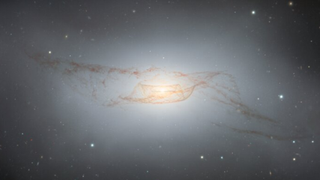
The twisted galactic disk of NGC 4753 as seen by the Gemini South Telescope
(Image credit: International Gemini Observatory/NOIRLab/NSF/AURA)
A team of astronomers became a crew of cosmic crash scene investigators while studying wreckage left behind by two galaxies that smashed into one another over 1 billion years ago.
The scientists used the Gemini South Telescope to investigate the twisted galactic disk of the galaxy NGC 4753, located around 60 million light-years from Earth, seeing it in more detail than ever before. The team paid particular attention to a complex network of dust tracks that appear to twist around the heart, or galactic nucleus, of NGC 4753.
Galaxies come in four main shapes: Lenticular, elliptical, irregular and spiral, like the Milky Way. While NGC 4753 is classified as a lenticular galaxy, however, the merger with a smaller dwarf galaxy 1.3 billion years ago has left its disk of stars and dust with a twisted shape that fits it into the aptly named subclass of “peculiar” galaxies.
“Galaxies that gobble up another galaxy often look like train wrecks, and this is a train-wreck galaxy,” Tom Steiman-Cameron, team leader and a senior research scientist at Indiana University, said in a statement.
Related: Astronomers accidentally discover ‘dark’ primordial galaxy with no visible stars
NGC 4753 was first discovered by German-British astronomer William Herschel in 1784; it’s located in the constellation of Virgo. The galaxy is situated in the NGC 4753 Group of galaxies which, in turn, is part of the Virgo II cloud of 100 galaxy clusters that sits on the southern edge of the Virgo supercluster of galaxies.
The twisted dust lanes of NGC 4753 have long been a source of fascination for astronomers. In 1992, a team of scientists, also led by Steiman-Cameron, determined that this mystifying feature is the result of a lenticular galaxy colliding with a gas-rich dwarf galaxy.
Such a collision would have injected the lenticular galaxy with a massive amount of gas, triggering bouts of intense star formation called “starbursts” and filling NGC 4753 with vast amounts of dust.
As the dwarf galaxy mixed into the larger lenticular galaxy with its stars spiraling toward its galactic center, the accumulated dust spread would’ve spread out into a disk-like structure.
A fascinating phenomenon called “differential precession,” caused by the angle at which the two galaxies collided, would have then taken over to wind the dust into a more intriguing shape.
The easier way to picture precession is to think of a child’s spinning top. Imagine what it would look like if you set it spinning, then viewed it aerially. As the top slows and loses momentum, the top of the top — for lack of a better word — would start to wobble, and its angle of orientation would changes. That’s a simple precession analog.
The precession experienced by NGC 4753 is called “differential” because it varied across the galaxy according to its distance from the galactic nucleus.