

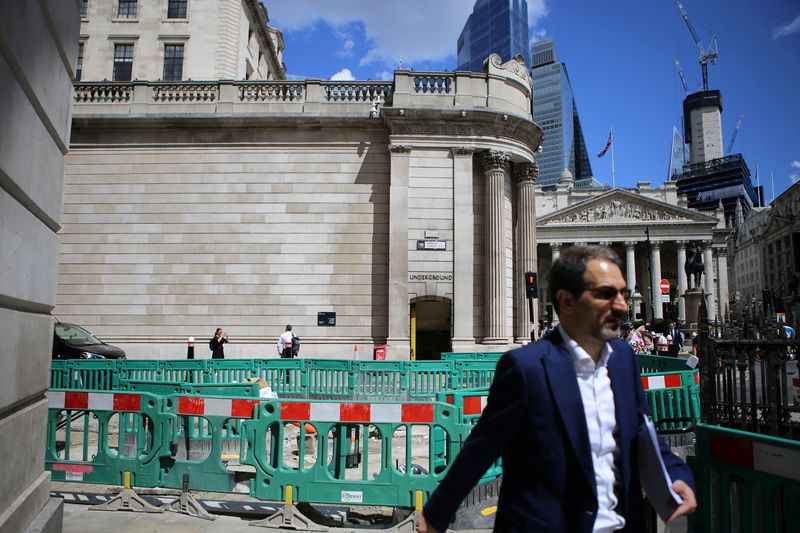

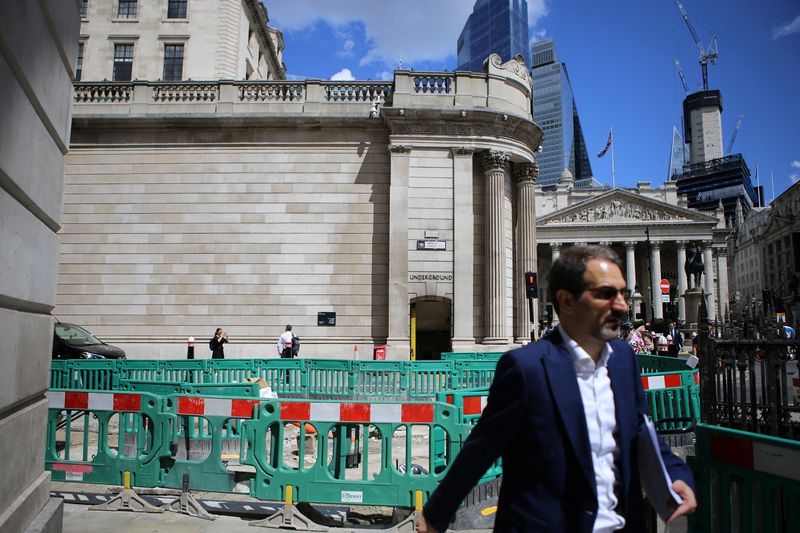
© Reuters. A man walks past the Bank of England in London’s financial district, as Britain struggles with the highest inflation rate among the world’s big rich economies, London, Britain, 17 July 2023. REUTERS/Rachel Adams/File Photo
LONDON (Reuters) -The International Monetary Fund (IMF) warned Britain’s Conservative government on Tuesday not to cut taxes in the run-up to a national election expected later this year, due to high levels of public debt and growing demands on services.
The warning from the IMF’s chief economist, Pierre-Olivier Gourinchas, came after the body cut its forecast for British economic growth next year as part of a wider forecast update.
“We would advise against further discretionary tax cuts,” Gourinchas said in response to a question from a reporter.
He highlighted growing demands for health and social care, education and environmental investment.
“It’s very important to have in place medium-term fiscal plans that accommodate these pressures, at the same time as ensuring that debt dynamics remain stable and contained,” Gourinchas said.
British government debt surged as a share of national income during the COVID-19 pandemic, although it remains lower than in the United States, Japan or France.
Finance minister Jeremy Hunt cut payroll taxes and made permanent a tax break for business investment in November. Earlier on Tuesday said he would like to make further tax cuts in an annual budget statement due on March 6.
“It is too early to know whether further reductions in tax will be affordable … but we continue to believe that smart tax reductions can make a big difference in boosting growth,” Hunt said.
He has taken a more cautious approach to tax cuts than his predecessor Kwasi Kwarteng, whose unfunded plans under previous Prime Minister Liz Truss panicked bond investors, drew criticism from the IMF and forced the Bank of England (BoE) to prop up the government debt market.
CONSERVATIVES TRAIL IN POLLS
Britain’s ruling Conservatives are far behind the opposition Labour Party in opinion polls, and many Conservative lawmakers think tax cuts could help narrow the gap.
Asked if the government would follow the advice of the IMF or its own lawmakers, a spokeswoman for Prime Minister Rishi Sunak told reporters: “The prime minister has said he wants to continue cutting taxes where we can afford to do so.”
However, doubts about whether Britain should prioritise tax cuts are common among economists.
Mohamed El-Erian, a veteran bond market investor who now heads the University of Cambridge’s Queens’ College and advises insurance giant Allianz (ETR:), told a House of Lords committee that the IMF was right to be sceptical.
“Tempting as it is to use the fiscal space – the ‘headroom’ as we call it – for tax cuts, it should be used for other things that directly generate the sort of long-term growth and productivity growth that we need,” he said.