


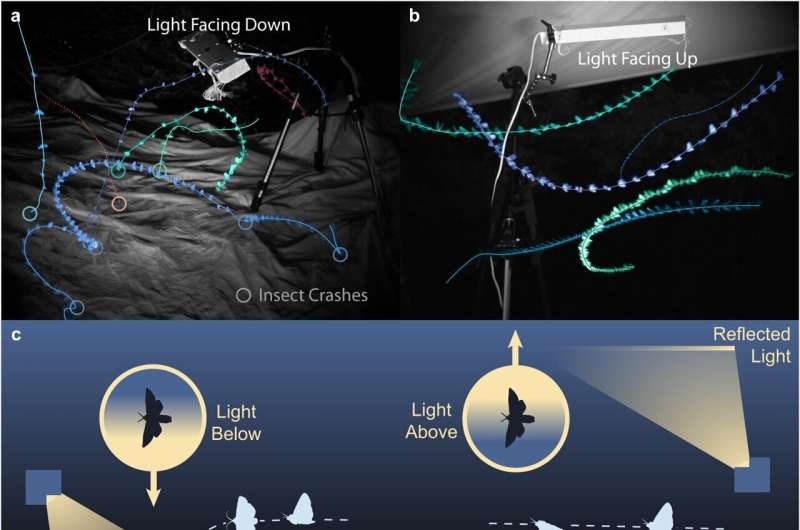
The effect of reflected light was strongly dependent on whether it came from below or above the insect. Credit: Nature Communications (2024). DOI: 10.1038/s41467-024-44785-3
It’s an observation as old as humans gathering around campfires: Light at night can draw an erratically circling crowd of insects. In art, music and literature, this spectacle is an enduring metaphor for dangerous but irresistible attractions. And watching their frenetic movements really gives the sense that something is wrong—that instead of finding food and evading predators, these nocturnal pilots are trapped by a light.
Sadly, centuries of witnessing what happens have produced little certainty about why it happens. How does a simple light change fast, precise navigators into helpless, flittering captives? We are researchers examining flight, vision and evolution, and we have used high-speed tracking techniques in research published in Nature Communications to provide an answer.
Many old explanations for this hypnotic behavior have not fully panned out. An early notion was that the insects might be attracted to the heat of a flame. This was interesting, as some insects really are pyrophilic: They are attracted to fire and have evolved to take advantage of conditions in recently burned areas. But most insects around a light are not in this category, and cool lights attract them quite well.
Another thought was that insects were just directly attracted to light, a response called phototaxis. Many insects move toward light, perhaps as a way to escape dark or entrapping surroundings. But if this were the explanation for the clusters around a light, you might expect them to bump straight into the source. This theory does little to explain the wild circling behavior.
Still another idea was that insects might mistake a nearby light for the moon, as they attempted to use celestial navigation. Many insects reference the moon to keep their course at night.
This strategy relies on how objects at great distance seem to hover in place as you move along a straight path. A steady moon indicates that you have not made any unintentional turns, as you might if you were buffeted by a gust of wind. Nearer objects, however, don’t appear to follow you in the sky but drift behind as you move past.
The celestial navigation theory held that insects worked to keep this light source steady, turning sharply in a failed attempt to fly straight. An elegant idea, but this model predicts that many flights will spiral inward to a collision, which doesn’t usually match the orbits we see. So what’s really going on?
To examine this question in detail, we and our colleagues captured high-speed videos of insects around different light sources to precisely determine flight paths and body postures