


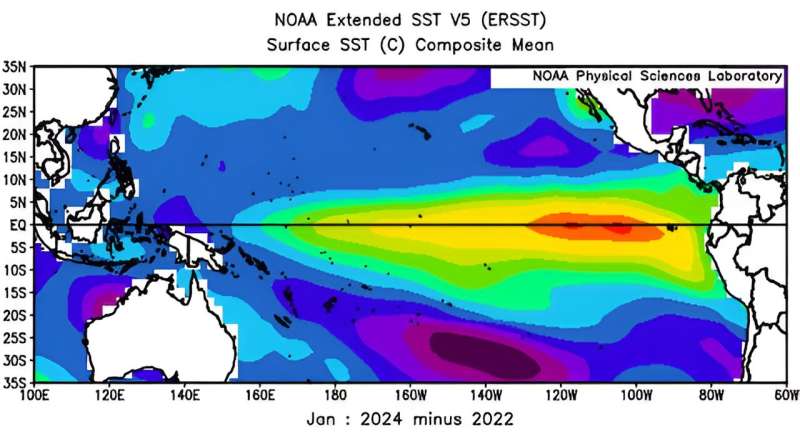
Reds and yellows indicate areas of the Pacific Ocean that were warmer in 2024 than in 2022. This region of abnormal warmth along the equator is known as El Niño. Weak El Niño occurrences happen every few years, with intense events like this happening roughly once every 10 to 20 years. Credit: NOAA
The past few months have witnessed turbulent weather patterns across North America, partly due to a potent El Niño that caused temperatures to soar in 2023. This climate anomaly fueled atmospheric rivers that saturated the West Coast and contributed to the extreme summer heat in the South and Midwest, as well as the wet autumn storms in the East.
The robust El Niño is now showing signs of diminishing and is projected to dissipate by late spring 2024.
Implications of the Weakening El Niño
As the strong El Niño weakens, it raises questions about what lies ahead in the coming months and how it might impact the 2024 hurricane season.
Understanding El Niño
El Niño and its counterpart, La Niña, are climatic phenomena that influence global weather patterns. El Niño tends to elevate global temperatures, a trend witnessed in 2023, while La Niña episodes usually result in slightly cooler conditions. These fluctuations in global temperatures deviate from the overall warming trend attributed to climate change.
El Niño originates from the accumulation of warm water along the equator in the eastern tropical Pacific Ocean near South America. Normally, the easterly trade winds move across the tropical Pacific, leading to cold water upwelling along the equator and the buildup of warm water in the western Pacific. At intervals of about three to seven years, these winds weaken or reverse direction, causing warm water to flow eastward. This elevated temperature water promotes increased rainfall and alters wind patterns globally, a phenomenon known as El Niño.
The warm water persists for several months before eventually cooling down or moving away from the equator due to the return of trade winds. When the eastern equatorial Pacific region experiences a colder-than-normal phase, La Niña emerges, triggering shifts in global weather patterns again.
Outlook for El Niño in 2024
Although the El Niño event of 2023-24 likely reached its peak in December, it remains robust. Weather forecasts indicate that throughout the remainder of winter, the prevailing strong El Niño conditions will likely result in uncharacteristic warmth in Canada and the northern United States, along with sporadic stormy conditions in the southern states. The El Niño phase is expected to conclude in late spring or early summer, transitioning briefly to a neutral phase. There is a high probability that La Niña conditions will emerge by fall, although predicting the exact timing and subsequent developments is challenging.
How El Niño Progresses in the Equatorial Pacific Ocean.
What Happens When an El Niño Event Comes to an End.
Read more at the article linked above.