


Studying the Impact of Stellar Light on Planet Formation
For many years, scientists have understood that the intense light emitted by massive stars has the potential to disrupt the swirling disk of dust and gas surrounding young stars, where planets are typically formed. One critical question that remained unanswered was the speed at which this disruption occurs and whether enough material is left behind for planet formation. Recent observations using the NASA/ESA/CSA James Webb Space Telescope and the Atacama Large Millimeter Array (ALMA) focused on the Orion Nebula’s stellar nursery, specifically examining a protoplanetary disk named d203-506. This disk, which usually contains planet-forming material within a small area, had its material spread over a larger region. This unique scenario allowed astronomers to measure the rate of material loss with unprecedented precision.

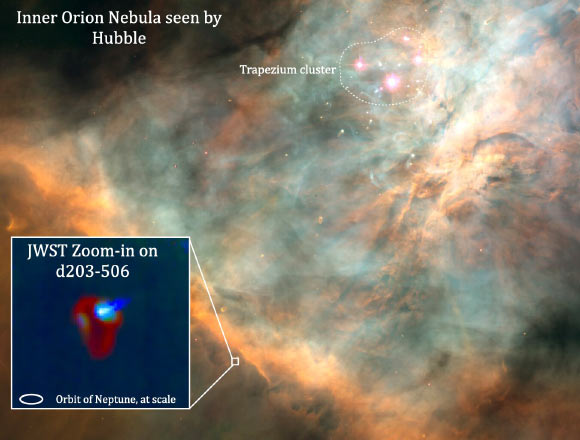
Observing the far-ultraviolet-irradiated protoplanetary disk d203-506 in the Orion Nebula.
Understanding the Impact of Photoevaporation
Typically, young low-mass stars are surrounded by protoplanetary disks made of dust and gas, essential for planet formation but relatively short-lived in nature. The formation of gas giant planets can be hampered by processes like photoevaporation, where mass is removed from these disks.
Photoevaporation occurs when the upper layers of these disks are heated by X-ray or ultraviolet radiation, leading the gas to heat up and escape the system. Since low-mass stars often form in clusters with massive stars, their protoplanetary disks are exposed to external radiation sources and subsequently undergo ultraviolet-driven photoevaporation.
Unlocking the Mystery Through Observation
Theoretical models have suggested that far-ultraviolet radiation creates photodissociation regions, where nearby massive stars influence gas chemistry on the surfaces of protoplanetary disks. Yet, directly observing these processes has been a challenge.
Researchers, led by Dr. Thomas Haworth from Queen Mary University of London, utilized a combination of infrared, submillimeter, and optical observations from the Webb and ALMA telescopes to study protoplanetary disk d203-506 in the Orion Nebula. Their analysis of the emitted lines within the photodissociation region revealed that d203-506 is experiencing significant mass loss due to far-ultraviolet-driven heating and ionization.
Implications for Planet Formation
The rapid rate at which mass is being lost from d203-506 suggests that the gas within the disk could disappear within a million years, potentially hindering the formation of gas giants within the system. Dr. Haworth emphasized that this case study provides crucial insights, showing that the young star is shedding a substantial amount of material annually, making it improbable for Jupiter-like planets to develop in this environment.
By aligning their measurements with theoretical models, the research team gains confidence in understanding how diverse environments influence planet formation in the broader cosmic landscape. Unlike other scenarios, where multiple types of UV radiation are present, the absence of a ‘hot cocoon’ in this particular system has allowed for more extensive study of the planet-forming material.
Exploring the impact of stellar light on protoplanetary disks opens new avenues for understanding the intricate processes that shape planetary systems across the universe.
______
Original Research by Olivier Berné Read more