


The Transformation of the Universe: Discoveries from the Early Ages
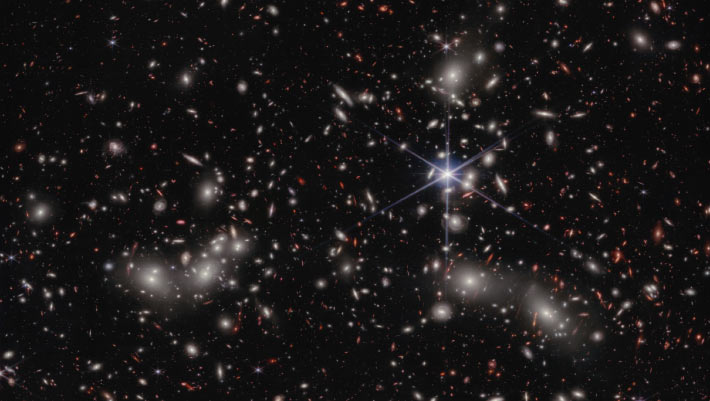
500 to 900 million years after the Big Bang, the reionization of the Universe took place. This significant event marked the shift of neutral hydrogen into ionized gas, signifying the end of the ‘Dark Ages’ in cosmic history. Recent observations by astronomers using the NASA/ESA/CSA James Webb Space Telescope have shed light on eight ultra-faint dwarf galaxies that existed less than a billion years after the Big Bang. These findings have the potential to resolve an ongoing scientific debate regarding the factors driving reionization and are crucial for understanding the formation of the earliest galaxies.
The Mystery of the Early Universe
The era of reionization in the Universe’s early history remains shrouded in mystery. Before the emergence of stars and galaxies, the Universe was engulfed in darkness and dense hydrogen gas, akin to a fog. As the first stars began emitting radiation, they ionized the surrounding gas, allowing light to penetrate through the darkness.
Unveiling the Role of Ultra-Faint Galaxies
For years, astronomers have sought to pinpoint the sources responsible for emitting radiation powerful enough to disperse the hydrogen fog enveloping the early Universe. The recent discovery of ultra-faint galaxies has illuminated the vital role they played in the early Universe’s evolution.
Astronomers emphasize the significance of these low-mass galaxies in shaping the Universe’s history. Despite their diminutive size, these galaxies are prolific in generating ionizing photons that transform neutral hydrogen into ionized plasma during cosmic reionization. Their collective energetic radiation output significantly impacted the state of the entire Universe during this critical period.
New Insights from Spectral Analysis
In a groundbreaking study, astronomers analyzed the spectra of eight faint galaxies, magnified by the lensing cluster Abell 2744. Surprisingly, these galaxies were found to be massive producers of ultraviolet light, surpassing previous assumptions by fourfold. This discovery implies that a substantial portion of the photons responsible for reionizing the Universe likely originated from these dwarf galaxies.
Charting the Evolutionary History
The findings published in the journal Nature signify a significant leap in our understanding of the early Universe. With the assistance of the James Webb Space Telescope, astronomers are delving into uncharted territories, raising new questions and exciting possibilities in unraveling the evolutionary history of our cosmic origins.
Overall, the insights gained from studying ultra-faint dwarf galaxies provide valuable contributions to the ongoing exploration of the early Universe’s transformative epochs.