

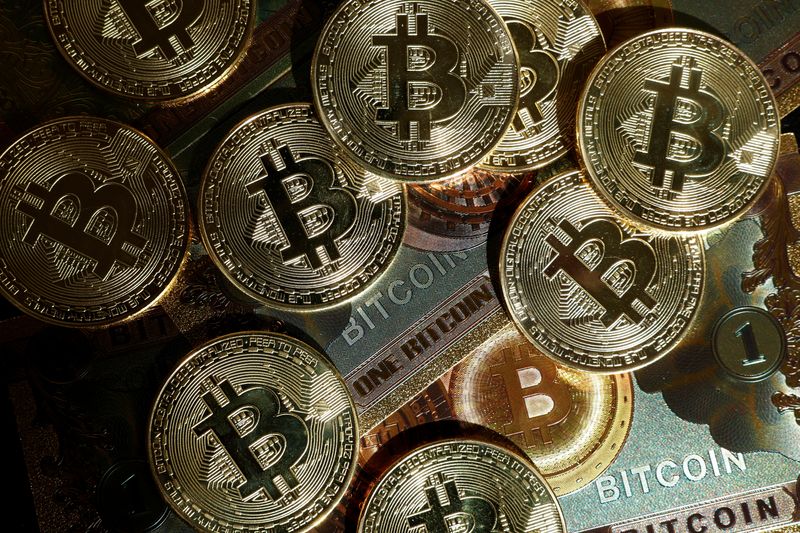

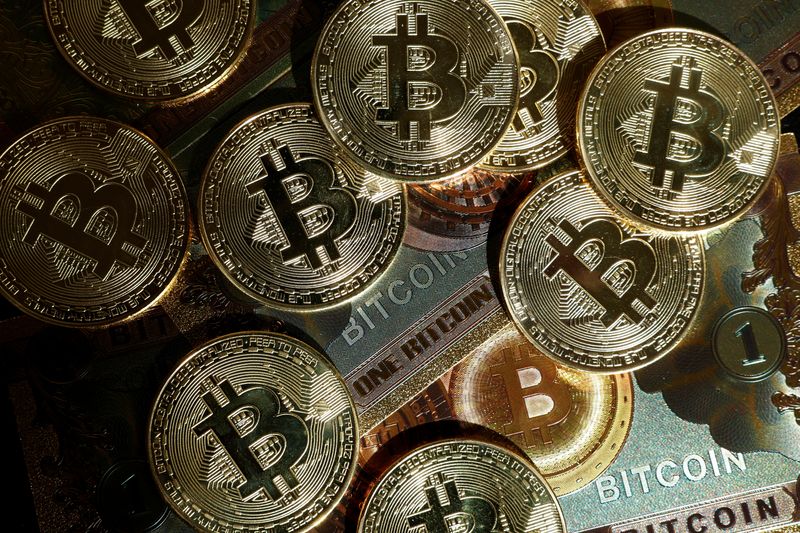
© Reuters. File Photo: Illustration of cryptocurrency Bitcoin in Paris, France
With bitcoin’s value soaring, the focus is shifting towards its upcoming “halving” event and its potential influence on the market.
Views on the halving vary widely, with some seeing it as a critical development that enhances bitcoin’s value as a scarce asset, while others perceive it as a technical adjustment hyped up by traders to boost its price.
So, what exactly is the halving, and does it hold significance?
Understanding the Halving Process
The halving refers to a modification in bitcoin’s fundamental blockchain technology, aimed at reducing the pace at which new bitcoins are generated.
Bitcoin, conceptualized by the enigmatic Satoshi Nakamoto, was intentionally designed with a finite supply of 21 million tokens.
Nakamoto integrated the halving mechanism into bitcoin’s code to diminish the rate of new bitcoin issuance.
Presently, around 19 million tokens have been brought into existence.
Execution of the Halving
Blockchain technology entails forming data records, known as ‘blocks,’ which are appended to the chain through a process called ‘mining.’
Miners utilize computational power to solve intricate mathematical puzzles to build the blockchain and earn rewards in the form of new bitcoins.
During the halving event, the rewards granted to miners in bitcoins are halved, thus reducing mining profitability and decelerating the creation of new bitcoins.
(To visually grasp blockchain’s functionality, click here.)
Anticipated Timing of the Halving
While no exact date has been stipulated, the halving is anticipated to occur towards the end of April.
The blockchain’s design prompts a halving every 210,000 blocks added to the chain, translating to roughly a four-year interval between each occurrence.
Connection to Bitcoin’s Price Trends
Advocates of bitcoin argue that its scarcity is a primary driver of its value.
According to this perspective, a reduction in supply should propel the price upwards, assuming all other factors remain constant.
Conversely, skeptics question this narrative, positing that the market has likely already factored in any potential impacts on price.
Furthermore, the supply of bitcoin is heavily influenced by crypto miners, but the sector’s operations are shrouded in opacity, leading to limited information on inventories and supplies.
If miners decide to offload their reserves, this could exert downward pressure on prices.
Identifying the catalyst behind a crypto price surge is challenging, especially due to the relative lack of transparency in terms of market participants and their motivations.
While a notable rationale for this year’s price surge is attributed to the U.S.
» …
rnrn