


World
/
April 26, 2024
The humanitarian convoy is trying to deliver vital aid to Gaza at a time when the stakes—and the risks—could not be higher.
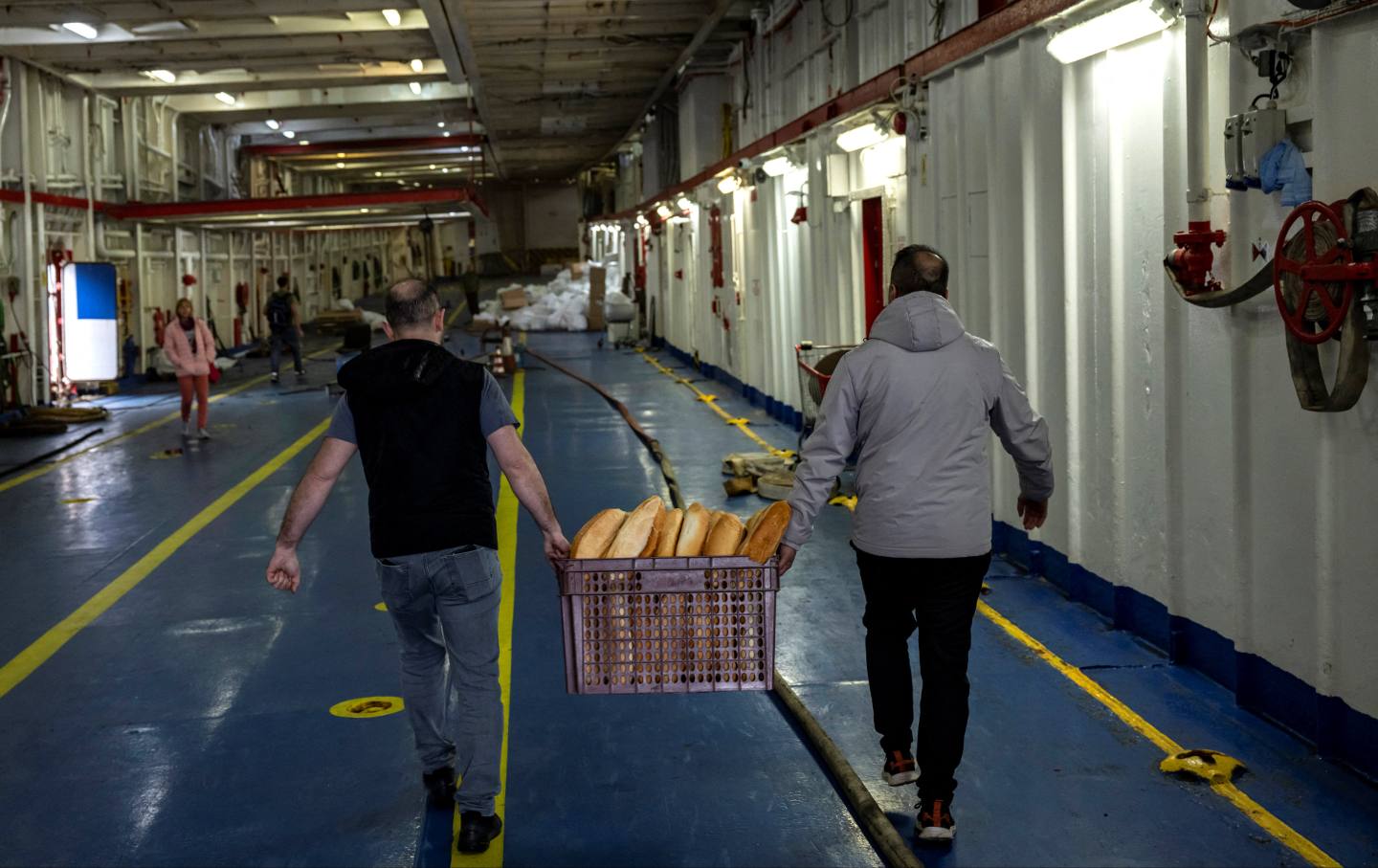
Bread is carried on board as workers prepare a ship from the Freedom Flotilla Coalition while it anchors in the Tuzla seaport, in Istanbul on April 19, 2024.
(Yasin Akgul / AFP via Getty Images)
The voyage of the Free Gaza Movement began in 2008 when two small fishing boats carrying 44 passengers sailed toward the Gaza Strip. The boats brought in about 10 international activists who would stay in Gaza for longer than the rest—people determined to bear witness to the effects of the brutal Israeli occupation—and brought out several Gazans who desperately needed to evacuate. Among those the group managed to get out were a 15-year-old amputee seeking medical care, a mother and children who had been separated from their family for years, and students who had the opportunity to study abroad but were prevented from pursuing their education.
Huwaida Arraf, the former chairperson of the Free Gaza Movement, a group created to alert people about the “prison-like” conditions in the Strip through such voyages, led five of these trips in 2008 without Israel’s permission to enter Gaza, which Israel had put under an almost total blockade. Arraf remembers “how overjoyed the people of Gaza were that we arrived,” she said, “because they saw people willing to challenge Israel’s siege.”
Eventually, the movement upgraded its boats to large fleets and partnered with other organizations to form the Freedom Flotilla Coalition. Now, that coalition—consisting of hundreds of people from over 30 countries, including the United States, Turkey, Malaysia, South Africa, and Ireland—is attempting to transport 5,500 tons of aid by sea from Istanbul to Gaza. This is far from the first time the coalition has tried to break Israel’s 17-year naval blockade of the Strip, but it is perhaps the most consequential voyage it has taken in its history.
The Freedom Flotilla passengers are determined to end the illegal siege of Gaza, despite the risks this mission poses to their lives. Gaza has been sealed off since 2007, but after October 7 Israel escalated the blockade and prevented the entrance of food and other aid into the Strip, killing even humanitarian workers who attempted to deliver it with Israeli permission. At least 31 Palestinians have died of starvation, on top of the over 34,000 Palestinians killed by Israeli shelling.
The volunteers say that, since their governments have largely stood by while Israel destroys Gaza, it’s their responsibility, and right, to take nonviolent, direct action.
Current Issue

Flotilla organizers told me that everyone on board went through an extensive vetting process to ensure that they are well-intentioned and mentally suited to embark on such a journey, and that they are required to be unarmed during the voyage. The group also gathered in Istanbul for training focused on nonviolent de-escalation prior to departure.