

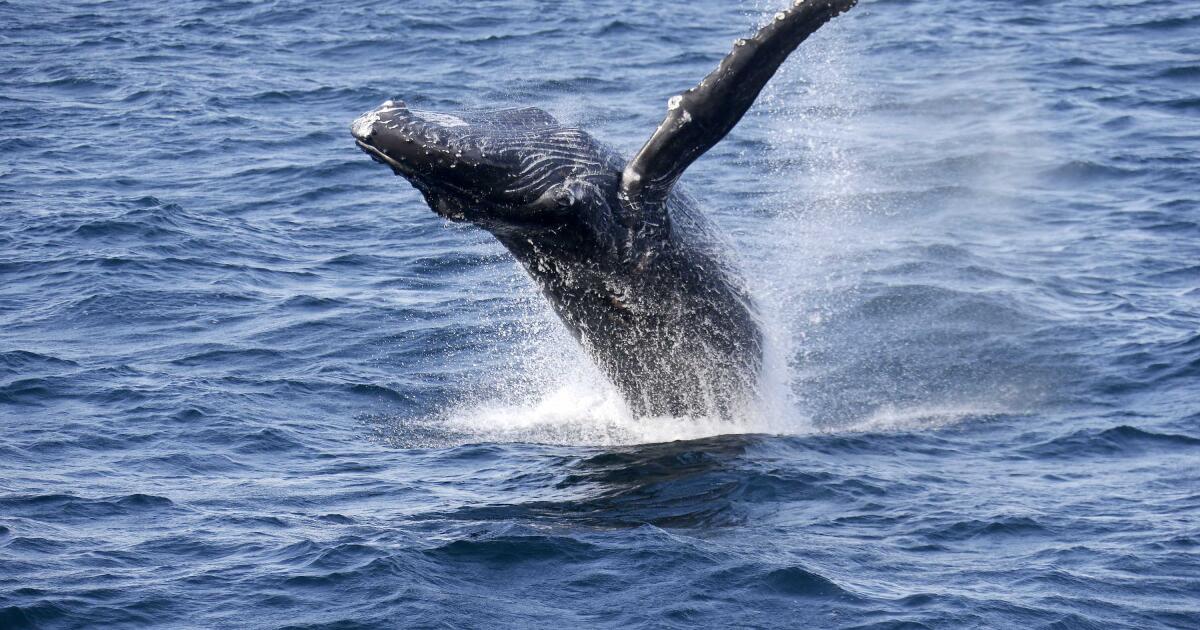

Imagine it’s the early 1900s and you’re a giant blue whale basking in the warm waters of the Santa Barbara Channel, just off the coast of Southern California. What do you hear? Fellow whale songs, murmuring currents, the occasional foghorn, perhaps.
Fast-forward to 2024, and the quiet environment you once called home now sounds vastly different as massive cargo ships churn overhead, slicing through the water with powerful propellers as they converge upon two of the busiest ports in the world.

Aggressive and impactful reporting on climate change, the environment, health and science.
While few land dwellers have given much thought to this shift in ambient marine noise, new research has modeled, for the first time, how the Industrial Revolution and the advent of commercial shipping have turned up the volume in the waters off Los Angeles.
The once-quiet environment of the Santa Barbara Channel is now about 30 times louder than it once was, according to a study published recently in the journal Marine Pollution Bulletin.
Researchers estimated noise levels in the Santa Barbara Channel using acoustic modeling. The black lines represent ships passing through the channel. (Scripps Institution of Oceanography)
The noise can have a profound effect on whales and other creatures that pass through the channel or call it home, many of whom rely on sound and echolocation as their primary mode of perceiving the world around them, according to Vanessa ZoBell, the study’s lead author and a postdoctoral researcher at Scripps Institution of Oceanography.
“Sound is everything to marine organisms,” ZoBell said — particularly because about 90% of the ocean is pitch black during the day, and 100% at night.
“It’s the only sense that a lot of marine organisms have, and noise pollution — specifically for the L.A. region — is dominated by commercial shipping,” she said. “When you’re radiating a bunch of noise into the region, it’s kind of masking that sense that these animals need to survive.”
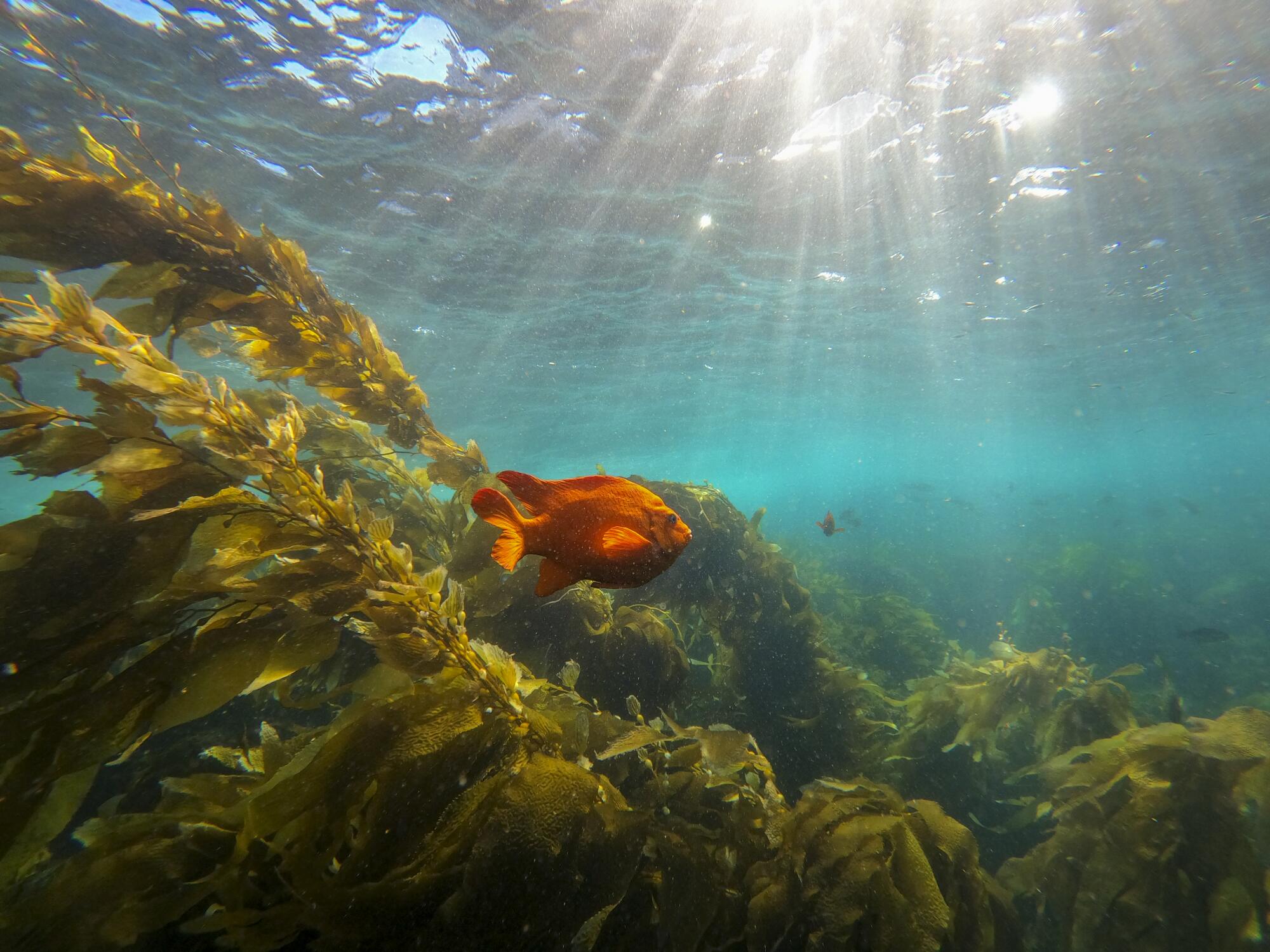
A Garibaldi swims in shallow waters off Catalina Island in January 2016.
(Allen J. Schaben / Los Angeles Times)
The researchers chose to focus on the Santa Barbara Channel in part because it encompasses Channel Islands National Marine Sanctuary and a foraging ground for the federally endangered northeastern Pacific blue whale.
The study modeled the channel’s soundscape in August 2017, when both whales and heavy ship traffic were present, and compared it with the same area decades earlier — before the influx of commercial shipping transformed the ports of Los Angeles and Long Beach into the two busiest ports in the Western Hemisphere.
They found that before the introduction of vessel cargo containerization in the 1950s, the baseline volume in the channel was about 60 to 80 decibels — a relatively low hum compared to the cacophony heard today. Now, noise levels are up to 15 decibels louder.