

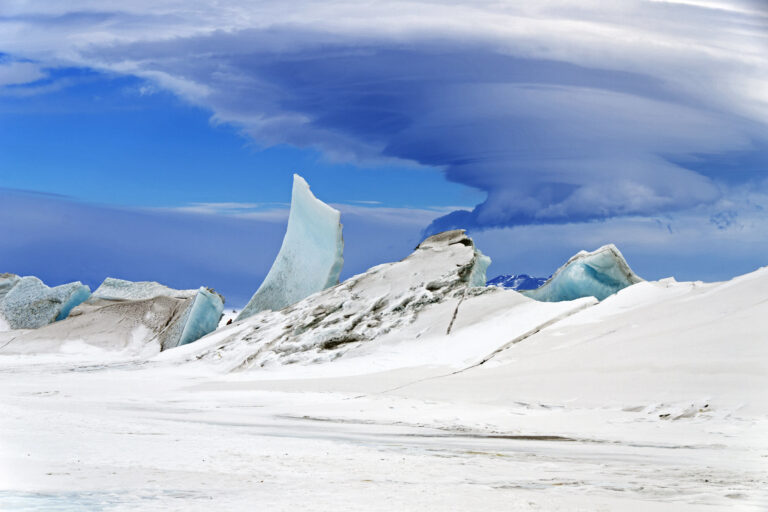

- The Arctic and Antarctic are changing rapidly in response to global warming, with scientists striving to understand how escalating impacts on these unique regions impact the rest of the world. This story summarizes three significant recent studies.
- A new comprehensive greenhouse gas budget for Arctic terrestrial ecosystems estimates that the permafrost-covered region now emits more greenhouse gases — including carbon dioxide (CO₂), methane (CH₄) and nitrous oxide (N₂O) — than it stores. That trend is expected to accelerate if Arctic warming worsens further.
- Another recent study looked at the ice shelves edging the Antarctic continent, which act as brakes slowing the flow of glacial ice into the ocean that adds to sea-level rise. Although many factors impact the mass and stability of these shelves, a new model shows El Niño warming events help melt ice from below to increase shelf loss.
- Scientists also analyzed a record-breaking heat wave hitting Antarctica in March 2022, when temperatures soared by up to 40°C (72°F) above normal. They determined that this “black swan” event is having long-term impacts on the region’s ecosystems. The odds are that more such high-heat events will occur in future.
Most of us will never travel to Earth’s poles, but every creature on this planet will likely experience the consequences of escalating global warming in the polar north and south.
Rapidly rising temperatures are radically altering the freezing, melting and precipitation patterns in the polar regions. And there’s strong evidence those changes don’t stay in the Arctic or Antarctic, but resonate across the world.
Scientists now know that events in the far north and south affect global weather, sea level rise, biodiversity, ocean currents and more. Three recent studies add new insights about the effects of warming in the coldest places on Earth — and, by extension, on all of us.
 Aerial view of a permafrost thaw slump on Herschel Island (Nunataryuk project), Unorganized Yukon, Canada. Arctic permafrost can store greenhouse gases for many centuries, but when that permafrost melts it releases those gases and they add to global climate change. Image by GRID-Arendal via Flickr (CC BY-NC-SA 2.0).
Arctic shifting from greenhouse gas sink to source
For centuries, the Arctic landscape has been a reliable long-term repository for greenhouse gases that, if released in large amounts into the atmosphere in coming years, could significantly accelerate global warming. But since the late 1970s, the Arctic has warmed at least twice — and perhaps almost four times — as fast as the rest of the world, leading to more thawed permafrost, raging record wildfires, and drastic terrain alterations.
In March 2024, scientists released a new study of this changing landscape that compared estimated emission releases versus uptake of three powerful greenhouse gases — carbon dioxide, methane and nitrous oxide — from 2000-2020.
They scaled up observational data from more than 1,000 in-situ flux monitoring sites scattered across five types of terrestrial ecosystems,