


The Eye of Mosaic Fly
December 1, 2023
3 min read
Black hole sun; the deepest mine
By Mark Fischetti
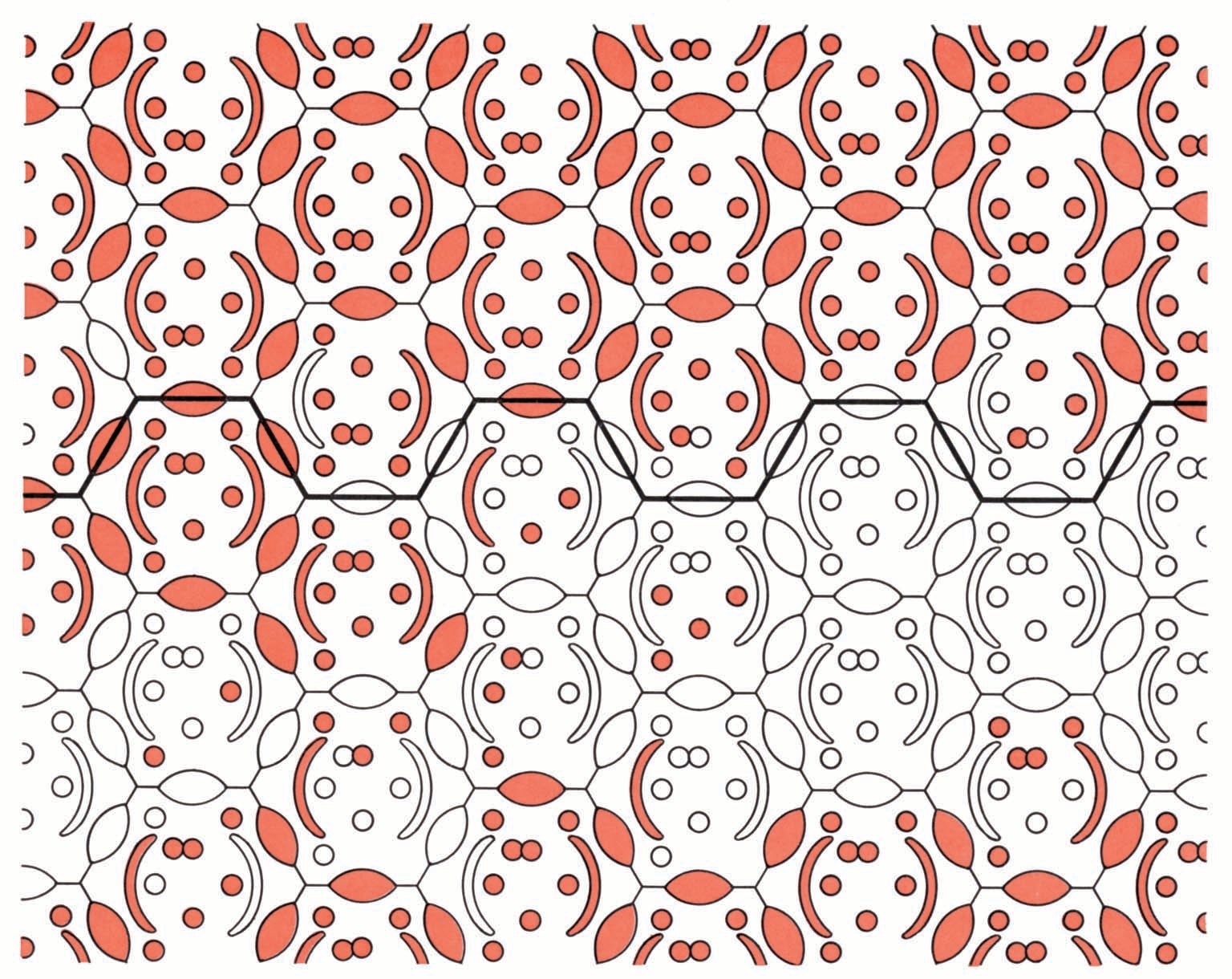
1973, Fly’s Eye: The eye of a mosaic fly (which has original and mutant genotypes) “is an array of hexagonal ommatidia, each containing eight photoreceptor cells (circles) and two primary pigment cells (crescents), surrounded by six shared secondary pigment cells (ovals). The fact that a single ommatidium can have white and normal genotypes shows its cells are not necessarily descended from a common ancestral cell.”
Credit:
Scientific American, Vol. 229, No. 6; December 1973
1973
Nobel Prize Winners, No Ph.D. Needed
“The 1973 Nobel prize in physics was awarded to Leo Esaki and Ivar Giaever ‘for their experimental discoveries regarding tunneling phenomena in semiconductors and superconductors respectively,’ and to Brian Josephson ‘for his theoretical predictions of the properties of a supercurrent through a tunnel barrier.’ Tunneling occurs because particles have the properties of waves; such waves do not stop abruptly at a barrier but penetrate some tiny but measurable distance. It is remarkable that all three of the recipients did their prizewinning work before they had received their doctorate.”
1923
Edison Inspired by Gas lighting
“There are 350,000,000 incandescent lamps in the U.S. and about an equal number in foreign countries. When Edison first studied incandescent light, commercial arc lights operated on the ‘series’ system, the only system for distributing electricity known. Current generated in the dynamo flowed through the field coils, out to one lamp after another over a wire, then back to the dynamo. One lamp could not be turned on or off without doing the same with all the others. Edison realized it never would be satisfactory for household lighting. He decided to pattern electric lighting after gas lighting, with which it would compete. He reasoned that a constant-pressure system could be made similar to that of gas. In 1879 he made a dynamo which met every requirement, and a carbon lamp in which the filament consisted of a carbonized piece of ordinary thread. On October 21, 1879, current was turned into the lamp and it lasted forty-five hours. All incandescent lamps today embody the original features.”
The Deepest Mine
“The deepest hole in the earth is a gold mine in Brazil, known as the Morro Velho or St. John del Rey mine. The St. John del Rey Mining Company has been working it almost continuously since 1834. The mine is now 6,726 feet below the surface. The temperature of the rock at the lowest level is 117 degrees. The miners work in an air temperature of 98 degrees. The outside air has an average temperature of 68 degrees, but is cooled to 42 degrees before being forced to the lowest levels by powerful fans. On its way it gains heat from the rocks and from its own compression,