

Foreign Affairs
One year on, the Argentine president has outperformed expectations.
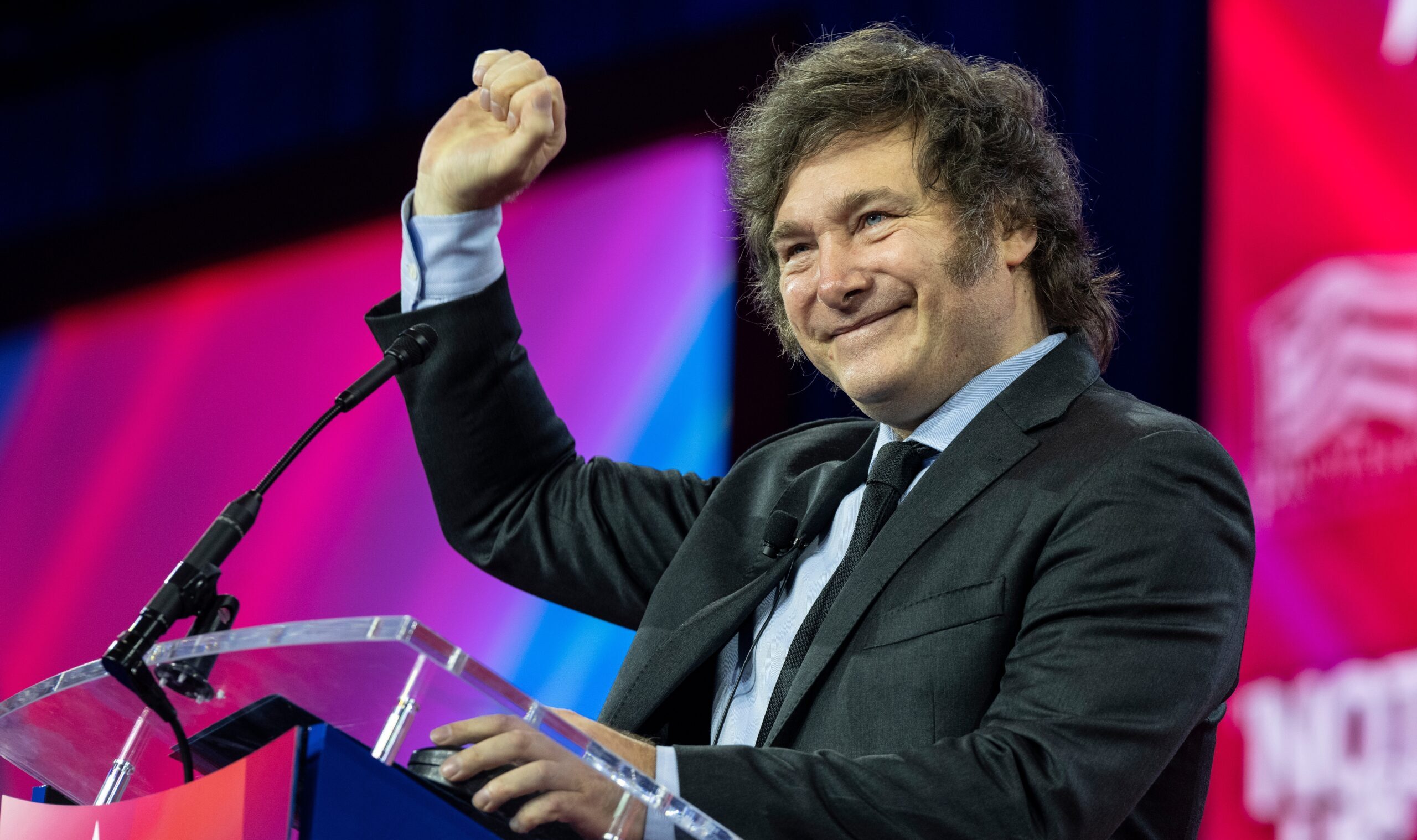
By all reasonable standards, Javier Milei should never have become president of Argentina. An outsider to the political class that rules the country, Milei is the son of middle-class parents with no public profile. He and his family suffered greatly from the staggering inflation and general economic collapse of Argentina during the late ’70s and early ’80s. The country’s lamentable condition inspired Milei—among thousands of other young Argentines—to dedicate himself to the study of economics (Argentina has one of the highest concentrations of economists per capita) in an effort to understand where things went wrong and, perhaps, how they might be improved.
During the course of his university studies, Milei encountered the works of Murray Rothbard and other economists of the Austrian School such as Friedrich Hayek. He left a convert to the radical school of libertarian thought known as anarcho-capitalism, which proposes the total abolition of the state and its replacement with businesses and other methods of private-sector social organization. Milei was always somewhat flamboyant—he was nicknamed “El Loco” in his youth for his furious conviction—and his new, revolutionary conception of the Argentine Problem provided excellent fuel for the spark of his aggressive style.
Milei entered the public eye as a media personality, who shouted down interviewers on public television and heaped scorn on journalists and politicians. His radical ideological orientation, his combative style and his extreme personal eccentricities—the characteristic unruly mop of hair, a highly unusual private life (he claims to be a tantric sex guru), rare religious proclivities (he professes a desire to convert to Orthodox Judaism), and a bizarre relationship to his dogs (he has five, all clones of his one-time pet English Mastiff named Conan, and with whom he consults on matters political and spiritual) made him an unlikely proposition either for election or for successful governance.
But Milei has managed to defy the odds and calculations of journalists and politicians, harnessing Argentines’ furor with the political status quo to successfully seat himself in the Casa Rosada (the Argentine executive office, equivalent to the White House). His tenure has proven remarkable, and he has likewise overturned the expectations of pundits, many of his fellow economists, and other more-or-less reasonable people to deliver the Argentine economy from looming hyperinflation and begin a vast campaign of substantive libertarian political reform with a finesse that would seem incredible from a perusal of his pre-presidential biography.
When Milei took office at the end of 2023, inflation was on an upward spiral, from five percent per month in January to a massive 125 percent per month in December. The previous Argentine government of Alberto Fernández created massive social programs in response to the Covid-19 pandemic, funding them with reckless deficit spending and a massive program of money creation from the Argentine central bank. When the flood of pesos inevitably devalued the currency and raised prices,