

Rewilding and restoration of land often rely on the reintroduction of species. But what happens when what you want to reintroduce no longer exists? What if the animal in question is not only locally extinct, but gone for good?
Yes, this might sound like the plot of Jurassic Park. But in real life this is actually happening in the case of the Aurochs (Bos primigenius). This wild ancestor of all modern cattle has not been seen since the last individual died in 1627, in today’s Poland.
Aurochs have been deep within the human psyche for as long as there have been humans, as attested by their prominence in cave art. However, the advent of agriculture and domestication put the magnificent animal on a path to extinction.
So why bring the Aurochs back today and how? And what is the likely outcome?
What is left of Aurochs, besides their depiction in cave paintings, are some fossil remains and some descriptions in the historical record. “Their strength and speed are extraordinary,” wrote the Roman emperor, Julius Caesar, in Commentarii de bello Gallico.
Despite the former large range of habitat of this animal (from the Fertile Crescent to the Iberian Peninsula, from Scandinavia to the Indian subcontinent), the historical record is quite slim on exact descriptions. And in all likelihood its size, behaviour, and general temperament will have varied across different environments. Despite this likely variation, the Auroch has survived into modernity as the primordial, powerful and enormous, ox.
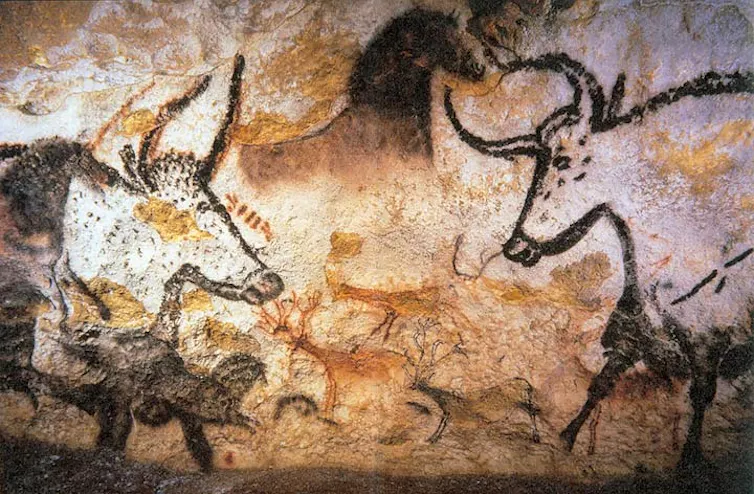
Lascaux painting of Aurochs.
Prof saxx/Wikimedia
A super-bull
The idea around today is that the Aurochs’ characteristics have survived, genetically scattered throughout its descendants. By breeding these together and selecting offspring that show increasingly more Aurochs-like traits, the theory is that we can eventually re-create something very similar to the lost animal. This theory is known as back-breeding: literally breeding backwards.
The first attempt to revive the Aurochs was made in the 1930s in Germany by two zoo directors, the brothers Lutz and Heinz Heck, with an undeniable Nazi party affiliation.
Their creation, now known as the Heck cattle, took only 12 years to accomplish and mixed breeds of domestic cattle with fighting bulls from Spain. The brothers focused more on size and aggression than on being faithful to the anatomical description of the Aurochs. This is partly why nobody today considers Heck cattle to be actual recreations of an extinct species, something reflected in the name these animals carry.
The Heck cattle made it through World War II and have since populated pastures and zoos throughout Europe. Though certainly not Aurochs, many find that they do the Aurochs’ job just fine. This is why the famous Oostvaardersplassen nature reserve in the Netherlands uses them as one of their primary grazers.
Recreating wilderness
For most of the 20th century it was assumed that the landscape in Europe before human settlement was mostly forest.