

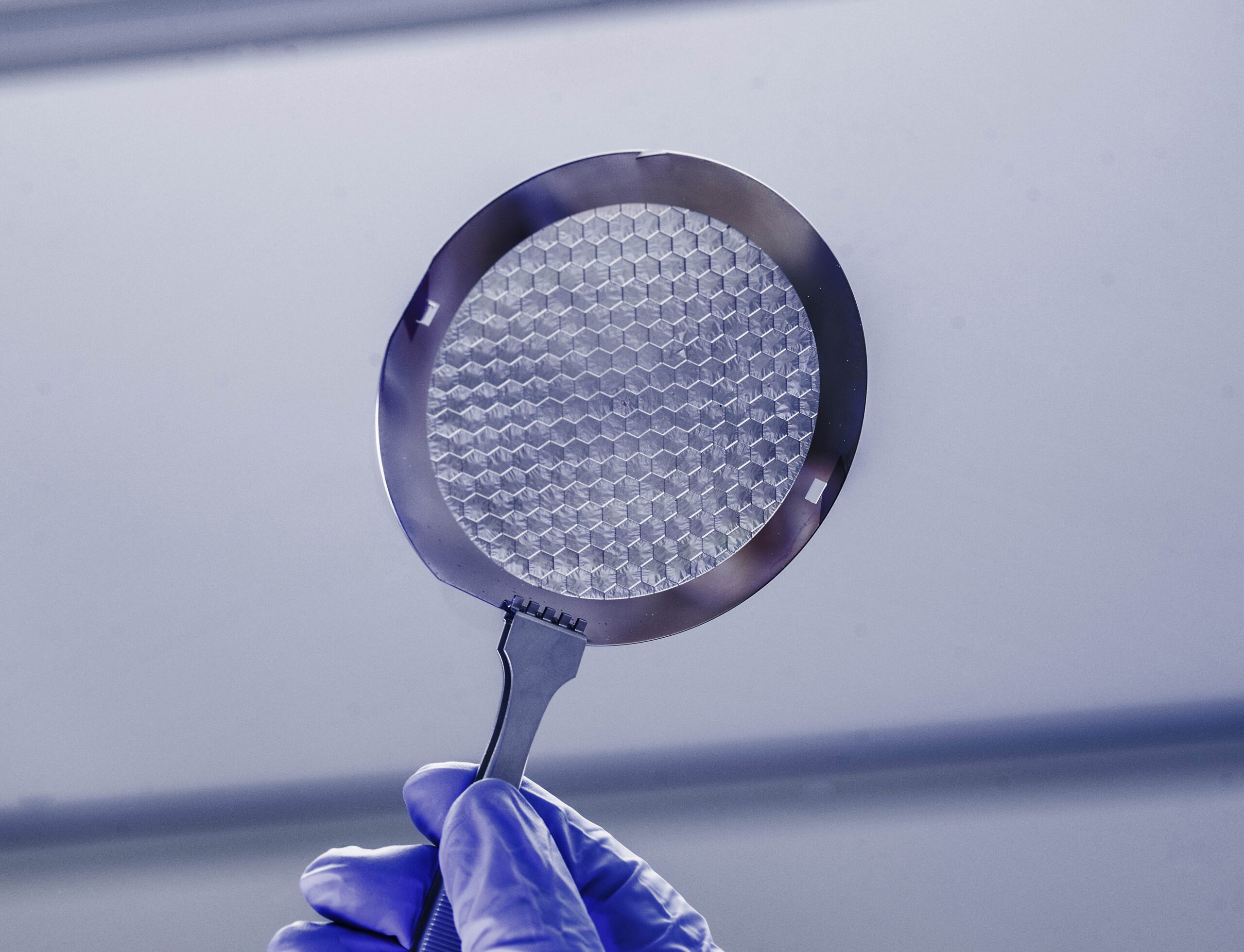

Photon sieves are a groundbreaking technology that can focus extreme ultraviolet light, and they are about to revolutionize our understanding of the Sun. A pair of precision-orbiting small satellites will attempt to capture the first-ever views of small-scale features near the Sun’s surface that scientists believe are responsible for the heating and acceleration of solar wind.
Dr. Doug Rabin, a Heliophysicist at NASA’s Goddard Space Flight Center, is excited about the potential of photon sieves. He believes that this technology will be able to resolve features 10 to 50 times smaller than what can be seen today with the Solar Dynamics Observatory’s EUV imager.
To make photon sieves effective, they must be wide, super-thin, and etched with precise holes to refract light. In the Goddard’s Detector Development Laboratory, engineer Kevin Denis has developed new ways to create wider and thinner membranes from silicon and niobium wafers. Each advancement has required additional steps to protect the resulting sieves, such as leaving a honeycomb of thicker material to support the membrane and prevent tearing.
Dr. Doug Rabin emphasized the physical challenge of constructing these precision sieves. “Their smallest features are 2 microns across with a 2-micron gap between perforations, that’s about the size of most bacteria,” he said.
Etched from the center with ever smaller rings of holes, sieves are built to refract light similarly to Fresnel lenses used in lighthouses. Thin membranes matter for solar science because these sieves transmit more light than thicker materials, Denis said.
Engineers Kelly Johnson and Kevin Denis have successfully produced a 3-inch (8-cm) diameter silicon sieve, a mere 100 nanometers thick. Now they are experimenting with niobium membranes, which can further improve light-gathering efficiency because they transmit up to seven times more light than silicon. They have successfully etched a 5-inch (13 cm) diameter niobium sieve just 200 nanometers thick.
Denis takes inspiration from working closely with scientists to overcome barriers to advancing their field, he said. “They have done a great job using the sieves in near-term science applications while we push the technology for larger and more capable missions.”
Photon sieves are already part of the technology demonstration VISORS – Virtual Super Optics Reconfigurable Swarm – CubeSat mission, expected to launch in 2024. This mission consists of one compact satellite about the size of a briefcase outfitted with sieves to refract light onto a receiver on a second satellite 130 feet (40 m) away. Maintaining these spacecraft’s high-precision orbit and developing a sunshade are the focus of other Goddard IRAD projects.
The success of VISORS could pave the way for a larger future mission with the greater resolution of Denis’s thinner sieves once they are ready for spaceflight.
Another larger photon sieve will be used to calibrate the MUSE – Multi-slit Solar Explorer – spectrometer expected to launch in 2027.