


Experts advise people with serious interest in home solar to act quickly and consider their choices carefully to avoid any headaches.
July 11, 2025
Ben Zientara
From pv magazine USA
In many US states, rooftop solar installations can provide financial benefits. The solar energy goes toward reducing the home’s grid energy usage, and any excess electricity generated can be sent back to the utility for at least some credit. In this way, a solar installation that is the property of the homeowner acts as a hedge against rising utility costs.
These financial benefits have been enabled partially by the Residential Clean Energy Tax Credit, which provides a tax credit of 30% of the cost to install solar panels to homeowners in the year after installation. But with the passage of H.R. 1 (aka the One Big Beautiful Bill Act), the US residential tax credit will end after 2025.
Without the tax credit, people in states with lower average electricity prices may no longer see financial benefits from getting solar panels installed.
So what should homeowners do if they want to take advantage of the tax credit? Solar industry leaders and experts who spoke with pv magazine USA agree on a few pieces of advice:
If you’re serious about getting solar panels, begin the process as soon as possible
Choose the company you work with carefully
Understand your options for claiming the tax credit
When it comes to getting solar in time to claim the Residential Clean Energy Tax Credit, time is of the essence. A study of solar installation timelines by the National Renewable Energy Laboratory (NREL) showed that it typically takes between 70 and 112 days to go from a signed contract to the day your utility company grants permission to operate your system interconnected with the grid.
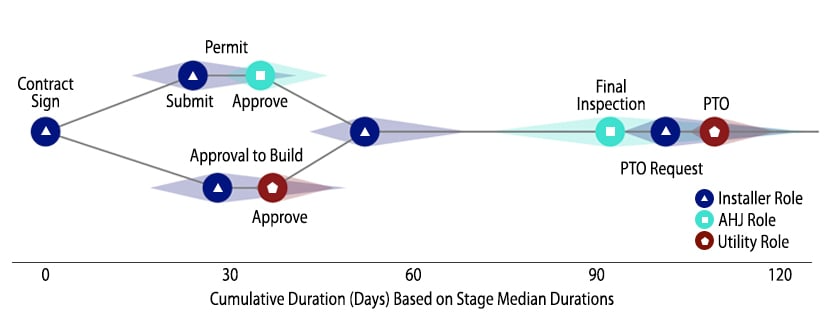 Image: NREL
Experts say that timeline may be ambitious, given the rush of business that is expected to happen before the deadline.
“If homeowners wait until October to start the process, I suspect most installers will say, ‘hey, we’re booked through the end of the year,’” said Kevin Conroy, president of residential solar financing provider Halo Funding .
Dean Chiaravalloti, chief revenue officer at Solar Insure, agrees.
“The closer we get to December 31st, the more likely city departments and utilities will be overwhelmed,” said Chiaravalloti. “That slows everyone down. If you’re planning to go solar, do it now – not in Q4 when everyone else is scrambling.”
Another recommendation has to do with choosing a solar company and making sure they’ll follow through on promises made. Conroy advised homeowners to go with a local solar installer over a national company. Chiaravalloti added “choose a contractor with strong credit, at least 3 years of operations, no unresolved lawsuits, and solid licensing.”
Joy Seitz, CEO of American Solar & Roofing in Phoenix Arizona,