


As China ramped up its security in Bejing ahead of its largest military parade in history, over in Chongqing, a city of 30 million people, slogans mysteriously appeared projected on the walls of a university residential complex. “Only without the Communist Party can there be a new China,” read one. “Freedom is not given but seized,” said another. A third urged: “Down with red fascism, overthrow Communist tyranny.”
When the police finally tracked down the source of these projections to a hotel room nearby, they found it empty apart from a projector and remotely controlled cameras which captured their confusion at the puzzling scene. This footage was uploaded on to X along with the slogans projected on the university building walls.
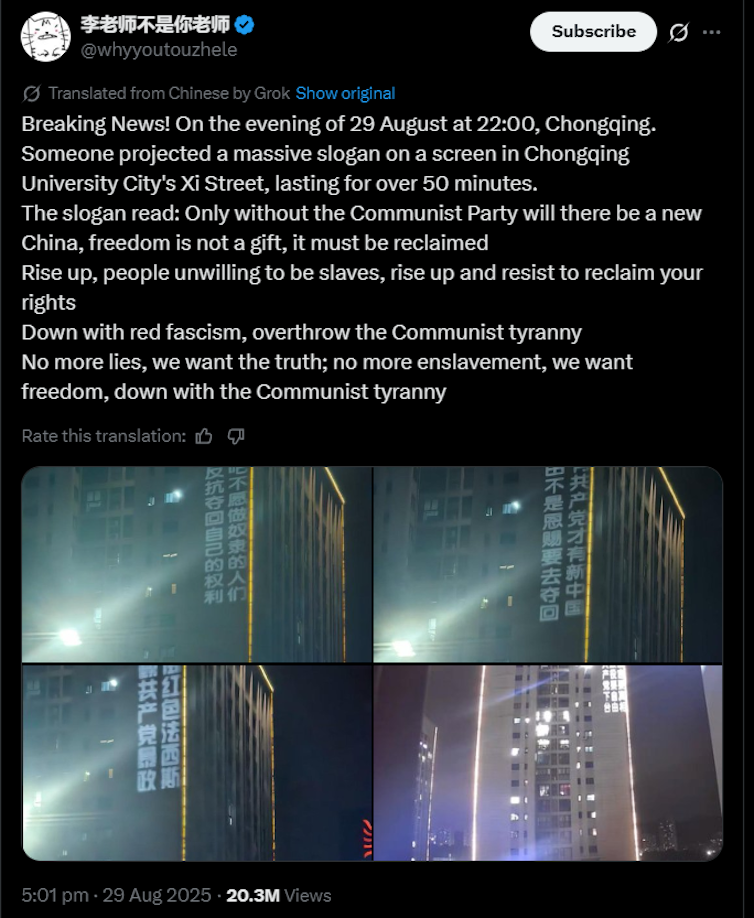
News of the incident was quickly shared on social media.
@whyyoutouzhele via X
The man behind this coup de théâtre – Qi Hong, a 43-year-old Chongqing native – had already left the country with his family for a “holiday” in the UK, from where he operated the projector and cameras remotely. Within six days, the posts had been viewed more than 19 million times.
This striking act of defiance points to the fact that dissenting voices – given sufficient ingenuity and determination – are still able to penetrate China’s formidable surveillance state. Furthermore, it may signal that there are significant subterranean levels of opposition to the country’s leadership under Xi Jinping.
China’s embrace of digital technologies has always presented it with a dilemma: how to exercise control over this inherently expansive and unruly – yet economically indispensable – communications sphere. As the online world became the most important platform for change in China, giving rise to pro-democracy initiatives, environmental NGOs, human rights defenders and grassroots opposition, the state’s response has essentially remained the same.
Predisposed to top-down control throughout Communist Party history in order to maintain its grip on power, the Chinese state has never been capable of imagining political solutions. Rather, it has consistently fallen back on deploying technology in the suppression of opposing voices.
Hence the Great Firewall of China (also known as the Golden Shield), launched in the late 1990s, which combined censorship with multi-layered online monitoring. This was followed by Skynet, a mass video surveillance system introduced in 2005.
These technologies – later upgraded with big data, AI, facial recognition and cloud computing – were presented as tools against crime and foreign threats. But they have also been widely criticised, both inside and outside China, for silencing dissent and restricting press freedom.
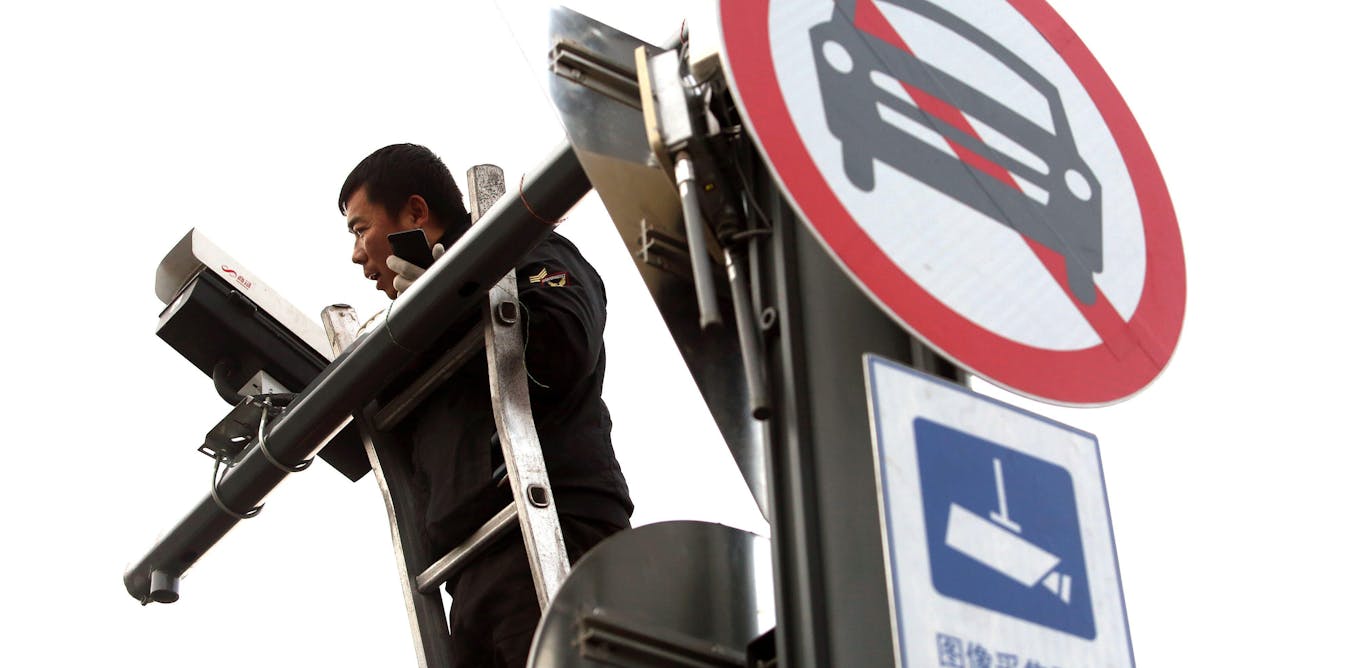
By 2024, China had installed more than 600 million cameras – roughly one for every two adults – making it the largest video surveillance system in the world.
While some devices are used for urban management, Wall Street Journal reporters Liza Lin and Josh Chin have shown how the party-state increasingly harnesses surveillance for social control – often in harsh and coercive ways.