

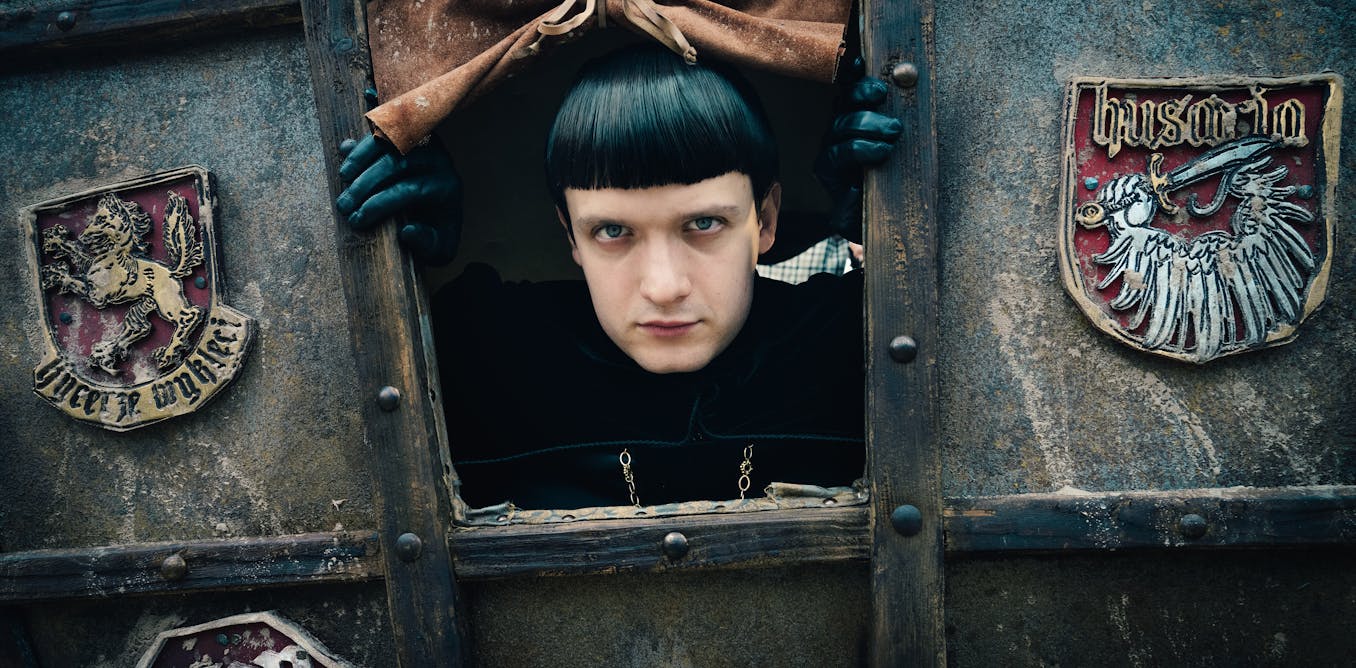

Netflix’s 1670 is one of the sharpest period comedies of recent years.
Shot in a mockumentary style, it follows Jan Paweł Adamczewski (Bartlomiej Topa), a vain provincial nobleman, and his family, in the Polish-Lithuanian Commonwealth of the late 17th century.
Season two, released this month, builds on the absurd humour of the first – mixing slapstick with political parody and playful anachronisms.
But while the series is not meant as a history lesson, it works best when viewed against the real story of Poland-Lithuania, a vast but fragile state that once dominated East-Central Europe. Understanding this background explains why the jokes land, and why the series resonates beyond Poland.
A big, bold and unstable commonwealth
The Polish-Lithuanian Commonwealth was created in 1569, when the Kingdom of Poland and the Grand Duchy of Lithuania joined in a union. At its height, it stretched from the Baltic Sea almost to the Black Sea, covering much of present-day Poland, Lithuania, Latvia, Belarus and Ukraine. Home to some 11 million people in the 17th century, it was one of Europe’s largest states.
This commonwealth was unique. It was neither a monarchy like France at the time, nor an autocratic empire like Russia. Instead, it called itself a “Republic of Nobles”. The king was elected, not hereditary. The parliament (the Sejm) had representatives from across the realm, but only nobles (about 10% of the population) had political rights. Most people were peasants, bound to estates and excluded from decision-making.
One of the state’s defining quirks was the liberum veto: the right of any single deputy to dissolve parliament by shouting “I object”. This was meant to protect noble freedom, but in practice it paralysed government. The commonwealth became famous for dysfunction: assemblies collapsed, reforms failed and decisions were delayed.
Nonetheless, the state produced a striking culture. Convinced they descended from ancient warriors, Polish nobles cultivated a proud, mustachioed style known as Sarmatism. It was colourful, theatrical, self-important – and ripe for parody.
The commonwealth endured until the late 18th century, when its neighbours (Russia, Prussia and Austria) dismembered it in three “partitions” (1772, 1793 and 1795).
How 1670 plays with history
1670 mines this history for comedy. Jan Paweł dreams of being the most famous John Paul in Polish history, oblivious to his own mediocrity.
His wife Zofia (Katarzyna Herman) is a religious fanatic, his daughter Aniela (Martyna Byczkowska) a rebellious proto-feminist, and his brother-in-law Bogdan, a hussar given to mushroom-induced visions. They argue, scheme, and confess to camera with the self-importance of characters from The Office.
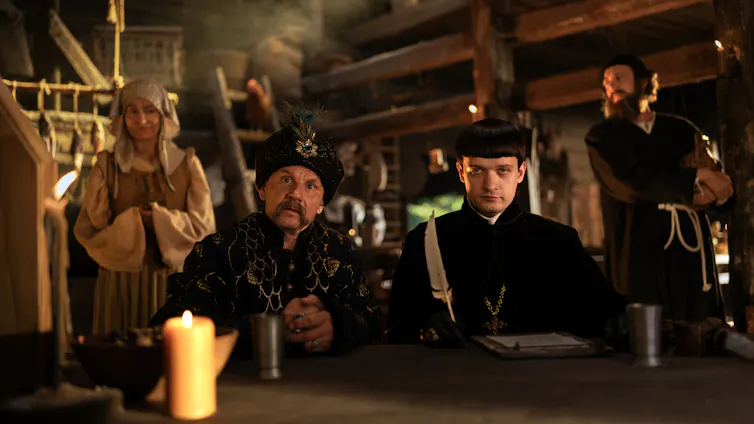
Polish nobles in the 17th century believed they were descended from ancient warriors.
Jarosław Sosiński/Netflix
Season two sees the family blunder into diplomacy with the Ottomans, organise a ruinous harvest festival, and navigate witch trials, funerals and romantic scandals. The humour is often absurd – at one point we see a talking donkey – but always circles back to the vanity of power.