

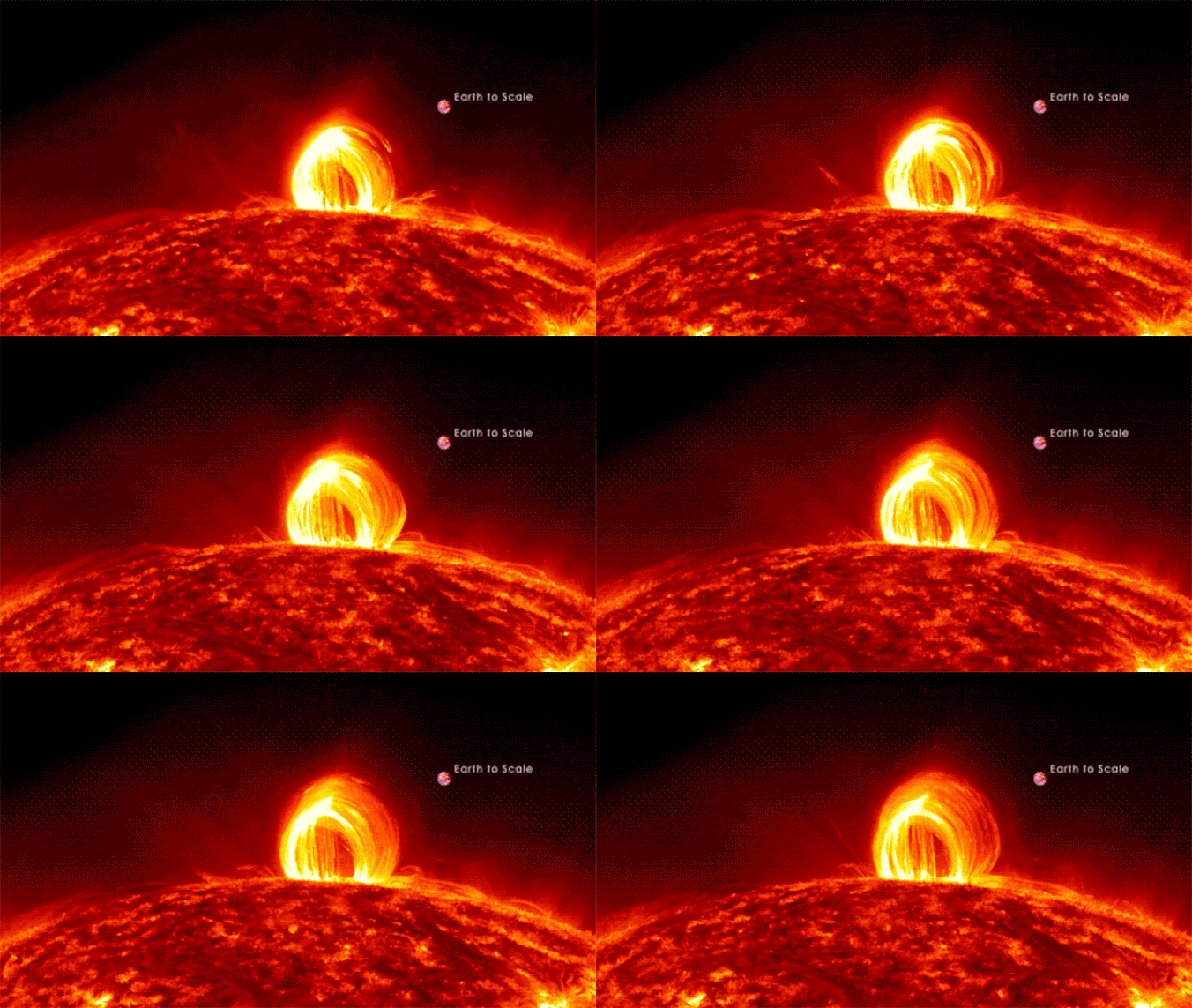

A coronal loop and resultant coronal rain on the sun with Earth shown to scale.
(Image credit: NASA’s Solar Dynamics Observatory/Emily Mason)
Scientists may have solved the physics behind massive and violent “superflares” that rip free from stars thousands of times as bright as the sun.
Our host star regularly erupts with solar flares that can impact Earth and, if strong enough, disrupt communications and power infrastructure on a global scale. But these solar flares are mere child’s tantrums compared to the thousands of “superflares” that NASA’s Transiting Exoplanet Survey Satellite (TESS) and now defunct Kepler space telescopes have seen blasting from stars between 100 and 10,000 times brighter than the sun.
Superflaring stars have stronger magnetic fields than the sun, leading to brighter flares, and these stars also seem to display an initial, short-lived boost in brightness enhancement, followed by a secondary, longer-lasting (but less intense) flare.
Yet despite this disparity in scale and power, the superflares of bright, distant stars and the solar flares of the sun are believed to share the same underlying physical mechanisms, emerging from the sudden release of magnetic energy. Thus, a team of scientists led by University of Hawaii Institute for Astronomy Postdoctoral Researcher Kai Yang and Associate Professor Xudong Sun used solar flares as a proxy for superflares to model these massive eruptions of plasma.
Related: Gigantic ‘hole’ in the sun wider than 60 Earths is spewing superfast solar wind right at us
“By applying what we’ve learned about the sun to other, cooler stars, we were able to identify the physics driving these flares, even though we could never see them directly,” team co-leader and University of Hawaii Institute for Astronomy Postdoctoral Researcher Kai Yang said in a statement. “The changing brightness of these stars over time actually helped us ‘see’ these flares that are really far too small to observe directly.”
Keeping scientists in the loop
Scientists have theorized that coronal loops, which are massive hoops of plasma that follow the trajectory of magnetic field lines seen on the sun, may be present in superflares as well. If they exist, however, these loops would need to be incredibly dense on the superflaring stars; as of yet, astrophysicists have been unable to test this idea. From our vantage point on Earth, we can only witness coronal loops on the sun.
But another feature could hint at the presence of these distant stars’ coronal loops, the team says.
In particular, Kepler and TESS have spotted some stars with a peculiar “bump” in associated light curves. This “peak bump,” as it’s called, seems to represent a jump in brightness and result in a light curve that resembles a phenomenon seen on the sun when an initial burst of light is followed by a second, more gradual peaking of the light — a phenomenon called “solar late-phase flares.”
Sun, Yang and fellow colleagues wanted to know if these presumed late-phase brightness enhancements in visible light on distant stars could be caused by massive stellar loops like the sun’s coronal loops cause our star to vary in brightness.