


Countries pledged just a 10 percent emissions cut; breaching 1.5°C warming is now “inevitable,” said António Guterres.
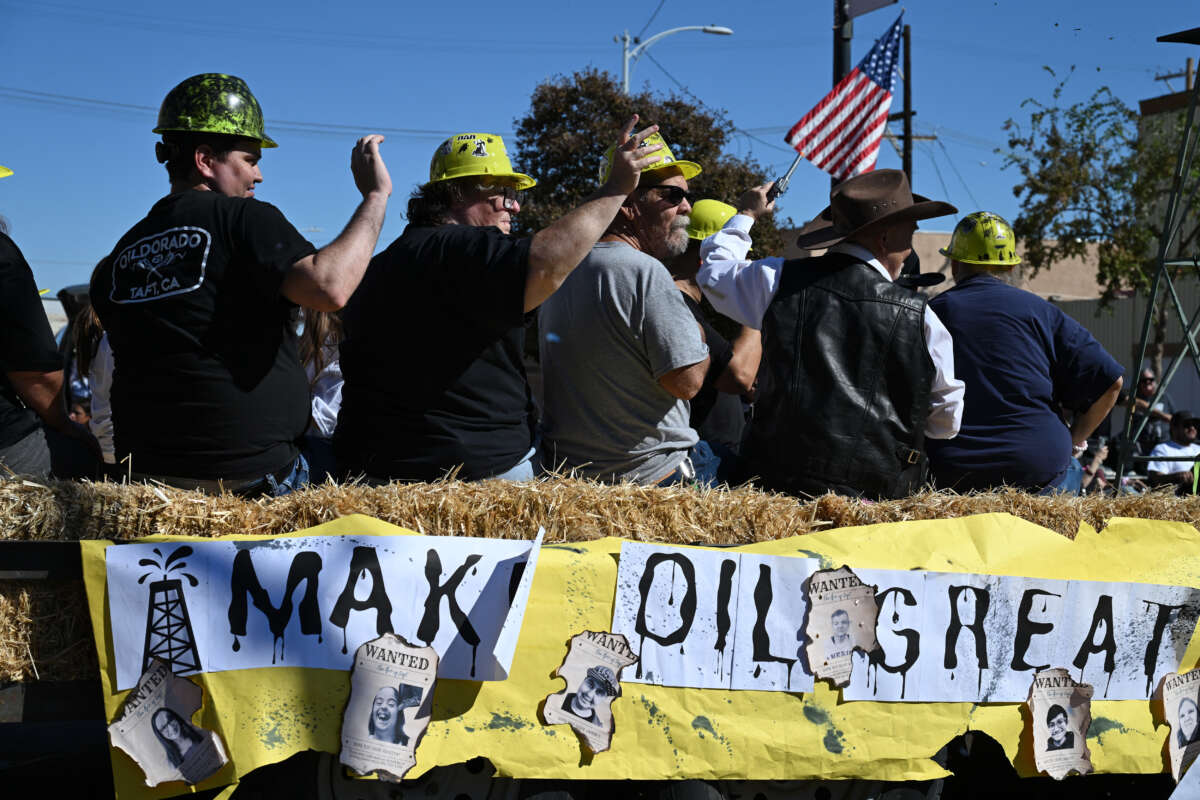 People ride a float during the Oildorado Grand Parade, themed “Make Oil Great Again,” on October 18, 2025, in Taft, California, a town of about 7,000 residents built atop the Midway-Sunset Oil Field. ROBYN BECK / AFP via Getty Images
Did you know that Truthout is a nonprofit and independently funded by readers like you? If you value what we do, please support our work with a donation.
Ahead of the United Nations’ global summit on the climate emergency in Belém, Brazil, a report on countries’ climate plans released Tuesday served as both “a progress update and a warning siren,” one campaigner said.
According to the Nationally Determined Contribution (NDC) Synthesis Report, governments have submitted plans to the UN that would reduce fossil fuel emissions by just 10% by 2035 compared to 2019 levels, a fraction of what is needed to keep the planet from warming more than 1.5°C above preindustrial temperatures.
The report includes climate action plans from fewer than a third of the nations that signed the Paris Agreement, the legally binding treaty demanding countries take action to limit planetary heating to 1.5°C, a decade ago.
Get our free emails
China and the European Union have not yet submitted their NDCs ahead of the UN Climate Change Conference (COP30), and in the United States, President Donald Trump ordered the country’s withdrawal from the Paris Agreement for a second time earlier this year and has been pushing for more fossil fuel extraction while dismantling renewable energy projects.
The report’s projection includes a plan that was submitted by the US in the last weeks of the Biden administration, which Trump has said he has no plans to fulfill.
Without officially submitting an NDC, China has pledged to cut its carbon emissions by 7-10% of their peak by 2035, and the EU has been debating a reduction of 62-72.5%.
Judging from the commitments that have been made so far, UN Secretary-General António Guterres told The Guardian and Amazon-based news outlet Sumaúma that the 1.5°C goal will be breached, at least temporarily.
“Overshooting is now inevitable,” he said, noting that an international goal should now be to reverse course on emissions in time to return to the 1.5°C mark by the end of the century.
“Let’s recognize our failure,” he told the outlets. “The truth is that we have failed to avoid an overshooting above 1.5°C in the next few years. And that going above 1.5°C has devastating consequences. Some of these devastating consequences are tipping points, be it in the Amazon, be it in Greenland, or western Antarctica or the coral reefs.”
Guterres said it is “absolutely indispensable to change course in order to make sure that the overshoot is as short as possible and as low in intensity as possible to avoid tipping points like the Amazon.