


This is a rush transcript. Copy may not be in its final form.
AMY GOODMAN: This is Democracy Now!, democracynow.org. I’m Amy Goodman, with Nermeen Shaikh.
NERMEEN SHAIKH: Sudan’s government says the Rapid Support Forces paramilitary group has killed at least 2,000 people in the three days since it seized control of the city of El Fasher in the Darfur region. The World Health Organization has condemned the reported killing of 460 patients and their companions at the Saudi Maternity Hospital in El Fasher.
The fall of El Fasher is seen as a major blow to the Sudanese military. The city has been besieged by the RSF for 18 months, leading to widespread famine.
The civil war in Sudan erupted in 2023. Since then, more than 150,000 people have died across the country, and about 12 million have fled their homes.
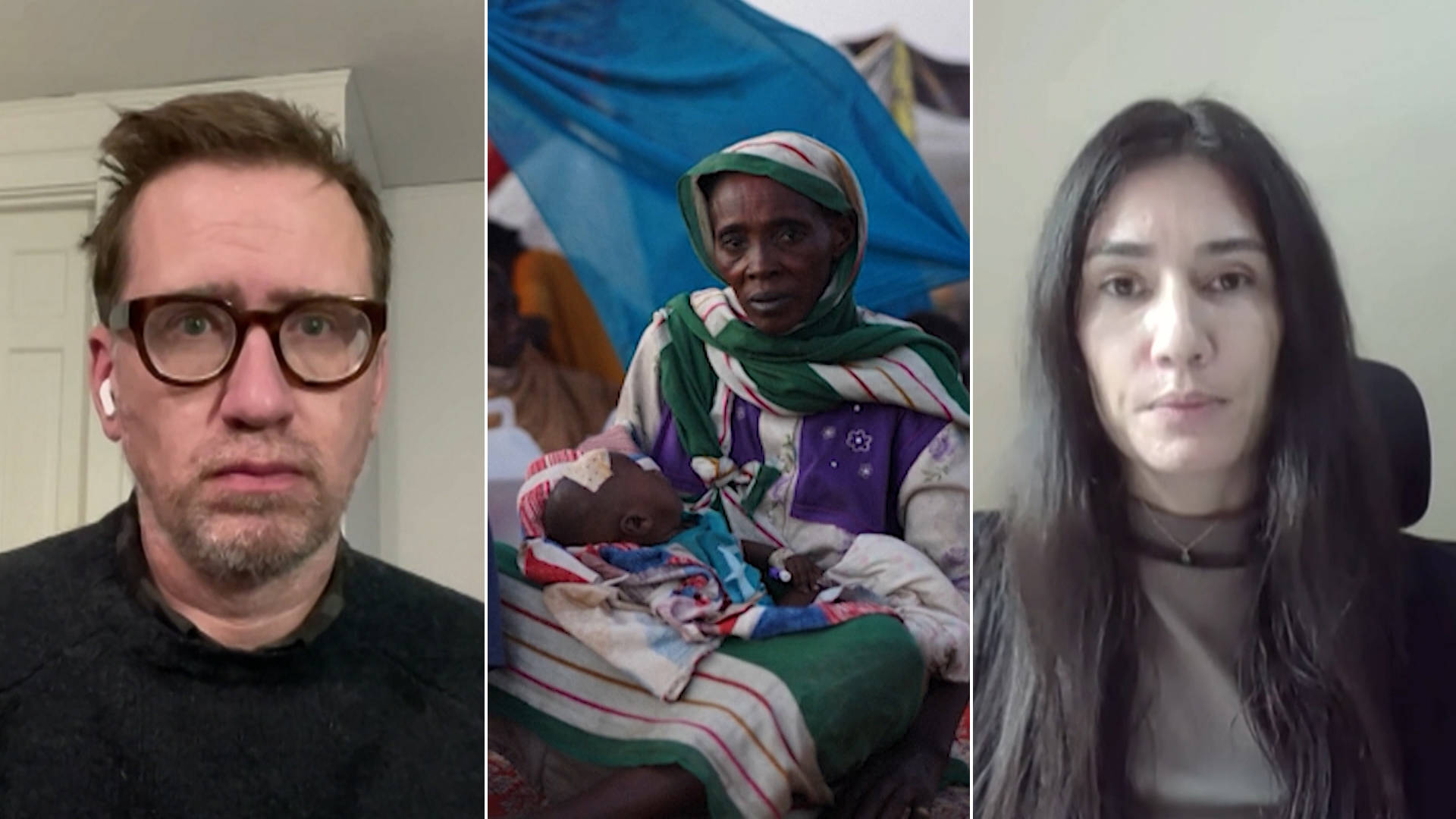
AMY GOODMAN: For more, we’re joined by Mathilde Vu, Sudan advocacy manager at the Norwegian Refugee Council. She’s joining us from Nairobi, Kenya. And we’re joined by Nathaniel Raymond, executive director of the Humanitarian Research Lab at the Yale School of Public Health. The lab has been monitoring El Fasher for the duration of the siege.
We welcome you both to Democracy Now! Mathilde, I want to go to you first. Have you reached Norwegian Refugee Council workers on the ground in El Fasher? What do you understand has taken place? Can you talk about what you know of the Saudi Hospital and the hundreds killed there?
MATHILDE VU: What’s happening is no less than a mass, calculated, long-planned campaign of destruction and annihilation, a mass slaughter of civilians, deliberate attack on civilian infrastructure, like the hospital that you just mentioned. It just became a killing ground as hundreds of people were sheltering in it. And it’s not only in El Fasher. Anyone who is trying to flee El Fasher right now is subjected to horrifying violence.
My teams are not in El Fasher. No one is. There hasn’t been any organization allowed to deliver assistance into El Fasher for the past 500 days. But we’re receiving people who have managed to flee, who have survived it, 60 kilometers of horror, of looting, of attack, of rape, mass detention. And it’s just overwhelming to see this mass atrocity unfolding as we speak.
NERMEEN SHAIKH: And, Mathilde, could you talk about the fact that so many people, as they’re fleeing, are also being killed, raped, assaulted, detained?
MATHILDE VU: Yeah, what really strikes us is that we are in this town called Tawila, where we’re receiving the people who are fleeing, and there’s only a few thousand people, actually a little bit more than 5,000 people, who have managed to reach Tawila. But we know that ten thousands of people are trying to flee El Fasher. So, where are all those ten thousands of families,