

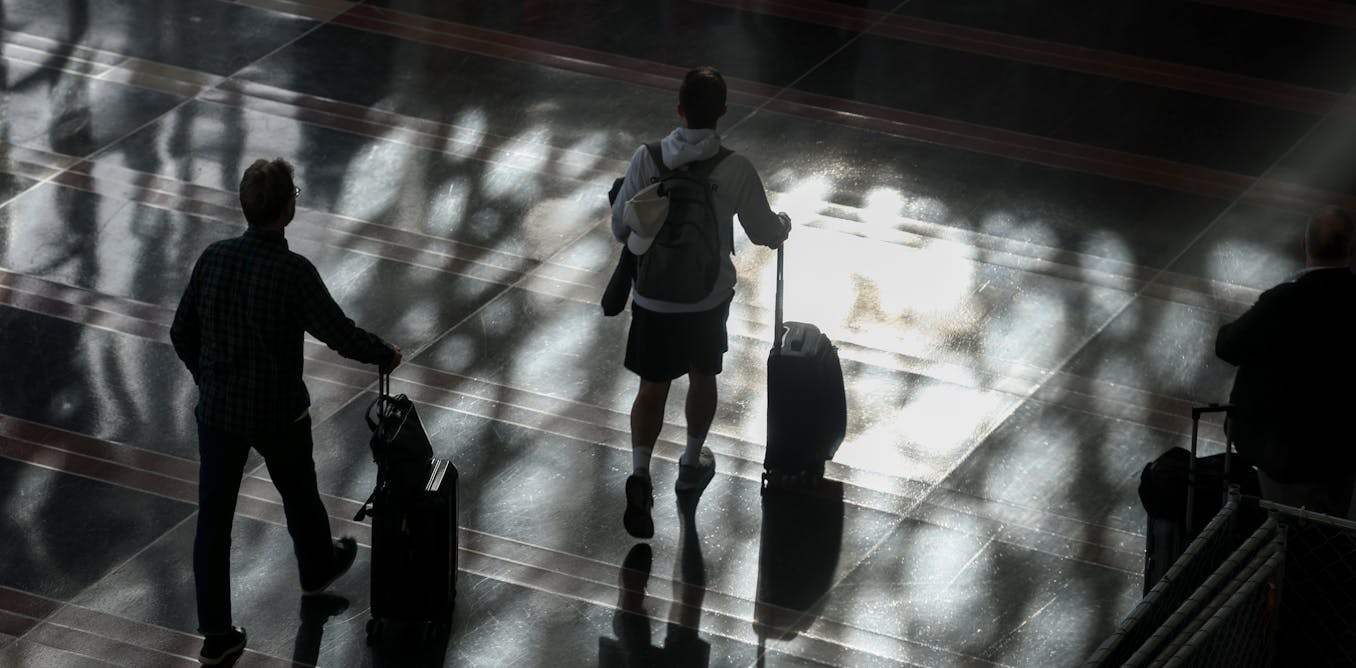

Major airports across the United States were subject to a 4% reduction in flights on Nov. 7, 2025, as the government shutdown began to affect travelers.
The move by the Federal Aviation Administration is intended to ease pressure on air traffic controllers, many of whom have been working for weeks without pay after the government shut down on Oct. 1. While nonessential employees were furloughed, workers deemed essential, such as air traffic controllers, have continued to do their jobs.
But what does that mean for the many Americans who take to the skies every day? To find out, The Conversation U.S. spoke with Laurie A. Garrow, a civil aviation expert at Georgia Tech.
What do we know about the FAA’s plans so far?
The first thing to note is that things can change fast. But as of this morning, 4% of flights are being canceled across 40 “high-volume” airports. The list is publicly available, but it includes most of the big hubs across the United States, such as Atlanta, New York’s airports, Chicago O’Hare, Los Angeles International and Dallas/Fort Worth.
The plan is to ramp this up to 10% by Nov. 14 should the shutdown extend that long.
The FAA, the U.S. Department of Transportation and the airlines are working together on the details of which flights and routes are affected – and this will no doubt be monitored as the days go on.
But they are trying to make the cancellations in a way that cause the least disruption to customers.
So we are looking at cuts to domestic, not international, flights – flights across the Atlantic, Pacific and to Latin America are not, for now at least, subject to cuts.
The 4% of cancellations we are seeing are really targeting the high-frequency routes. This should help mitigate the impact. For example, typically American Airlines flies nine flights a day from Miami to Orlando, but they are planning to fly eight this weekend.
And carriers are looking at reducing regional flights. For example, my mom lives near Erie, Pennsylvania, where American Airlines flies three daily flights to their hub in Charlotte – I would expect that to go down to two, or one.
But the FAA was clear that it wasn’t going to cut flights to markets entirely, just reduce them.
What will this mean for existing flights?
For starters, you are going to see more passengers on them. It is fortunate that we are in the lull before Thanksgiving. This isn’t like the summer. There is more slack in the system – so there are extra seats available. If one flight gets canceled on a busy route, it will at this stage be fairly easy to accommodate on another flight.
And I expect customers will be asked to get to airports a little earlier than they would normally.