

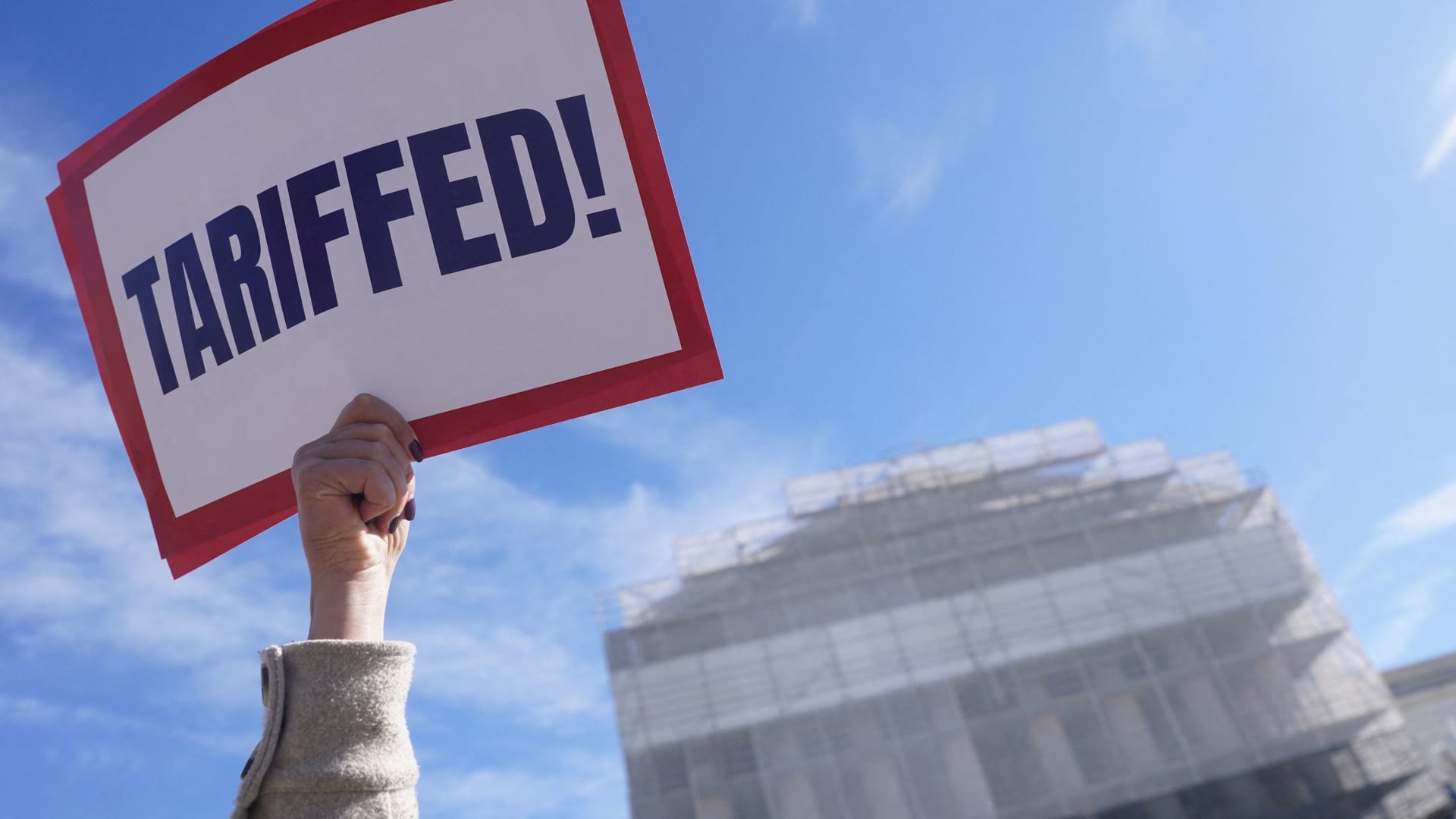

A protester with the Main Street Alliance holds a sign outside the U.S. Supreme Court, as its justices are set to hear oral arguments on U.S. President Donald Trump’s bid to preserve sweeping tariffs after lower courts ruled that Trump overstepped his authority, in Washington, D.C., U.S., November 5, 2025.
Nathan Howard | Reuters
American importers say that if the Supreme Court rules that the money they paid for President Donald Trump’s tariffs must be refunded to them, it would be relatively simple to do and not the “mess” that some have claimed it would be.
Importers pointed to U.S. Customs paperwork that clearly details the tariffs they pay on goods brought into the United States.
During oral arguments last Wednesday for a case that will decide the fate of Trump’s tariffs, most Supreme Court justices expressed skepticism that the duties were legal.
But some justices raised questions about what would happen if they ruled Trump did not have the power to impose those tariffs unilaterally.
Justice Amy Coney Barrett said repaying the billions of dollars in tariffs the U.S. has collected since they took effect earlier this year would be “messy.”
Neal Katyal, the lawyer representing a group of small businesses challenging the tariffs, conceded that repaying the duties would be “a very complicated thing.”
But Rick Muskat, CEO of DeerStags, a third-generation, family-run shoe company, told CNBC, “I beg to differ with the concern over the repaying of tariffs as being a mess.”
“On every customs entry, we detail specific line items that indicate the duty/tariff rates we are paying,” Muskat.
On Customs Entry Summaries, importers identify the specific product code, country of origin, and type of tariffs being paid.
Muskat provided to CNBC a Customs Entry Summary for a recent shipment that DeerStags received from China.
One code on that document classified a 6% tariff for an item based on the name, use, and material. This duty has been in place for years, Muskat said.
The second line charge was 20% for a “fentanyl tariff,” which Trump imposed on Canada, China and Mexico for failing to stem the flow of opioids into the U.S.
The third line showed a 10% “reciprocal” tariff that Trump imposed by invoking the International Emergency Economic Powers Act. Trump is the first president to use IEEPA to unilaterally impose tariffs.
Since Trump announced many of his tariffs in early April, on what he called “liberation day,” Muskat has paid more than $1 million in tariffs.
“U.S. Customs was able to add these additional line items to the entry summary each time the president changed the tariffs,” Muskat said.
“So it should be simple for importers to apply for refunds based on this tariff itemization,” he said.
He added: “The IRS has no problem issuing refunds for overpayment of taxes.