


Armed Conflicts, Featured, Global, Headlines, IPS UN: Inside the Glasshouse, Nuclear Disarmament, Nuclear Energy – Nuclear Weapons, TerraViva United Nations

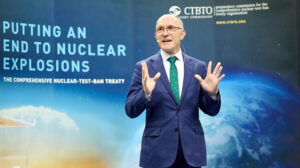
CTBTO Executive Secretary Robert Floyd addressing staff, Vienna International Centre, Vienna, Austria, 2023. Credit: CTBTO Preparatory Commission
UNITED NATIONS, Nov 12 2025 (IPS) – The US took another step backward –to break ranks with the United Nations– when it voted against a draft resolution calling for the entry into force of the Comprehensive Nuclear-Test-Ban Treaty (CTBT).
The negative vote followed an announcement by President Trump last month that the US plans to resume nuclear testing after a 33-year hiatus. The US stood alone on the UN vote, which was supported by almost all member States in the General Assembly’s First Committee.
The resolution was adopted by an overwhelming majority: with 168 votes in favor, with one against (United States) and 3 abstentions (India, Mauritius, Syria).
During Trump’s first term, the US abstained on the vote. And in other years they had been voting in favour.
Jackie Cabasso, Executive Director, Western States Legal Foundation, which monitors and analyzes U.S. nuclear weapons programs and policies, told IPS the chaos and uncertainty arose from Trump’s factually-challenged social media post that “because of other countries testing programs, I have instructed the Department of War to start testing our Nuclear Weapons on an equal basis.”
The U.S. government’s first ever “No” vote, on the annual UN resolution in support of the Comprehensive Test Ban Treaty (CTBT), raises further troubling questions about U.S. intentions.
Trump did not specify whether he meant explosive nuclear testing, missile tests, or something else. Russia and China are not conducting explosive nuclear tests, so the U.S. has no basis to respond in kind. They are conducting missile tests, but so is the United States, Cabasso pointed out.
In fact, she said, the U.S. conducted a “routine” test of an unarmed Intercontinental Ballistic Missile on November 5. The Department of Defense (now, Department of War) is responsible for missile tests, but it is the Department of Energy that is responsible for preparation for explosive nuclear testing.
Trump’s announcement was followed by mixed signals.
On November 2, Energy Secretary Chris Wright sought to explain Trump’s post when he told Fox News “I think the tests we’re talking about right now are system tests. These are not nuclear explosions. These are what we call non-critical explosions.”
The headline in a New York Times article was dead on target: Trump pushes Tests with a Nuclear Bang: A Top Aide Says Non-nuclear”.
The waters were further muddied, said Cabasso, by Trump’s unsubstantiated allegations in an interview with 60 Minutes (recorded October 31 but aired November 2) that Russia and China have been secretly conducting explosive nuclear tests deep underground.
In a written statement explaining its General Assembly vote, the U.S. – the only country to cast a No vote – stated,