

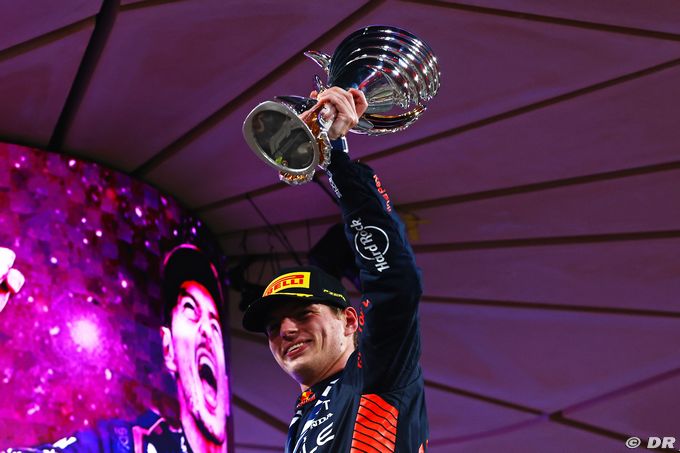

Gerhard Berger is increasingly convinced that Max Verstappen is the “greatest racing driver of all time.”
This is a bold claim coming from the former F1 driver, especially considering he was once teammates with the great Ayrton Senna at McLaren, and has also raced against Alain Prost, Niki Lauda, and even Michael Schumacher (early in his career).
But he declared that “never in my life have I seen a driver dominate like Verstappen did in 2023 – with 19 wins out of 22 Grands Prix.”
“Max is a racing driver who always gives 120%. Just like Senna or Schumacher did, or Hamilton does now.”
“But I’m sure Max is already back in his simulator and playing with all his virtual race cars again.”
But is Verstappen the most dedicated driver the sport has ever seen?
“Definitely,” replied Berger. “He lives and breathes for his sport – for Formula 1. It’s his passion. To me, he’s the greatest racing driver of all time.”
For Berger, the most impressive part of Verstappen’s third consecutive title this year wasn’t his 21 podiums out of 22 possible – but his record of having completed 100% of the laps in the season.
“That has become the biggest challenge for Helmut Marko. Because Max no longer needs him, to be told off from time to time. With zero mistakes, Helmut Marko simply has nothing to criticize anymore.”
So, Sergio Perez’s performances in the sister car stand in stark contrast.
“Yes,” Berger admitted. “When we look at Max and Perez together, Helmut Marko still has something to do.”
“Just look at Perez being overtaken by Leclerc on the last lap in Las Vegas, I have to say that even a beginner does not make such a mistake.”
Speaking of Marko, Red Bull’s consultant had said a few days ago that he expects Red Bull to face a much tougher challenge to stay ahead in 2024.
“Such statements are typical,” replied Berger. “Helmut Marko is just trying to ease the pressure a bit. Personally, I see another tough year for all of Red Bull’s rivals next year.”
At Mercedes F1, Lewis Hamilton seems to agree with that, as he recently questioned the ability of a team to bridge such a huge performance gap in just one winter.
“That’s exactly the language of Formula 1,