

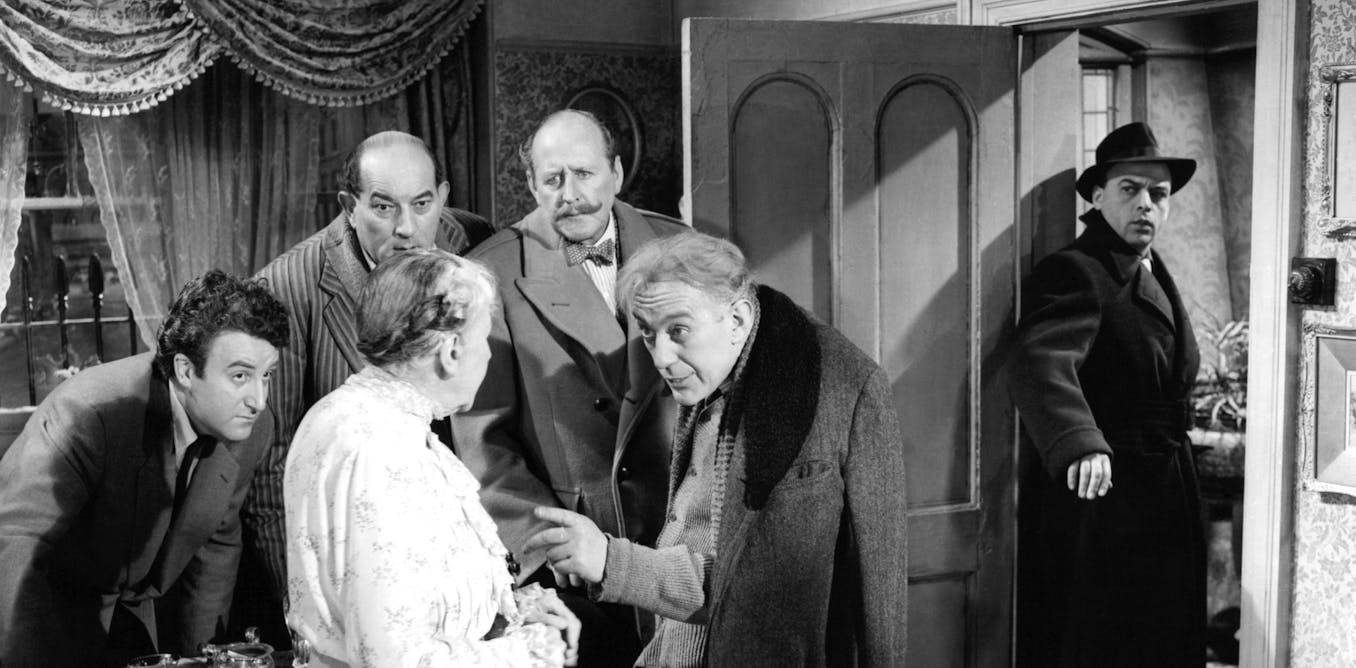

Mrs. Wilberforce (Katie Johnson) lives alone in a rickety Victorian house near London’s King’s Cross railway station. She rents a room to Professor Marcus (Alec Guinness), who claims to be a musician, and asks to use the room for practice sessions with his string quintet.
But wait. Professor Marcus and his four associates are in fact plotting an armed robbery and plan to use Mrs. Wilberforce in their dastardly scheme.
What a pleasure it is to revisit The Ladykillers (1955) – a jet-black, peculiarly subversive marriage of genteel English manners and anarchic criminality.
With its cast of eccentrics, dry wit and distinctively British whimsy, this film from London-based Ealing Studios perfectly zig-zags between kind-hearted and creepy. And 70 years on, it is fondly remembered as the closing flourish of the golden age of Ealing comedies.
A comic institution
Ealing Studios, based in the west London suburb of the same name, was founded in 1902, making it the world’s oldest continuously running film studio.
In the late 1940s and early 1950s, under the leadership of Michael Balcon, the studio became known for producing a series of comedies that reflected British values, class tensions and post-war anxieties, often in a light-hearted or ironic way.
Films such as Kind Hearts and Coronets (1949), Passport to Pimlico (1949) and The Lavender Hill Mob (1951) portrayed a particular brand of British humour: ironic, restrained and, above all, socially observant.
These films gently poked fun at the British class system while celebrating quirky individuals and tight-knit neighbourhoods. As Balcon himself later said:
We made films at Ealing that were good, bad and indifferent, but that were indisputably British. They were rooted in the soil of the country.
Earlier successes depicted criminal protagonists whose schemes were both ingenious and only slightly morally dubious. The Ladykillers took this tradition to its logical extreme: the criminals were no longer charming anti-heroes, but grotesque figures, hapless in their execution of the robbery.
The film’s delicious central irony, in keeping with the Ealing ethos, is that the one person capable of undoing the criminal plot is the least likely: a frail old woman with a kettle and a parrot.
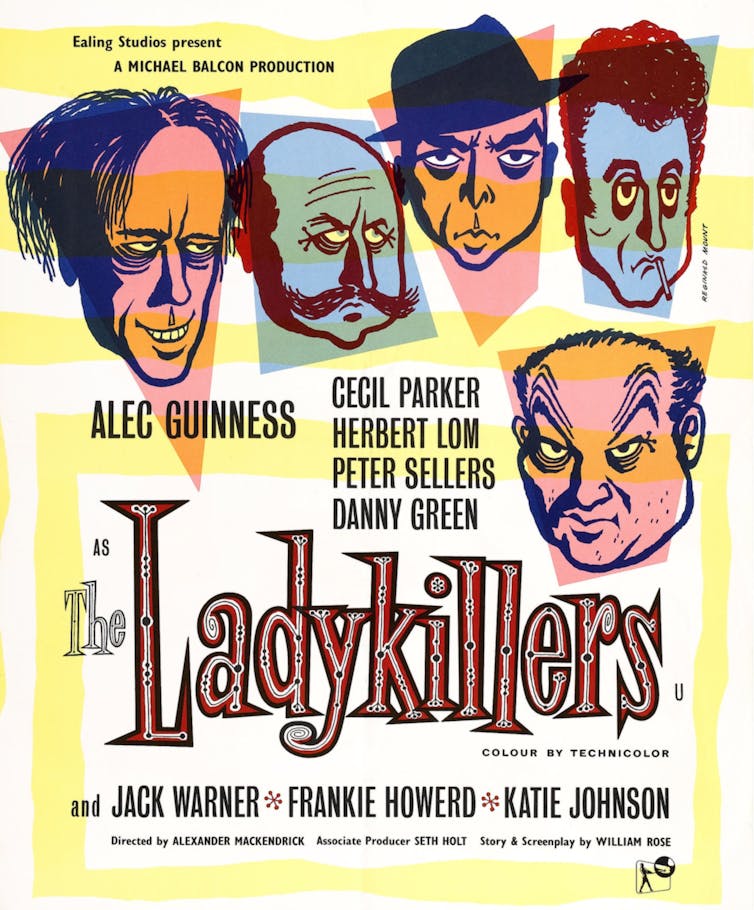
The Ladykillers poster art from 1955.
LMPC via Getty Images
Making a masterpiece
The Ladykillers was written by William Rose, who allegedly dreamt the plot and awoke to write it down. This dream-like provenance makes its way into the film.
Scottish-American director Alexander Mackendrick, who had previously worked for Ealing on Whisky Galore! (1949) and The Man in the White Suit (1951), gave the film its distinctive atmosphere of part-grotesque fairy tale and part-suburban farce. As Mackendrick once remarked
the characters are all caricatures, fable figures; none of them is real for a moment.
Mrs. Wilberforce’s house, where most of the action is set, was constructed on an Ealing backlot – a convincing reminder of the sooty urban geography of post-war London.