

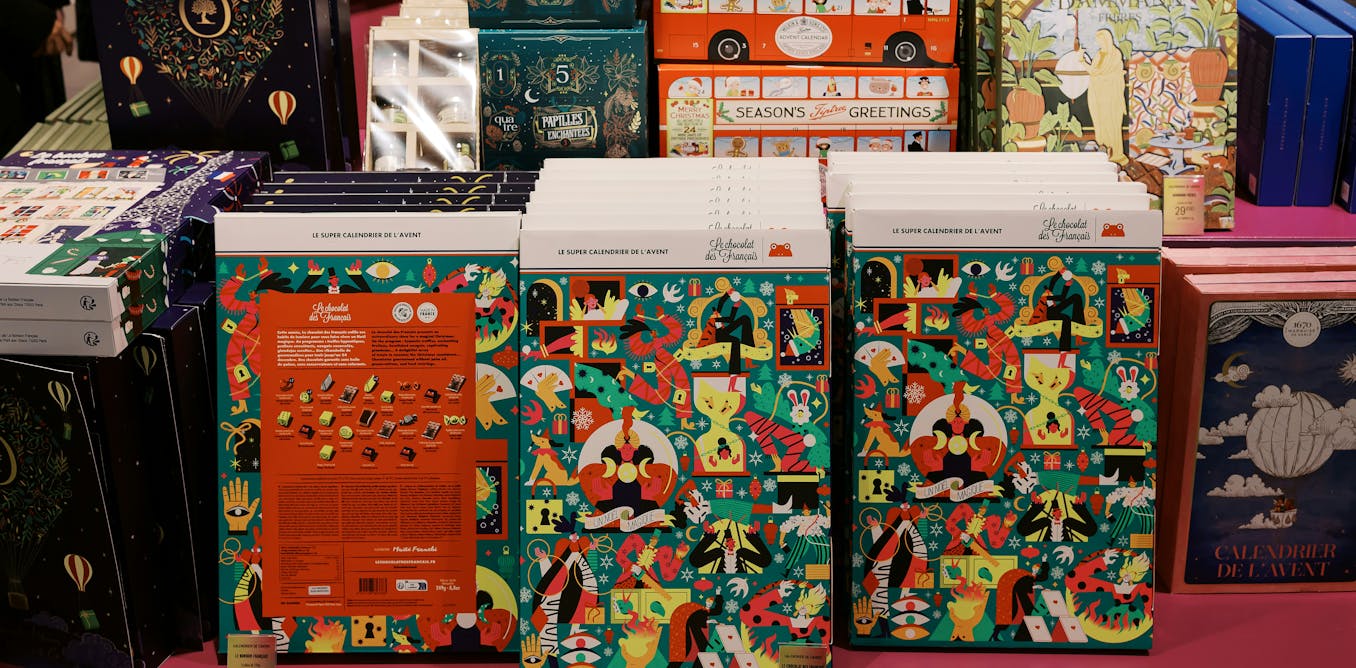

It would be easy to conclude that Advent calendars — usually with 25 compartments that reveal a treat, image or scripture, used to count down the days from Dec. 1 to Christmas Eve — represent just another way Christmas is ruined by commercialization. They’ve strayed far from their beginnings as devotional aids for 19th-century German Lutheran families.
Far from only featuring little numbered flaps to open on each December day, these calendars are now hot-ticket items. They highlight everything from beer to beard oil, and Lego to luxury silk. But have they completely lost their way?
As I pointed out recently on CBC’s The Cost of Living, I don’t believe so.
From devotional tool to consumerist gift
The first commercially printed Advent calendars, created by German publisher Gerhard Lang at the dawn of the 1900s, had paper windows that tore away to reveal Bible verses and art depicting the Nativity, the story of the birth of Jesus arising from the gospels of Luke (2:1-20) and Matthew (2:1-12).
By the mid-20th century, Advent calendars had spread to England and North America. Some versions began to include toys or chocolates and to downplay Christian themes.
Now, a full century after those first printed versions, Advent calendars have evolved into a dizzying array of “must-have” seasonal gifts that, at the top end, can include caviar, cocktails and even cut diamonds. In response, some emphasize homemade, reusable Advent calendars, while villages and neighbourhoods experiment with becoming “living” Advent calendars — local tourist draws — unveiling volunteer window displays each successive day of December.
Yet no matter how non-religious they may appear, as a scholar studying the origins of Christianity, I see ancient meanings of Advent still reflected in two characteristics of today’s calendars: a stoking of expectation and a purpose-filled sense of time.
The power of stoking expectations
Anticipation is what drives the appeal of every Advent calendar. The child’s or adult’s question — “What’s behind the next window?” — echoes the original Latin term adventus, meaning coming or arrival. To the query: “What is the world so eagerly awaiting in the season of Advent?” the church’s answer has historically been: the coming of Christ.
But it’s complicated. What even many Christians may not realize is that the coming of Christ — which the season of Advent was originally designed to mark — is the Second Coming, known as the “Parousia.”
Anticipation of this dates to the very beginning, with Paul and the first followers. The oldest complete Christian writing, 1 Thessalonians, buzzes with a kind of Advent expectation. It agonizes over Christ’s delayed return to end the march of time, abolish death and establish a new, justice-and-peace-filled reign of God over the Earth.
It’s not exactly children’s calendar material. For one thing, this Jesus was expected not as a meek and mild baby, but by at least some as a vengeful “end times” judge (2 Thessalonians 1:7-10).