

Did you know that your brain is pretty similar to a mouse’s brain? That’s right, although you can read this article and mice can’t, your brain neurons perform similarly to a rodent’s—making them perfect test subjects for scientific research into the way human minds’ work.
That’s why mice and rats are often used in neuroscientific research from the latest brain-computer interfaces (BCI) a la Neuralink, to drug research for mental health issues.
“The brain structures between human and mouse are basically the same structures,” Daniel Dombek, a neurobiologist at Northwestern University, told The Daily Beast. “We think they work in the same ways.”
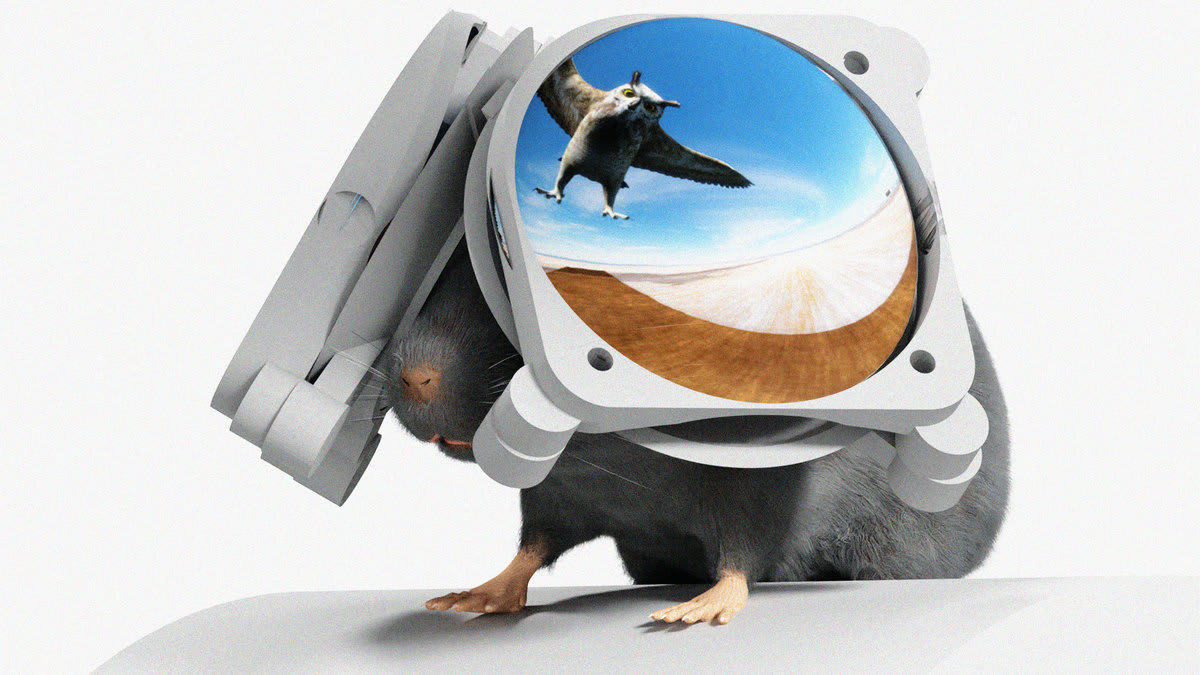
Technology has now enabled researchers to use virtual reality and mice to better study neuroscience and animal behavior. In a paper published Friday in the journal Neuron, Daniel Dombek and his team have developed a new set of VR goggles specifically designed for mice. The device is intended to immerse the mice in nearly any environment imaginable, helping to advance research in the field. It’s downright adorable.

Digital conceptual art of a mouse wearing the iMRSIV VR headset for mice.
Dom Pinke / Northwestern University
This new device allows researchers to immerse the mice in a virtual scenario, enabling them to uncover a wealth of insights about how the mice brains react to different environments. Unlike previous methods, it is fully immersive and provides a more effective way to study these reactions.
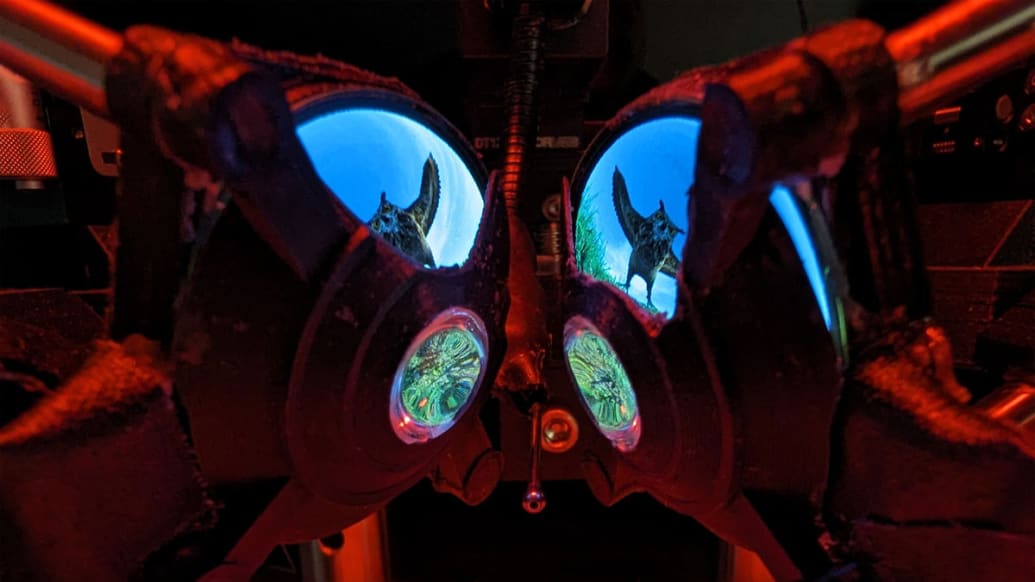

A look into the iMRSIV VR headset for mice. The headset is made of two lenses with screens in them that accommodate for a mouse’s 140 degree field of view.
The Miniature Rodent Stereo Illumination VR (iMRSIV) created by Dombeck’s lab is a clever solution to the limitations of previous methods. The headset is made of two lenses with screens in them that accommodate for a mouse’s 140 degree field of view, providing a more immersive environment.