


The Kimberley region in the north-west corner of Western Australia is full of rugged ranges and gorges, and long stretches of red soil and rocky ground. The dry seasons are long, and the wet seasons often flood the Martuwarra Fitzroy River – an artery to the Indian Ocean – in the region’s south.
But if you were to travel back to the Early Triassic period, 250 million years ago, you would see a very different landscape. Back then, the land was covered in brackish water and was more like a mudflat, on the shore of a shallow bay.
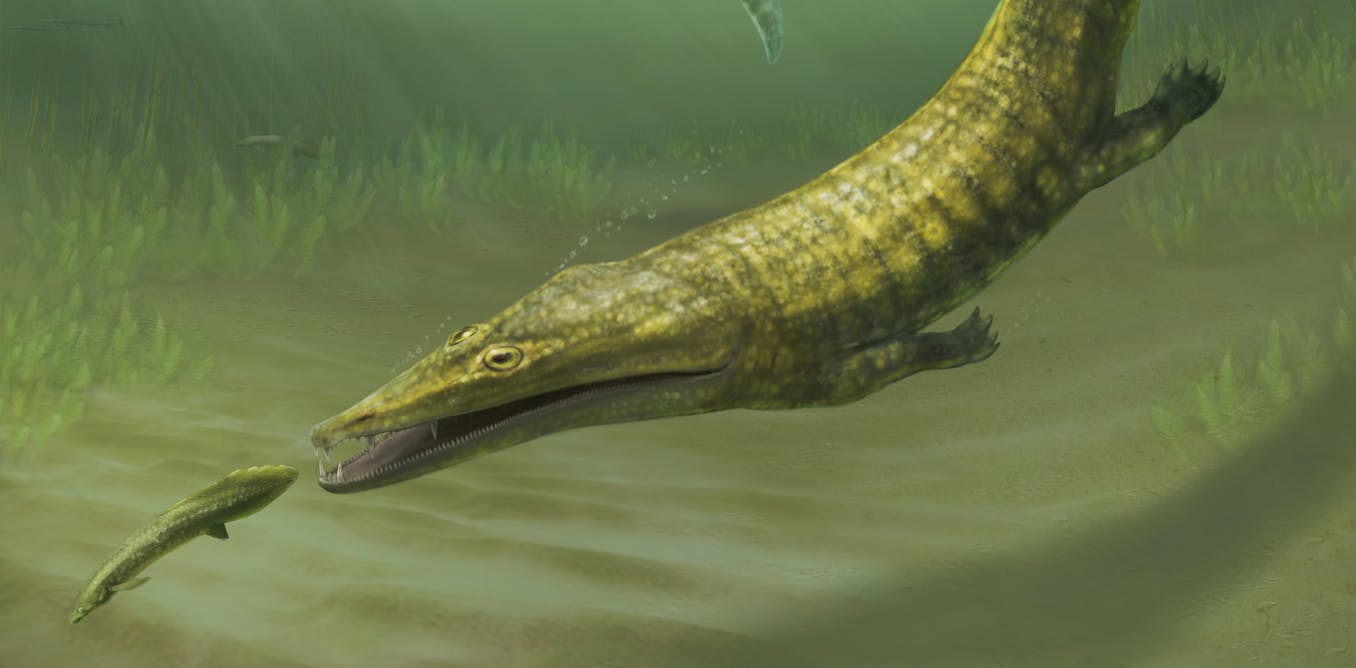
Inhabiting this area were creatures a far stretch from the dingoes, rock wallabies and livestock that populate the region today. Strange amphibians, called temnospondyls, which looked like a cross between a salamander and a crocodile, dominated this era, feeding on fish and other small animals.
A new study colleagues and I have just published in the Journal of Vertebrate Paleontology sheds new light on these animals. It shows for the first time how they were able to become an evolutionary success story.
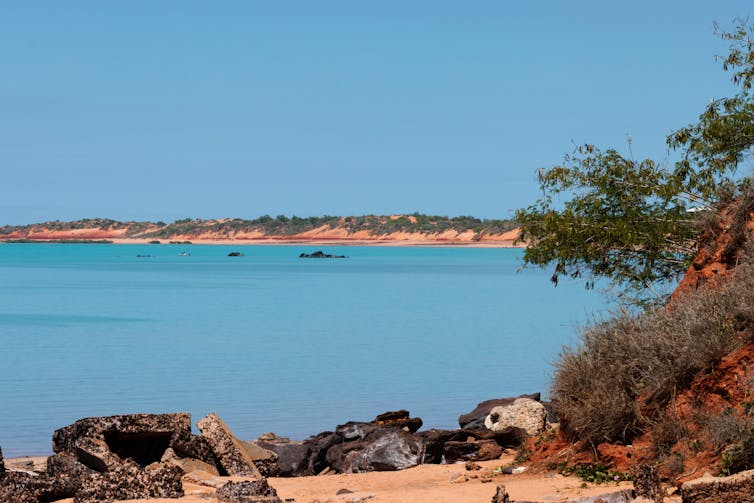
Some 250 million years ago, the Kimberly region was covered in brackish water, similar to Roebuck Bay bay near present-day Broome.
Richard Wainwright/AAP
Lost – then found
Palaeontologists uncovered fossils of these weird animals in rocks (known as the Blina shale) on Noonkanbah station, roughly 250 kilometres inland of Broome, during field expeditions in the 1960s.
Temnospondyls are an incredibly long and diverse lineage of vertebrates. Their fossil record extends some 210 million years, from the Carboniferous period through to the Cretaceous. They include prehistoric animals such as Eryops and Koolasuchus. Their story is one of great survival – one of the few vertebrate groups that persisted through the two mass extinctions at the end of the Permian and Triassic periods.
The temnospondyl discovered on Noonkanbah station was called Erythrobatrachus noonkanbahensis. It was named in 1972 by Cosgriff and Garbutt based on three fossil skull pieces that were retrieved on those field expeditions in the 1960s.
The specimens were sent to several museum collections in Australia and the United States. And some time in the following 50 years or so, they were lost.
Luckily, the Western Australian Museum retained a high quality plaster cast of one of the pieces. But our team was determined to find out more about these enigmatic fossils. We were completely blown away when one of the lost pieces turned up in a museum collection at Berkeley, in the US.
One species becomes two
Once we could look at these two pieces of Erythrobatrachus, we could see that they actually belonged to two different species of temnospondyl.
One of the original fossils was definitely unique enough to maintain the Erythrobatrachus name. The other one was more like a previously described,