


We all know we live in three-dimensional space. But what does it mean when people talk about four dimensions?
Is it just a bigger kind of space? Is it “space-time”, the popular idea which emerged from Einstein’s theory of relativity?
If you have wondered what four dimensions really look like, you may have have come across drawings of a “four-dimensional cube”. But our brains are wired to interpret drawings on flat paper as two- or at most three-dimensional, not four-dimensional.
The almost insurmountable difficulty of visualising the fourth dimension has inspired mathematicians, physicists, writers and even some artists for centuries. But even if we can’t quite imagine it, we can understand it.
What is dimension?
The dimension of a space captures the number of independent directions in it.
A line is one-dimensional. We can move along it forwards and backwards, but these are opposite, not independent, directions. You can also think of a string or piece of rope as practically one-dimensional, as the thickness is negligible compared with the length.

You can move forwards along a rope, or backwards – but not side to side.
Zsuzsanna Dancso, CC BY
A surface, such as a soccer field or the skin of a balloon, is two-dimensional. There are independent directions forwards and sideways.
You can move diagonally on a surface, but this is not an independent direction because you can get to the same place by moving forwards, then sideways. The space we live in is three-dimensional: in addition to moving forwards and sideways, we can also jump up and down.
Four-dimensional space has yet another independent direction. This is why space-time is considered four-dimensional: you have the three dimensions of space, but moving forward or backward in time counts as a new direction.
One way to imagine four-dimensional space is as an immersive three-dimensional movie, where each “frame” is three-dimensional and you can also fast-forward and rewind in time.
Consider the cube
A powerful tool for understanding higher dimensions is through analogies in lower dimensions. An example of this technique is drawing cubes in more dimensions.
A “two-dimensional cube” is just a square. To draw a three-dimensional cube, we draw two squares, then connect them corner to corner to make a cube.
So, to draw a four-dimensional cube, start by drawing two three-dimensional cubes, then connect them corner to corner. You can even continue doing this to draw cubes in five or more dimensions. (You will need a large piece of paper and need to keep your lines neat!)
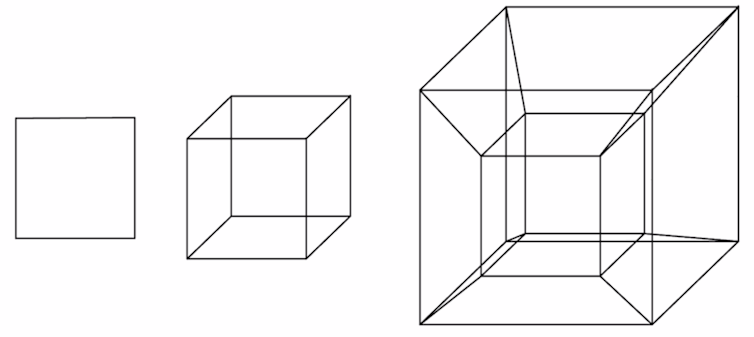
A two-dimensional, a three-dimensional and a four-dimensional cube.
Zsuzsanna Dancso, CC BY
This experiment can help accurately determine how many corners and edges a higher-dimensional cube has. But for most of us, it will not help us “see” one. Our brains will only interpret the images as complex webs of lines in two or at most three dimensions.