


A boat carrying 10 heavily armed men entered Cuban territorial waters on Feb. 25, 2026, intent, according to officials in Havana, on infiltrating the island nation and undermining the communist government through acts of sabotage and terrorism. When the men opened fire on an approaching Cuban Border Guard patrol boat, the border guards returned fire, killing four and wounding the other six. Another Cuban American who had allegedly flown to Cuba from the United States to meet the infiltration team on the beach was later arrested.
While details about the incident continue to come out, the gun battle comes at a time of heightened tensions between Cuba and the United States, which for weeks has been pursuing a de facto total oil blockade of the island. The latest episode is also reminiscent of the early 1960s, when Cuban exiles, trained and armed by the CIA, tried to infiltrate Cuba to conduct acts of sabotage and assassinate the leaders of the Cuban Revolution.
As a longtime expert on U.S. foreign policy toward Latin America and co-author of a history of the bilateral diplomacy between the United States and Cuba, I know that Cuba’s exile community has long contained paramilitary elements. Encouraged by Washington’s intensified sanctions and heated rhetoric, and a weakened government in Havana, these elements seem to sense an opportunity now.
Cuba’s exiled paramilitaries
Following the triumph of the Cuban Revolution and Fidel Castro’s rise to power in 1959, U.S. policy toward the new government was antagonistic almost from the start.
In 1961, the CIA under President John F. Kennedy organized the Bay of Pigs invasion – a military operation by exiled Cubans aimed at overthrowing the young Castro government.
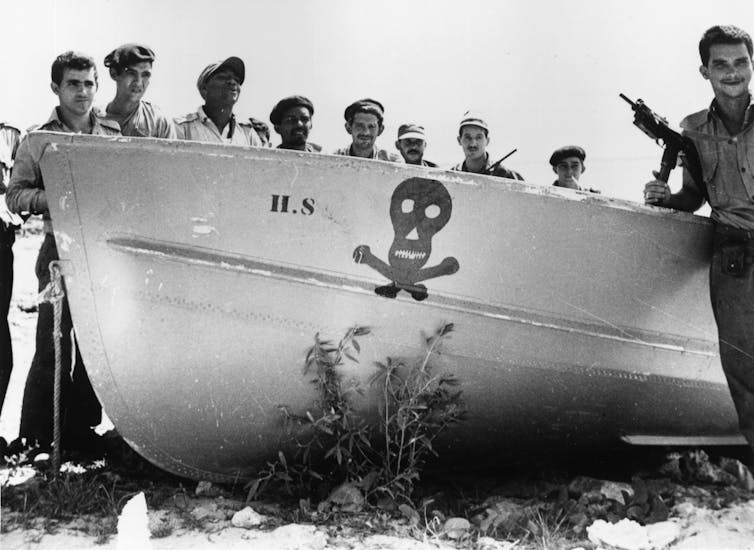
Pro-Castro soldiers pose at Playa de Giron, Cuba, after thwarting the ill-fated ‘Bay of Pigs’ invasion.
Graf/Getty Images
The attempted invasion was a “perfect failure,” in the words of author Theodore Draper, after which the agency recruited a number of the invaders to continue to wage irregular war against Cuba. They were part of Operation Mongoose, the Kennedy administration’s multifaceted program of diplomatic, economic, political and paramilitary pressure aimed at overthrowing the Cuban government.
The CIA’s financial support for exile paramilitary groups continued into the late 1960s, until it was phased out because of their ineffectiveness. Although the CIA gave up on overthrowing Castro by force of arms, the paramilitary exile groups did not.
Two of the most prominent groups – Alpha 66 and Omega 7 – continued their war against the Cuban government for years with tacit U.S. support. “We should not inhibit Cuban exile activity against their homeland,” President Richard Nixon wrote in 1971 in response to Coast Guard efforts to arrest members of Alpha 66. Five years later, two of the most prominent paramilitary leaders, Orlando Bosch and Luis Posada Carriles, orchestrated the bombing of a civilian airliner, Cubana Flight 455, killing all 73 people on board.
A change in attitudes
Frustrated by their inability to depose the Cuban government,