

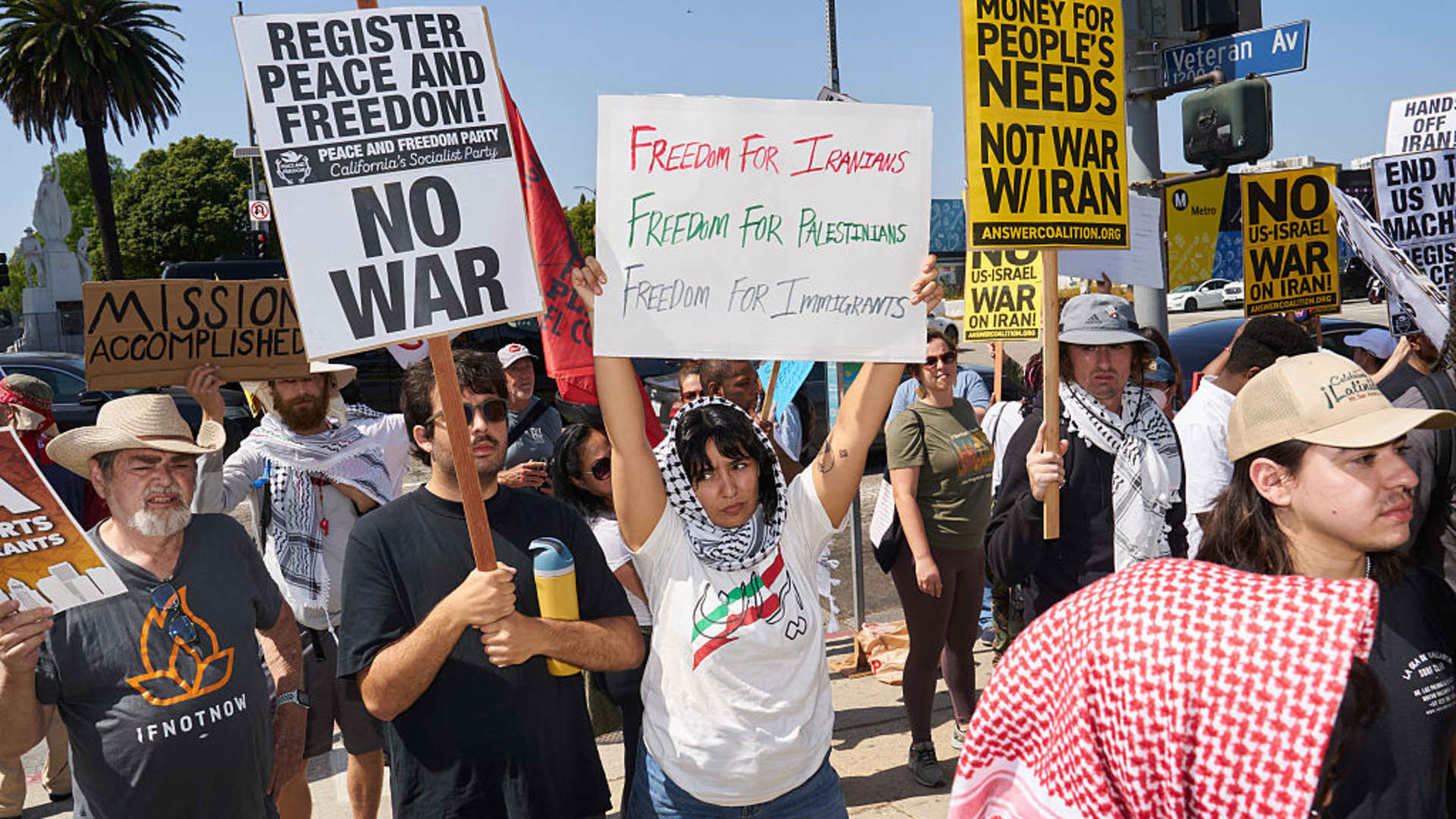

People protest against the US and Israeli strikes on Iran, ICE immigration raids, and in support of Palestinians during a demonstration outside the Westwood Federal Building in the Westwood neighborhood of Los Angeles on June 22, 2025.
Bing Guan | Afp | Getty Images
The U.S.-Israel conflict with Iran is extending into its third day with each side doubling down on sharper responses in the days ahead, deepening fears of a wider war that could rattle the global economy.
Where things stand
Washington and Israel launched massive attacks on Iran on Saturday, killing the Islamic state’s Supreme Leader Ayatollah Ali Khamenei, triggering retaliatory strikes from Tehran.
Tehran has struck back with missiles and drones against Israel and Gulf countries that host U.S. military bases, including the United Arab Emirates, Qatar, Kuwait and Saudi Arabia.
Civilian infrastructures were also hit by Iran’s retaliatory strikes, including Dubai’s luxury hotel Fairmont The Palm and the Dubai International Airport.
The death of Khamenei, who ruled Iran for over three decades and held ultimate power, has raised the question of who will run Iran next as he had not publicly designated a successor. A council comprising Iranian President Masoud Pezeshkian, the judiciary head and a member of the Guardians Council, has temporarily assumed leadership duties on Sunday.
More than 200 people in Iran have been killed during the strikes, according to Iranian state media.
Three American service members have been killed and another five were seriously wounded, the U.S. military said on Sunday.

Market reaction so far
Crude oil prices jumped Monday morning as traders parsed risks of a drawn-out conflict and a major oil supply disruption.
U.S. crude oil rose more than 8%, or $5.55, to $72.57 per barrel while the global benchmark Brent jumped about 9%, or $6.54, to $79.41, before pairing gains.
Stock Chart IconStock chart icon

WTI Crude (Apr’ 26)
Precious metals gold and silver climbed around 2% as investors flocked to the safe-haven assets amid global risk-off sentiment.
The U.S. dollar index was 0.26% higher at 97.863 as of 11:20 p.m. EST. The 10-year Treasury yield was little changed Monday at 3.97%, regaining some ground after falling to an 11-month low of 3.926% on Friday.
Risk assets are pulling back. Futures on the Dow Jones Industrial Average dropped 521 points, or 1%. S&P 500 futures lost 1% and Nasdaq 100 futures declined a little more than 1%.
Japan’s Nikkei 225 slipped 1.2%, while the Topix fell 1.34%. Hong Kong Hang Seng index opened 1.15% down, while mainland China’s CSI 300 was down 0.25%. Australia’s S&P/ASX 200 fell 0.48%.
De-escalation or spiraling tensions?
U.S. President Donald Trump has warned that there might be more American casualties as the operations unfold. Trump told the Daily Mail newspaper on Sunday that the conflict with Iran could go on for the next four weeks.
“It’s always been a four-week process.