

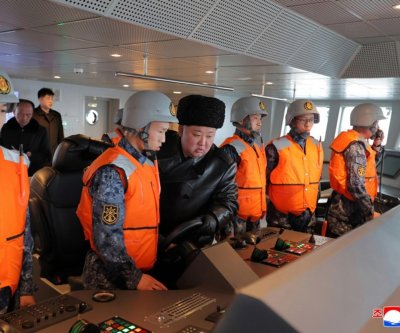

North Korean leader Kim Jong-un onboard the country’s first 5,000-ton multipurpose destroyer, the Choe Hyon, sailing in waters near the western coastal city of Nampho, North Korea. According to KCNA, Kim oversaw the launch of sea-to-surface strategic cruise missiles from the destroyer on 04 March to test the warship’s operational capabilities. Photo by KCNA / EPA
March 6 (Asia Today) — This commentary is the Asia Today Editor’s Op-Ed.
North Korea appears to be intensifying its pursuit of nuclear weapons and advanced military systems following U.S. and Israeli airstrikes on Iran, raising concerns about broader regional security implications.
North Korean leader Kim Jong Un inspected training exercises and observed test launches of ship-to-ground strategic cruise missiles aboard the newly built 5,000-ton destroyer Choe Hyon during visits on Monday and Tuesday, according to a report Wednesday by North Korean state television.
Images released by the North showed multiple cruise missiles launched from the destroyer, which analysts have described as a North Korean version of an Aegis-equipped warship. The missiles are believed to be part of the Hwasal series, which North Korea claims can carry tactical nuclear warheads.
Kim said the navy’s nuclear armament program was “being carried out satisfactorily,” signaling continued emphasis on integrating nuclear weapons into naval forces.
Developments in North Korea’s nuclear program have also been noted by the International Atomic Energy Agency, which said Tuesday that uranium enrichment facilities at Yongbyon and Kangson remain in operation. The agency also reported that construction of a new nuclear facility at Yongbyon appears to have been completed externally.
North Korea is believed to possess more than 100 nuclear warheads and has increasingly focused on improving delivery systems. Military analysts say submarine-launched ballistic missiles represent one of the most effective tools for ensuring a survivable nuclear deterrent because launches from submarines are more difficult to detect than those from land.
The U.S.-Israel strikes that reportedly killed senior Iranian leaders, including Supreme Leader Ali Khamenei, could further reinforce Pyongyang’s belief that nuclear weapons are essential for regime survival.
Such developments could make the long-standing goal of North Korean denuclearization even more difficult to achieve and place greater urgency on South Korea’s efforts to strengthen deterrence.
Some analysts have also raised concerns about renewed efforts within the South Korean government to restore parts of the 2018 inter-Korean military agreement, including restrictions on surveillance flights near the border.
Critics argue that such measures could limit South Korea’s intelligence, surveillance and reconnaissance capabilities at a time when North Korea is rapidly advancing its nuclear and missile programs.
Security experts say South Korea and its allies should draw lessons from recent conflicts where advanced intelligence gathering and artificial intelligence-based military technologies played key roles in targeting leadership structures and military infrastructure.
They argue that strengthening cyber capabilities, electronic warfare and other non-kinetic tools to disrupt missile systems before launch may be as important as traditional military deterrence.