

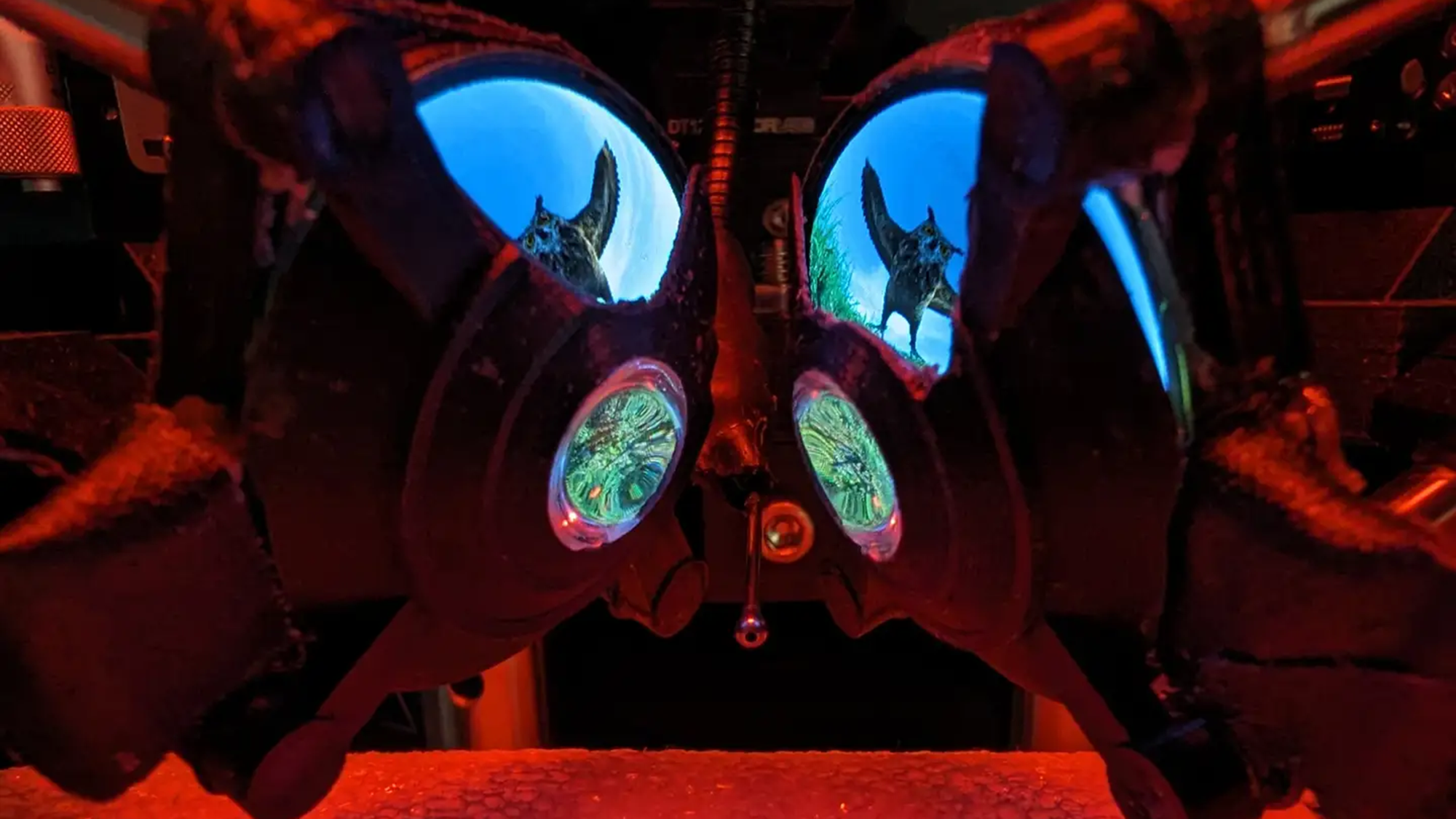

Getting mice to pay attention to two-dimensional screen projections of simulated surroundings can be tricky due to their tendency to notice the external lab settings around them. In a bid to get mice to focus on the experiment at hand, a team of researchers have built their own virtual reality headset sized for a mouse.
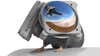 This illustration shows the VR setup, with an “overhead threat” projected into the top field of view. Credit: Dom Pinke/Northwestern University
Northwestern University researchers have taken a new approach to studying mice in a recent experiment. In a study just published in the journal Neuron, they’ve created their own VR headset for mouse test subjects. This VR device projects realistic, immersive, and natural surroundings to allow for more in-depth analysis and study of the rodents’ neural activity.
The team has been using “VR arrays” for over 15 years, but this new device is specially designed to combat the mice’s tendencies to notice the external lab settings and 2D imaging on computers and projection screens.
According to Daniel Domeck, the paper’s senior author, current lab simulation systems do not immerse the animals as much as in a real environment. The recent advances in hardware miniaturization have led to the Miniature Rodent Stereo Illumination VR, or iMRSIV. These bespoke lenses and tiny OLED displays shut out any real-world visual interferences by offering a 180-degree field-of-view for the mice.
Instead of goggles, the researchers designed a harness to suspend iMRSIV in front of a mouse’s face. The mouse runs on a treadmill to simulate movement within their VR surroundings, and initial results show promise for this new stimulation alternative.
Here’s a link to the full article.