


There’s a line in Cape Fever, the new book by award-winning South African novelist and playwright Nadia Davids, that doesn’t just establish the story, it also makes a haunting promise:
But small house, big house, smells or no smells, this is much the same: that in the city you will come to know a person by two things: what’s inside their house, and the house’s way with the wind.
The remark gestures towards the invisible forces moving through both houses and history. Just as a building’s “way with the wind” reveals how it stands in relation to its surroundings, Davids suggests that a household’s inner life exposes the moral currents shaping an entire society.
What lies inside Mrs Hattingh’s decaying colonial manor thus becomes a measure not only of its inhabitants’ inner lives, but also of an entire colonial society teetering on the brink of moral and historical reckoning.
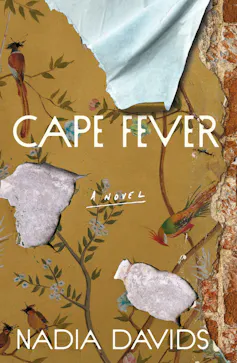
Simon & Schuster
Set in an unnamed harbour city in the early 1920s, clearly reminiscent of Cape Town, the novel follows Soraya Matas, a young Muslim woman who becomes a live-in maid for the financially struggling widow Mrs Hattingh. Mrs Hattingh’s household exists in a state of uneasy anticipation. Her son Timothy, a soldier who survived the first world war, is expected home from England, yet his return is repeatedly delayed.
Assumed to be uneducated, Soraya quietly conceals her literacy. When Mrs Hattingh offers to write weekly letters to Soraya’s absent fiancé, Nour, on her behalf, what begins as an act of benevolence unfolds into a strange ritual that binds the two women ever more tightly.
As a scholar of South African literature, I am interested in how fiction revisits the country’s layered pasts and the intimate spaces in which power unfolds. Davids’s work has occupied a distinctive place within this landscape, combining historical sensitivity with psychological insight. Cape Fever offers a tense and atmospheric story that gradually reveals itself as a probing meditation on voice, authority, and memory.
The power of the pen
Although Soraya dictates what she wants to say in the letters, Mrs Hattingh shapes the words on the page. She does not always record Soraya’s words faithfully. Sometimes she embellishes them, sometimes she alters their tone, and sometimes she quietly inserts her own interpretations. What appears to be an act of help becomes a quiet act of power.
As Mrs Hattingh’s words travel outward to Nour in the letters she writes for Soraya, the domestic space mirrors the wider colonial order, where white employers exercised intimate authority over the lives of the people who served them. Relationships were often framed as paternal kindness or protection, yet they were sustained by profound inequalities.
Davids captures this uneasy mixture of intimacy and hierarchy with striking precision. Assumed kindness masks control, hierarchy seeps into intimacy, and the power to tell a story becomes the power to define reality.
It is here that Davids’s portrayal of Mrs Hattingh reveals itself as one of the novel’s great strengths,