

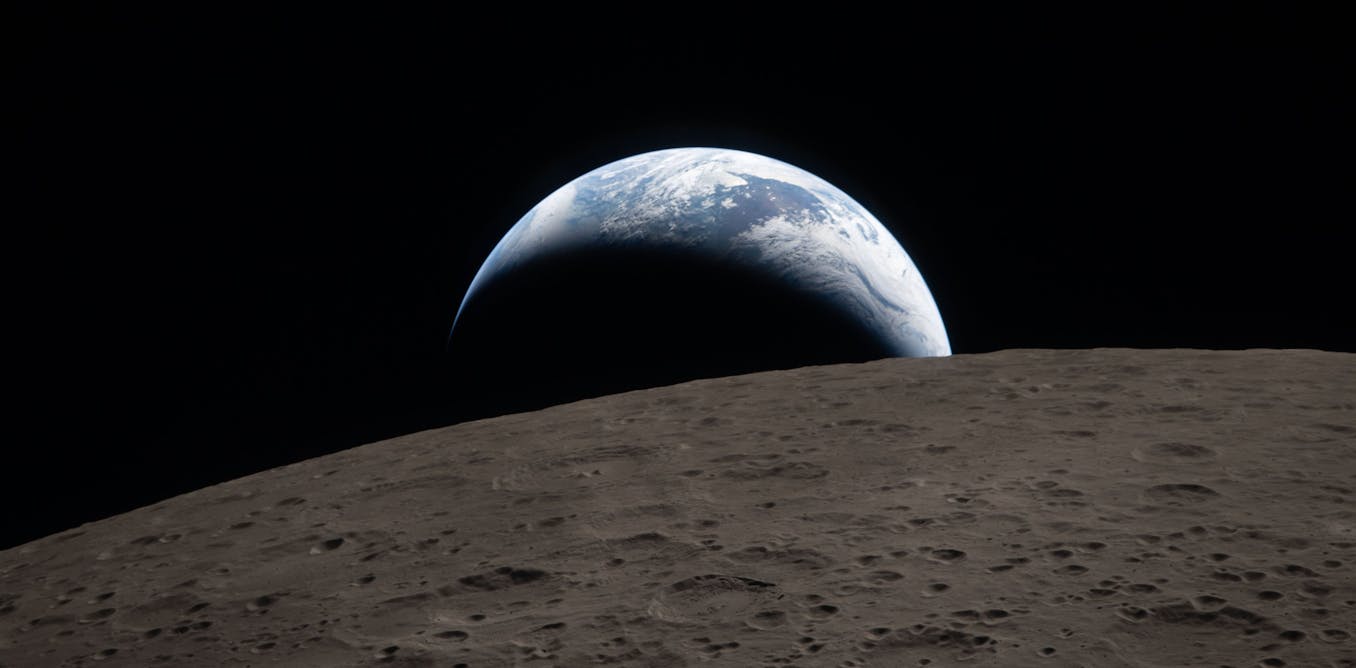

As Nasa’s Artemis II mission completed its lunar flyby, the astronauts sent back a stunning image of the colourful Earth setting behind the Moon. This breathtaking photo, called Earthset, draws inevitable comparisons with the original Earthrise photo from the Apollo 8 flight in 1968.
The Apollo-era photo showed our planet climbing above the lunar horizon. It revealed Earth as a bright blue oasis, standing out against the vast blackness of space and the barren Moon.
As I described in my book, Earthrise: a Short History of the Whole Earth, the effect of this image (actually part of a set) was profound. It caused a sensation on its release and helped inspire the burgeoning environmental movement.
Read more:
Earthrise to Earthset: how the planet’s climate has changed since the photo that inspired the environmental movement
The polished image from Artemis II and the slightly askew picture from Apollo 8 are, however, the product of entirely different approaches to photography from space.
“I don’t want to see you guys looking out the window,” Apollo 8 commander Frank Borman warned his colleagues Jim Lovell and Bill Anders during the 1968 mission to orbit the Moon.
Astronauts back then were discouraged from wasting film on touristy snapshots of the Earth. The Apollo 8 mission plan listed Earth images as mere “targets of opportunity”, the lowest priority of all.
The way the two missions kicked off underline the differences between 1968 and 2026. The crew of Apollo 8 took no still photos of Earth on the way out, but had reluctantly agreed to take a black-and-white TV camera for live transmissions.
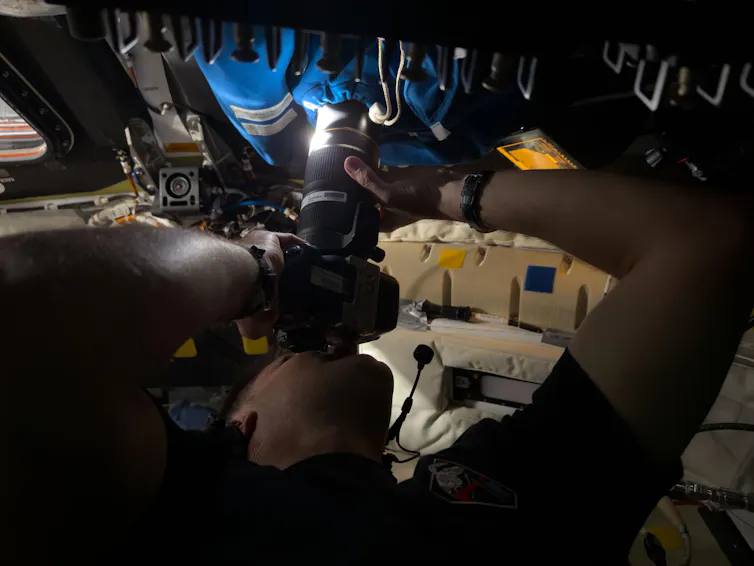
Photography is a high priority for the Artemis II crew, but things were different when the Earthrise image was taken in 1968.
Nasa
They were unable to fit the telephoto lens to the camera in time for the first transmission, so viewers saw only a fuzzy blob of light. Once the lens was fitted, the Moon bounced around the screen while mission control tried to issue “up a bit, down a bit” instructions with a 1.3-second delay.
Despite this more haphazard approach to photography during some of the Apollo missions, the imagery from that era looms large in the public imagination. Earthrise is one icon from that era; another is the whole-Earth image known as Blue Marble – taken in 1972 during the Apollo 17 mission.
One of the earliest images released by Nasa from the Artemis II flight was a crystal-clear image of our planet taken on a tablet computer by the mission’s commander, Reid Wiseman. The image of Earth’s full disk, initially dubbed “Hello, World” but later changed to “mother Earth”, clearly recalls the iconic Blue Marble photo.
Unlike that famous daytime image from 1972, it shows the Earth at night – but has been enhanced to look like daylight. In the new photo, auroras can be seen at the poles and a thin crescent of sunlight is visible,