

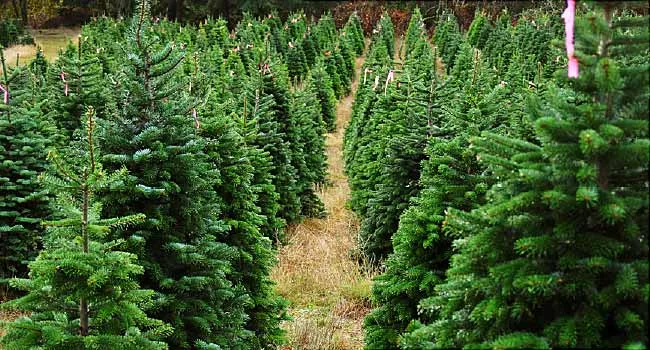

Discover Jessica’s secret to pest and pesticide free Christmas trees!
Dec. 8, 2023 – Michelle Pridgen sometimes finds tiny black bugs called aphids in her Christmas tree, and usually a bird’s nest as well.
“I just incorporate the nest into my decorating,” she said cheerfully.
Pridgen manages the farmers market in Independence, VA, and coordinates the preorders for pesticide-free Christmas trees, one of which she always gets for herself. The market first offered pesticide-free trees in 2012, when a local farm happened to skip spraying a stand of trees. Since then, the farm has stopped using pesticides entirely, although it may sometimes spray diluted herbicides to control weeds, Pridgen said.
“It matters a lot to our customers,” she explained. “That’s the main reason why a lot of people buy trees through our market. Most of our customers are at least environmentally concerned, so most of our vendors may not be certified organic, but they grow organically. In the community that supports our [farmers] market, how things are grown does matter to them.”
A small number of Christmas tree growers have turned away from traditional practices, and terms like “pesticide-free” and “no-spray” have attracted many Christmas tree buyers, although experts say a traditionally cultivated tree is typically exposed to the same or fewer chemicals than the food we eat.
Starting the week before Thanksgiving, the offer of “eco-friendly” trees from Reed Island Christmas Tree Farm in southern Virginia draws hundreds of people each year who navigate winding mountain roads to chop down their own classic Frasier fir, or occasionally a similar variety called a Canaan fir. The no-spray trees are so popular that sometimes, they sell out for the season within the first week of December.
Reed Island owner Billy Cornette Jr., 81, has been growing Christmas trees there since 1989. Raised in a family of Kentucky coal miners, he retired early at 47 years old from a career in civil engineering. Cornette and his wife, Betty Vornbrock, are now semi-professional musicians who specialize in a folk style called old-time music. Vornbrock recently returned from playing concerts in Japan, China, and Hawaii.
“We raise trees so we can do something else, and that’s play music,” said Cornette.
Health and Environmental Factors
Cornette and Vornbrock may identify as musicians first, but they’re dedicated farmers, too. They’ve even traveled to one of the few places in the U.S. where Frasier firs grow naturally to collect cones, bringing them home to start their own seedlings.
Things didn’t begin that way, though. At first, they bought commercially started seedlings, and the trees and land were sprayed to manage pests and weeds, just like at other Christmas tree farms.
“We did that because that’s what everybody told us to do,” Cornette said. “But the two of us just decided that we couldn’t do that anymore.”
They were concerned about cancer risks among tree growers, although an analysis by North Carolina State University shows that North Carolina counties where Christmas trees are grown have cancer rates that are lower than in non-mountain counties on the whole.