

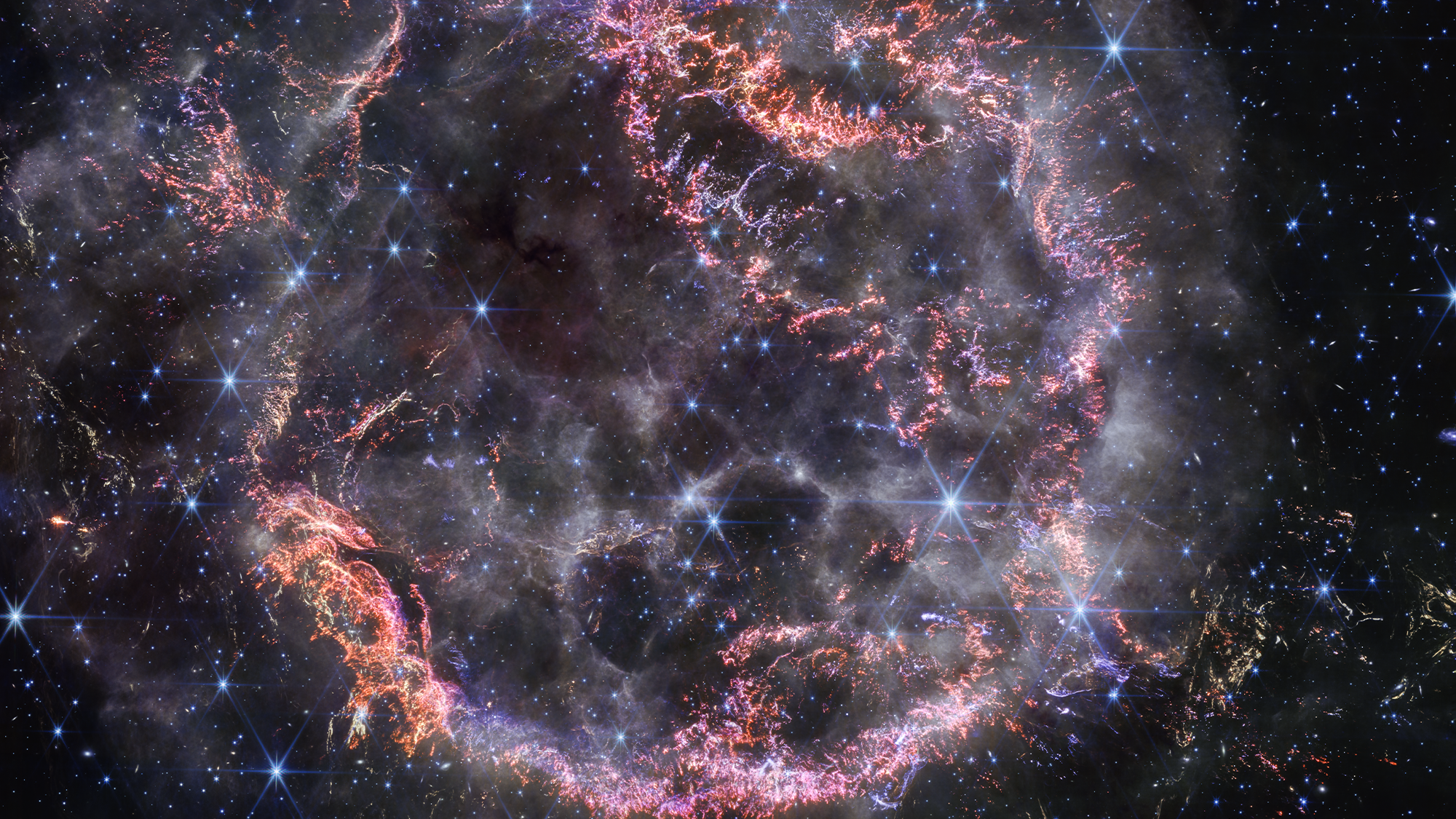

NASA has recently unveiled a striking new image of the supernova remnant Cassiopeia A (Cas A) captured by the James Webb Space Telescope (JWST). Despite being one of the most well-studied supernova remnants in the universe, JWST used its Near-Infrared Camera (NIRCam) to capture a different perspective of Cas A.
[Related: An amateur astronomer spotted a new supernova remarkably close to Earth.]
Cas A, situated about 11,000 light-years away from Earth in the constellation Cassiopeia, was formed from the remains of a massive star that is believed to have exploded approximately 340 years ago. Over time, NASA’s Chandra X-Ray Observatory, the Hubble Space Telescope, and the now-retired Spitzer Space Telescope have collectively established a multiwavelength view of the remnants of the stellar explosion. With the help of JWST, astronomers have been able to observe Cas A at different wavelengths, the new image showcasing intricate details of the expanding shell of material colliding into the star’s shed gas from before it exploded.
Color coding
Back in April, an image of Cas A created with JWST’s Mid-Infrared Instrument unveiled several surprising features in its inner shell. Astronomers are now investigating why many of these features are also present in the new image taken with NIRCam, providing a different angle of the same supernova remnants.
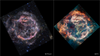 A side-by-side comparison of supernova remnant Cassiopeia A as captured by NASA’s James Webb Space Telescope’s NIRCam (Near-Infrared Camera) and MIRI (Mid-Infrared Instrument). At first glance, Webb’s NIRCam image appears less colorful than the MIRI image overall, but this is due to the wavelengths in which the material from the object is emitting its light. The NIRCam image appears a bit sharper than the MIRI image due to its increased resolution. CREDIT: NASA, ESA, CSA, STScI, Danny Milisavljevic (Purdue University), Ilse De Looze (UGent), Tea Temim (Princeton University)
To the human eye, infrared light is invisible. Image processors and scientists translate these wavelengths of light into visible colors for images like this one. Colors were assigned to various filters from JWST’s NIRCam which sees in near-infrared light. Each hue hints at something different happening within Cas A.
The clumps of bright orange and light pink make up the inner shell of the supernova remnant. JWST detected small knots of gas made up of sulfur, oxygen, argon, and neon that originated from the now exploded star itself. A blend of dust and molecules that will one day make up new stars and planetary systems are intertwined within the gas.
“With NIRCam’s resolution, we can now see how the dying star absolutely shattered when it exploded, leaving filaments akin to tiny shards of glass behind,” Purdue University astronomer Danny Milisavljevic remarked in a statement. “It’s truly astonishing after all these years of studying Cas A to now resolve those details, providing us with revolutionary insight into the star’s explosion.”
In the new near-infrared view,