

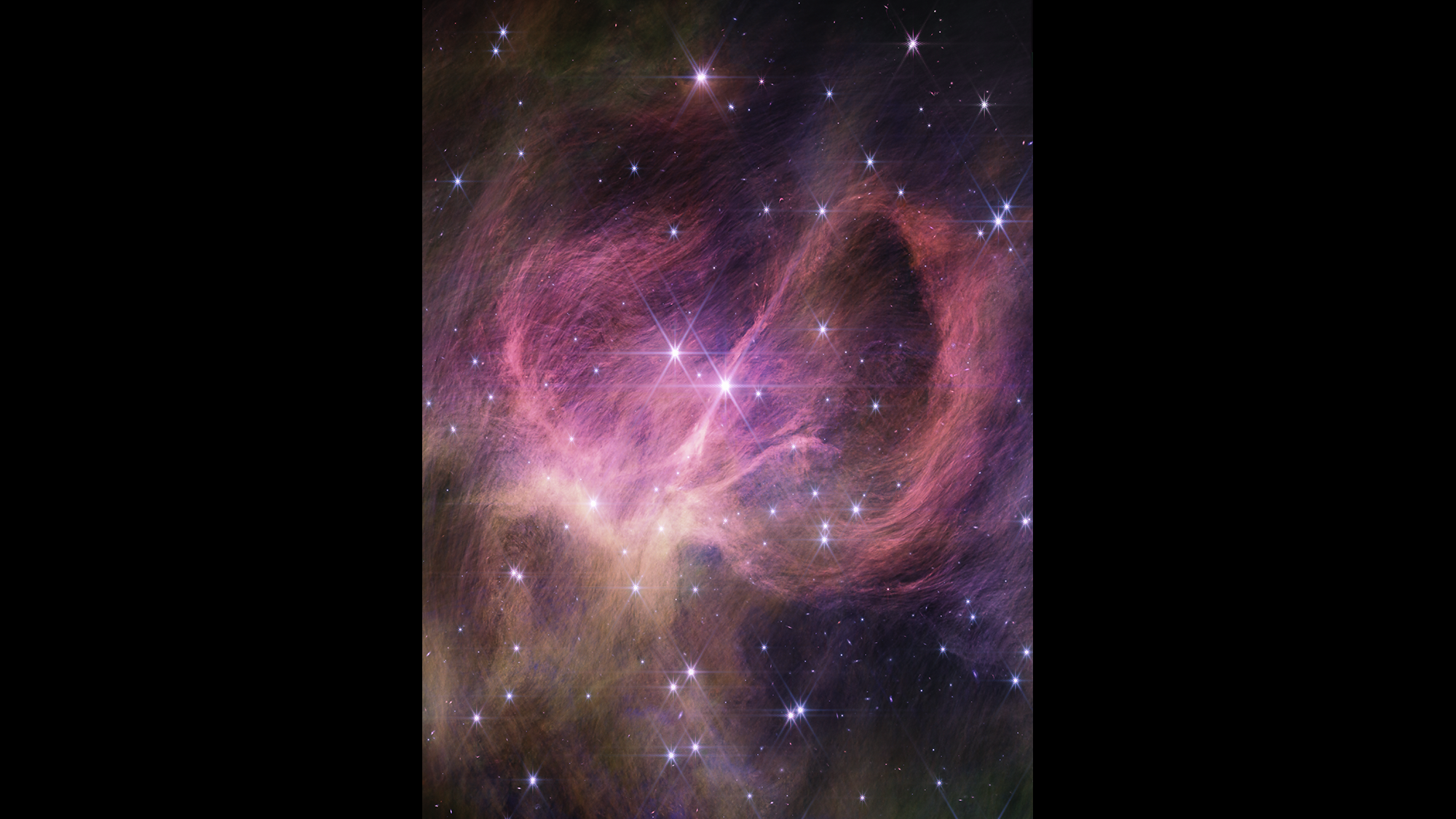

A team using the James Webb Space Telescope (JWST) has found something pretty remarkable: The smallest free-floating brown dwarf star ever recorded and two other “failed stars.” They are located in a star cluster that’s only 1,000 light-years from Earth and is not associated with a parent star. If you want to learn more about this fascinating discovery, then you’re in luck because the findings were published December 13 in the Astronomical Journal and may help astronomers better determine the boundaries between stars and planets.
[Related: Who knew? A Jupiter-sized dwarf star burns half as hot as a campfire.]
Failed Stars
So, what exactly are brown dwarfs? Well, they are celestial bodies that are more massive than planets, but not quite as large as stars. They form like stars, growing dense enough to collapse under the weight of their own gravity, but they never become dense and hot enough to start fusing the hydrogen needed to turn into a star. That’s why they are often humorously known as “failed stars.”
The brown dwarf JWST spotted has a mass around eight times that of the planet Jupiter. Meanwhile, the smallest of these stars has a mass around three times that of Jupiter, which challenges current theories about how these types of celestial bodies are formed. If you’re curious about the reason, you’ll be thrilled to know that astronomers are using JWST to try and determine what the smallest celestial objects that can form in a star-like manner are.
“One basic question you’ll find in every astronomy textbook is, what are the smallest stars? That’s what we’re trying to answer,” shared the study co-author and Pennsylvania State University astronomer Kevin Luhman, said in a statement.
Scouring the skies
Luhman and his colleague Catarina Alves de Oliveira began their search with star cluster IC 348, which is only about 1,000 light-years away in the Perseus star-forming region and is, luckily, only about 5 million years old. Star cluster IC 348 is relatively young, so any brown dwarfs present would still be relatively bright in infrared light and be glowing from the heat of their formation.
They imaged the center of the star cluster with JWST’s Near-Infrared Camera (NIRCam) to identify any brown dwarf candidates from their brightness and colors. They then used the microshutter array on the telescope’s Near-Infrared Spectrograph (NIRSpec) to look at the most promising targets. What’s particularly exciting about this is that the JWST’s sensitivity to infrared light allowed the team to detect objects that are fainter than anything other ground-based telescopes would be able to detect.
They narrowed the star cluster down to three possible targets. All of the stars weighed three to eight Jupiter masses and had surface temperatures ranging from 1,500 to 2,800 degrees Fahrenheit. If you find this fact interesting, then you might be thrilled to know that according to the team’s computer models, the smallest target was only three to four times the size of Jupiter and can offer clues to the star formation process.
[Related: Did you know? Two tiny stars actually fit into an orbit smaller than our sun.]
“It’s pretty easy for current models to make giant planets in a disk around a star,” shared the study co-author and European Space Agency (ESA) astronomer Catarina Alves de Oliveira of ESA said in a statement.