


The price of most chocolate bars has gone up worldwide in the past year, after cocoa bean prices rose dramatically in 2024.
As cocoa prices shot up, many farmers in tropical cocoa-producing countries including Nigeria saw profits rise.
With new cocoa farms opening up on the edges of the forested areas, trees are often cut down to plant more shrubs. However, this could increase deforestation in the biodiverse tropical rainforest regions where most cocoa is farmed.
But research shows that cutting down trees may actually result in fewer beans being produced in the long term because trees can protect the crop from pests and provide much needed shade.
Our research in the state of Ekiti, south-west Nigeria, has explored how, when and why trees are retained on cocoa farms, and what their potential is both for the farmer, and for the environment.
As the world’s fourth-largest cocoa producer, Nigeria plays a significant role in global supply.
Although Nigeria has seen more plantation-style farms with cocoa shrubs and without trees, its cocoa sector has, to some extent, bucked the deforestation trend seen in other cocoa-producing countries. This is partly because for many years the country’s economic policy focused on the oil sector, while not much was invested in cocoa “modernisation” policies that have caused so much damage and deforestation in other cocoa-producing countries, such as Ghana.
In Ekiti state in south-west Nigeria, an estimated 57% of cocoa is still grown on small farms with significant tree cover. However, Ekiti has lost significant forest cover over the past two decades, with one-third of deforestation driven by agriculture. As part of our research we wanted to understand why some farmers choose to retain trees and how existing production systems might be supported, despite producers around the world trying to meet new levels of demand.
How cocoa, timber, and fruit/spice trees contribute to farm revenue
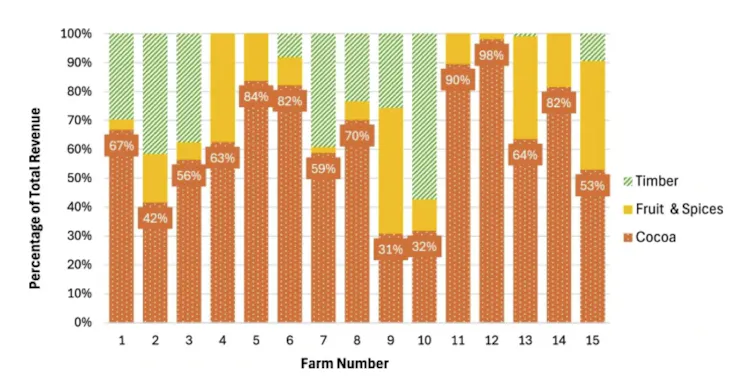
Author’s own research, CC BY-NC-ND
We visited 15 farms and found high levels of biodiversity. We recorded 42 different tree species, many recently planted by farmers. The trees creating the greatest shade across farms were all indigenous rainforest species, including increasingly rare tropical hardwoods such as Iroko (Milicia excelsa), Oganwo (Khaya senegalensis), Eku (Brachystegia eurycoma), and Obeche (Triplochiton scleroxylon). Some of these species are so rare in Nigeria that cocoa farms are now being used as a source for seed collection. There were also up to 26 bird species recorded on a single site.
Tree cover also plays an economic role in production. Many of the 15 farmers we surveyed valued shade trees for keeping plants cool. Cocoa doesn’t produce well if it gets too hot, and as climate change is now threatening the future suitability of many growing regions, regulating temperature is going to be increasingly important. And the trees are a harvestable resource in themselves: 11 of the 15 farmers valued trees as direct financial security,