


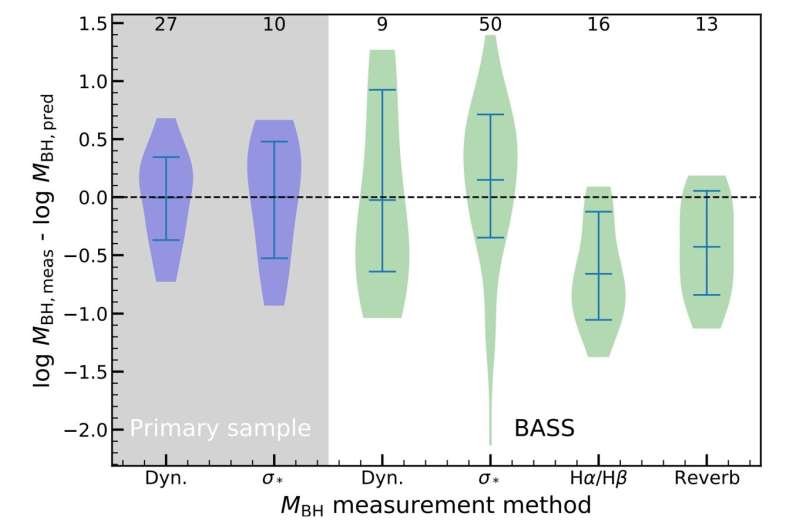
An entirely new way to probe how active black holes behave when they eat has been discovered by an international team of astronomers. A sample of active black holes at the center of 136 galaxies was found to shine in microwave and X-ray light in the same way, no matter their appetite for the surrounding galactic matter, like gaseous clouds of dust and plasma. This process is not something predicted by our current understanding of how black holes eat. Currently understood to be intrinsically different depending on their appetites, active black holes are characterized by the layout of their cores and the way they draw in the galactic matter. However, the team found these black holes may have more similarities than previously thought. Their findings, forthcoming in Monthly Notices of the Royal Astronomical Society: Letters, could offer new information about how galaxies evolve. Lead author Dr. Ilaria Ruffa, a postdoctoral research associate at Cardiff University’s School of Physics and Astronomy, said, “The microwave and X-ray glow we detect from the regions around these black holes seems to directly relate to their mass and to originate from streams of plasma disorderly falling into them. This is the case in both systems that have huge appetites that are eating nearly an entire star like our sun per year, and those with lesser appetites which are eating the same amount of material over 10 million years. This was very surprising because we had previously thought that such streams should occur only in systems eating at a low rate, whereas in those with huge appetites, the black hole should be fed through a more ordered and constant flow of matter (usually called ‘the accretion disk’).” The team made the discovery while investigating the link between the cold gas around active black holes and how these are fueled in the WISDOM sample of 35 nearby galaxies captured by the Atacama Large Millimeter/submillimeter Array (ALMA) of telescopes in Chile. Dr. Ruffa added, “Our study suggests that the microwave light we detect may actually come from these streams of plasma in all types of active black holes,” » …
Read More
rnrn