


(Image credit: NASA/Goddard/Arizona State University)
A NASA orbiter caught sight of Japan’s SLIM moon lander on the lunar surface after its historic touchdown.
SLIM, or the Smart Lander for Investigating Moon, is operated by the Japan Aerospace Exploration Agency (JAXA). It touched down on the moon in a precision landing on Jan. 19, making Japan the fifth country to make a soft landing on the lunar surface behind India, China, the United States and Russia (then the Soviet Union).
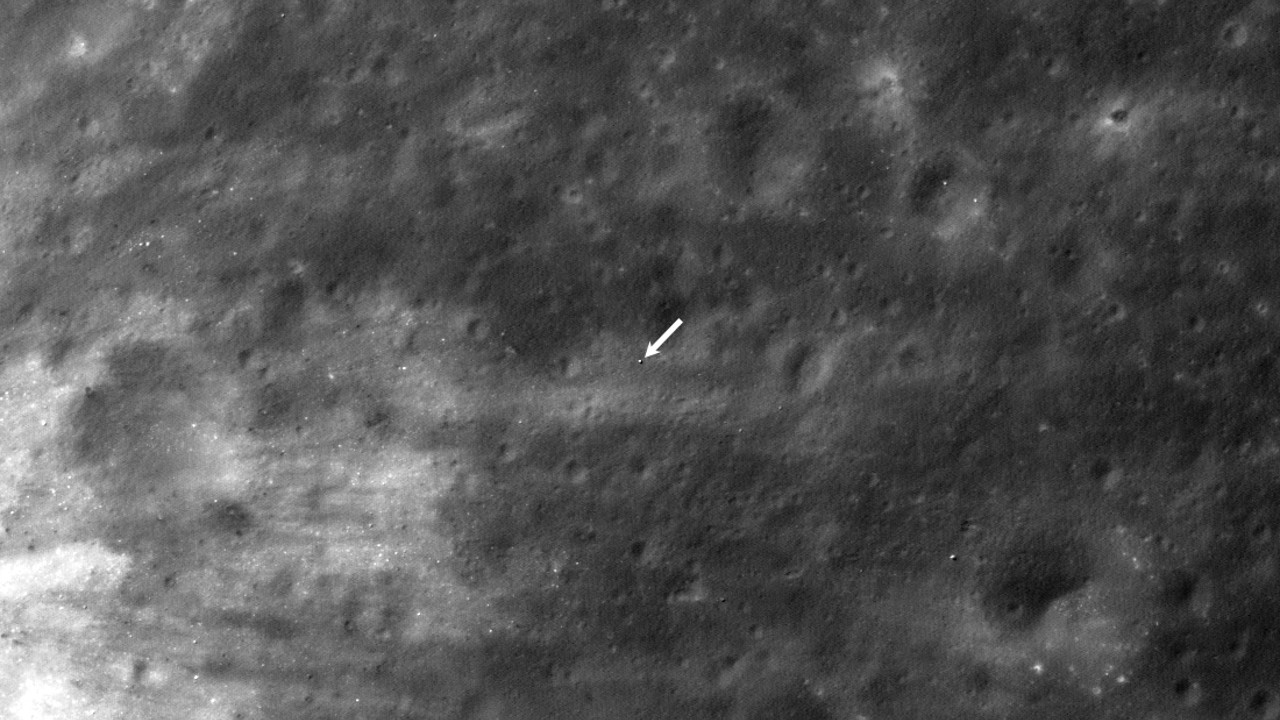
From its orbit 50 miles (80 km) above the moon’s surface, NASA’s Lunar Reconnaissance Orbiter (LRO) was able to see SLIM resting at its landing site. “Bright streaks on the left side of the image are rocky material ejected from the nearby, relatively young Shioli crater,” NASA’s Goddard Space Flight Center, which manages LRO, wrote in a statement.
Related: Japan’s SLIM moon lander photographed on the lunar surface — on its nose (image)
NASA’s images show SLIM’s landing site both before and after the probe’s touchdown. One of the images, seen below, is a composite that removes features that are the same in both the before-landing and after-landing images. In turn, it allows us to see changes in reflectance on the lunar surface, caused by the lander’s engine exhaust, to stand out.

A composite image dividing the before image from after. Features that are the same in both images disappear, highlighting the changes in surface brightness from the rocket plume. The image is 2,887 feet wide (880 meters), and lunar north is up. (Image credit: NASA/Goddard/Arizona State University)
SLIM accomplished its main goal of landing at a chosen site with near-pinpoint accuracy, touching down within 328 feet (100 meters) of its target despite ending up upside down due to an engine failure during descent.

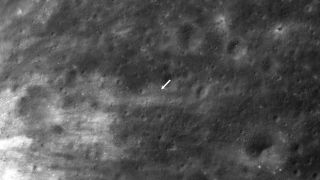
This image pair shows LRO views of the area surrounding the SLIM site before (frame M1254087075L) and after (frame M1460739214L) its landing. Note the slight change in reflectance around the lander due to engine exhaust sweeping the surface. These images are enlarged by a factor of two, and are about 1,444 feet (440 meters) wide. (Image credit: NASA/Goddard/Arizona State University)
Because of its orientation, SLIM is unable to use its solar panels to generate electricity, meaning the probe is relying fully on its battery. On Monday (Jan. 21), the lander’s battery dipped to 12% capacity, triggering a power down “to avoid being unable to restart for a recovery operation due to over-discharge,” SLIM team members stated on X.
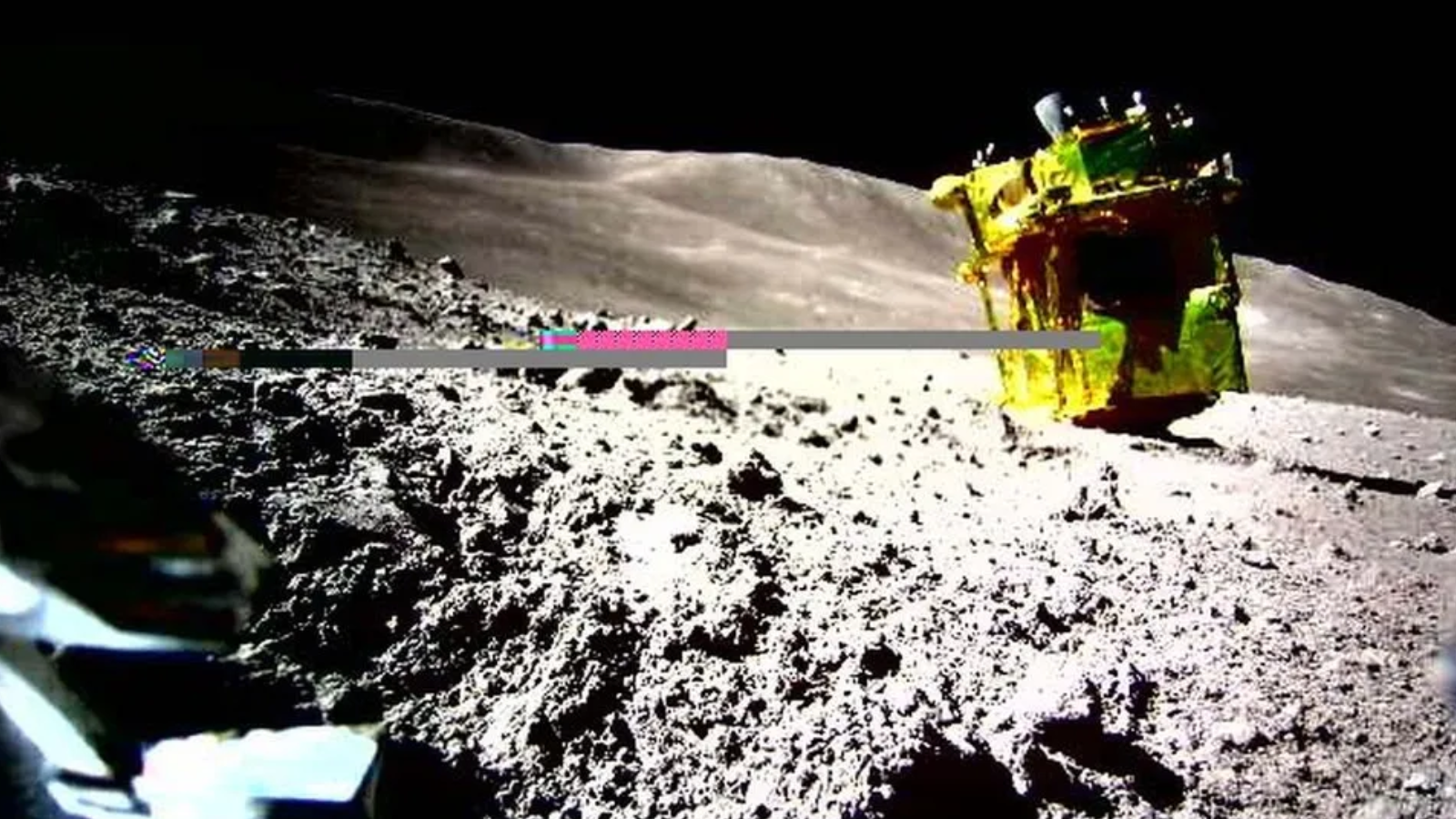
Japan’s SLIM moon lander, photographed on the lunar surface in January 2024 by LEV-2, a tiny rover that traveled to the moon with SLIM. (Image credit: JAXA)
Nevertheless, JAXA scientists are hopeful that, if sunlight shines on the lander from the lunar west, SLIM’s solar panels might be able to absorb enough sunshine to generate power and recover.
It’s not all bad news,