


Skip to the Best Raspberry Pi Expansions

Image: IDG
The Raspberry Pi is already versatile out of the box. But with hardware extensions that are plugged directly onto the board, you can significantly increase the possibilities. We introduce you to some remarkable components.
With the “Hardware Attached on Top” (HAT) concept, the Raspberry has an easy way to expand its capabilities. The add-ons are simply plugged onto the GPIO pins on the board. The expansion kits usually also include plastic spacers to protect against short circuits if the main board and expansion board come too close together. The range of such extensions has grown considerably in recent years. In addition to the official HATs, the manufacturer stands out in particular.
In this article, we present a series of particularly interesting HAT boards. The focus is on model 4, but the boards presented here can also fit older models or the brand new , although they do not have to. You should therefore find out about compatibility before you buy (see last point “Check before you buy!”).
Rich sound with DAC
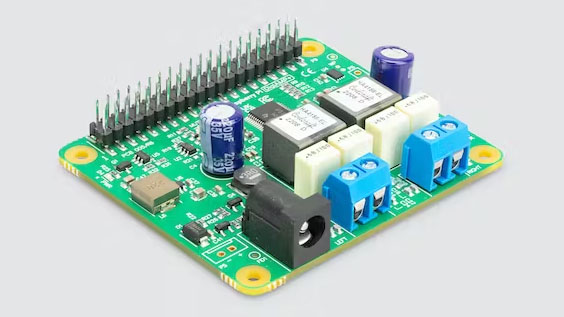
With a DAC, you can connect the board to passive or active speakers or to the stereo system. This turns the Raspberry into a streaming box.
Raspberry Pi Foundation
An extension that works immediately, i.e. “out of the box,” improves the sound characteristics of the board. The Raspberry Foundation has various models of such “Digital Audio Controllers” (DAC) on offer.
Which board is right for you depends on your environment. The is the right choice if you want to connect passive speakers to the computer. The board offers the usual clamp connections for the cables and delivers an output of up to 35 watts per channel. That’s definitely enough for the living room at home.
The , on the other hand, are intended for active speakers. They offer the classic connection via banana plugs. In such a system, the speaker with the integrated amplifier is connected to the signal source. The HATs convert digital signals into analog signals so that you can connect the Raspberry either directly to loudspeakers or the stereo system (AUX input). In combination with the right software, you can turn the Raspberry Pi into a streaming box for the WLAN or use it to play music stored on data storage media.
For all Lego fans
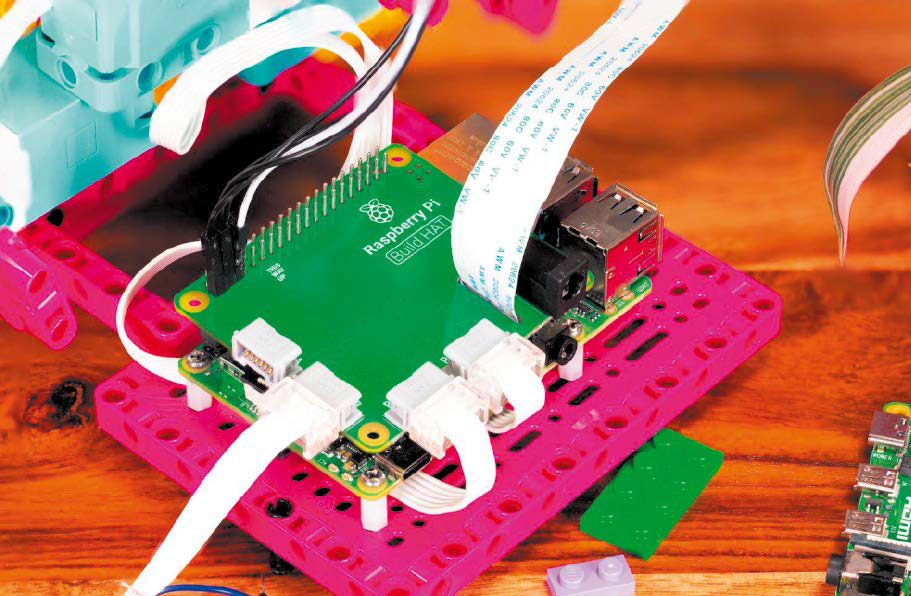
The HAT for Lego hobbyists opens up new possibilities for controlling sensors and motors from the Lego cosmos via Raspberry.
IDG
The expansion board, which can control up to four motors and sensors — including components from the Mindstorm cosmos — is available for all ambitious Lego hobbyists who are intensively involved with Lego Technics. You can even find a Lego board in specialized shops,