

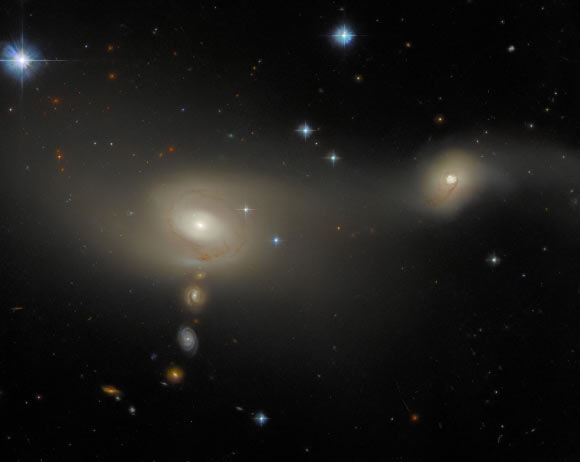

Check out the breathtaking new image of Arp-Madore 2105-332, a pair of interacting galaxies in the minor southern constellation of Microscopium here.


This Hubble image shows Arp-Madore 2105-332, a pair of interacting emission-line galaxies some 200 million light-years away in the constellation of Microscopium. Image credit: NASA / ESA / Hubble / J. Dalcanton / L. Shatz.
Arp-Madore 2105-332 is located approximately 200 million light-years away in the constellation of Microscopium.
“This system belongs to the Arp-Madore catalogue of peculiar galaxies,” Hubble astronomers said.
“The wonderful quality of this image also reveals several further galaxies, not associated with this system but fortuitously positioned in such a way that they appear to be forming a line that approaches the leftmost (in this image) component of Arp-Madore 2105-332.”
Find out more about the leftmost galaxy here.
Uncover the details about the rightmost galaxy here.
“These hefty names do not lend themselves to easy memorization, but they do actually contain valuable information: they are coordinates in the right ascension and declination system used widely by astronomers to locate astronomical objects,” the astronomers said.
“Both the galaxies are of a type known as emission-line galaxies. This simply means that, when observed with spectrometers, the spectra of both galaxies exhibit characteristic bright peaks, known as emission lines.”
“Emission lines are produced when gases are very hot, and therefore have sufficient energy that the atoms and molecules are ‘excited’ and emit light.”
“In other words, emission-line galaxies are highly energetic places, marking them out as likely hotbeds of star formation.”
“As with many galaxy types, categorizing a galaxy as an emission-line galaxy does not exclude it from having other descriptions that refer to its other properties.”
“Arp-Madore 2105-332, for example, is also a ‘peculiar’ galaxy, reflecting the atypical shapes of its two constituent galaxies.”