


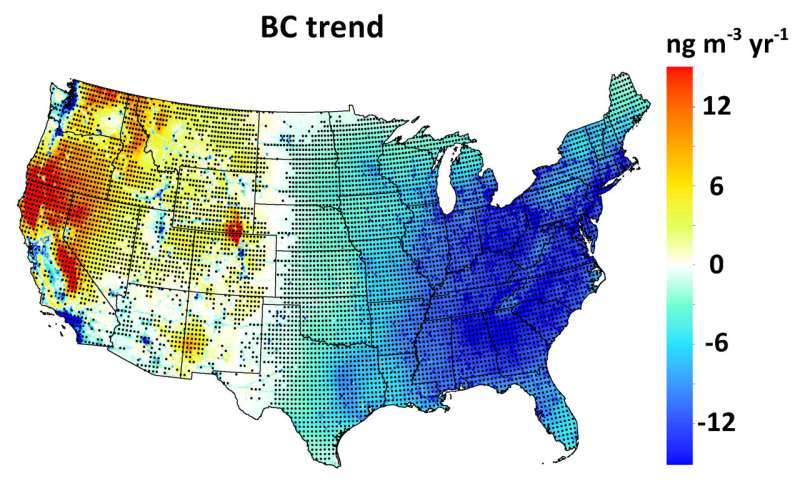
Remember last summer’s wildfires in the United States and Canada that fouled the air from coast to coast? Imagine the devastating effects these blazes can have on the environment and human health.
A new study has tabulated the toll from two decades of wildfires on air quality and human health in the continental U.S. The authors report that from 2000 to 2020, the air has worsened in the western U.S., mainly due to the increase in frequency and ferocity of wildfires causing an increase of 670 premature deaths per year in the region during that time period. Overall, the study’s authors report fires have undercut successful federal efforts to improve air quality primarily through reductions in automobile emissions.
The study, “Long-term mortality burden trends attributed to black carbon and PM2.5 from wildfire emissions across the continental US from 2000-2020: a deep learning modelling study,” is published online Dec. 4 in the journal The Lancet Planetary Health.
“Our air is supposed to be cleaner and cleaner due mostly to EPA regulations on emissions, but the fires have limited or erased these air-quality gains,” says Jun Wang, James E. Ashton professor and chair in the Department of Chemical and Biochemical Engineering, assistant director of the Iowa Technology Institute at the University of Iowa, and the lead corresponding author on the study. “In other words, all the efforts for the past 20 years by the EPA to make our air cleaner basically have been lost in fire-prone areas and downwind regions. We are losing ground.”
The researchers calculated the concentration of black carbon, a fine-particle air pollutant that has been linked to respiratory and heart disease, on a kilometer-by-kilometer (0.6 miles) grid for the continental U.S.
In the western U.S., the researchers report black carbon concentrations have risen 55%, on an annual basis, mostly due to wildfires. Not surprisingly, the highest premature mortality rates were in the western U.S., the region where the wildfires originated or that was most affected by smoke from wildfires in Canada. The authors say the increase of 670 premature deaths per year is a conservative estimate, as black carbon’s effects on human health are not fully understood.
“Wildfires have become increasingly intensive and frequent in the western U.S., resulting in a significant increase in smoke-related emissions in populated areas,” Wang and his team write. “This has likely contributed to a decline in air quality and an increase in attributable mortality.” The fires also have affected the Midwest. » …
Read More rnrn