

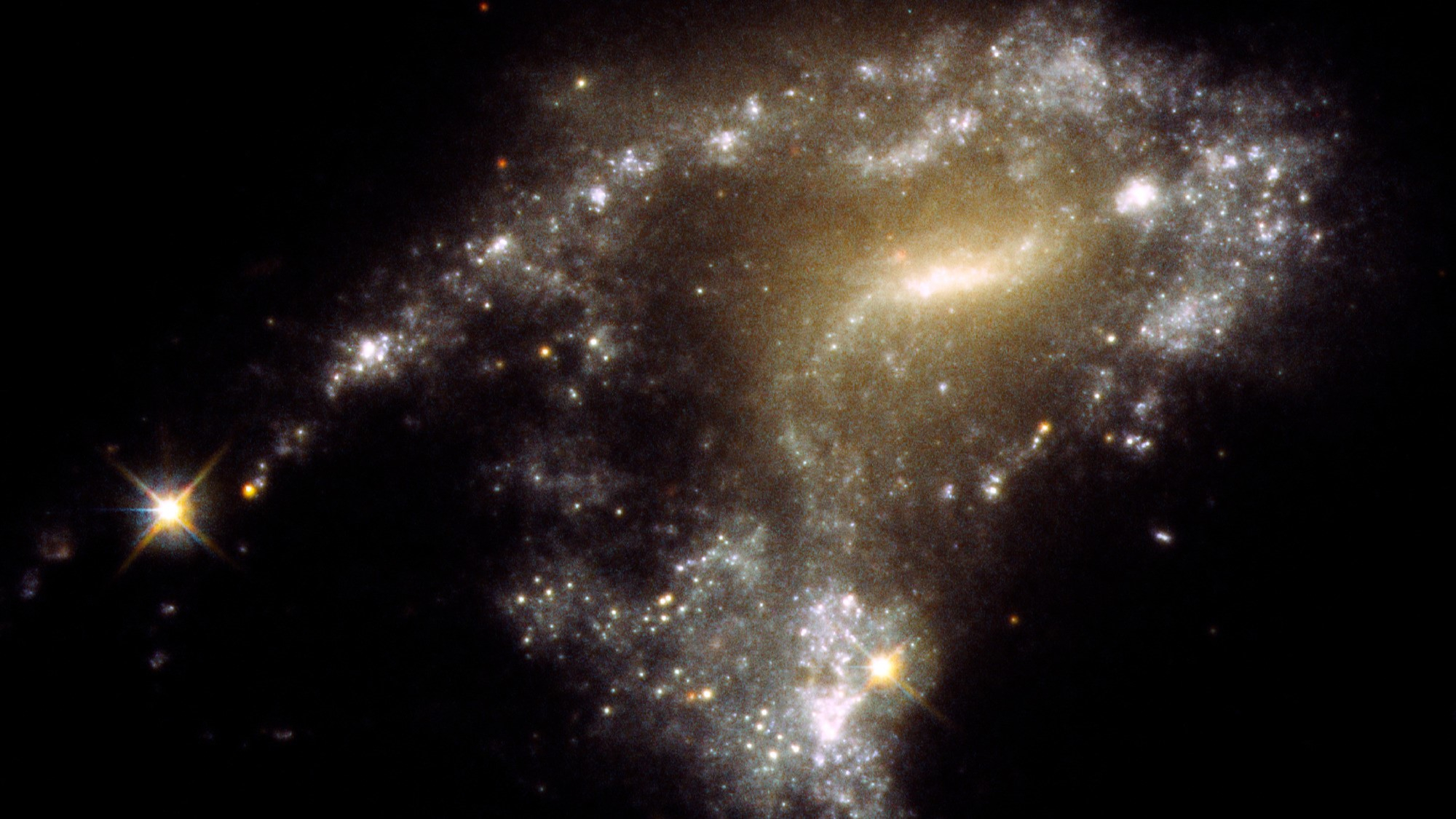

Exploring the Star-Forming Galaxies: Investigating Tidal Tails with Hubble Space Telescope
A fascinating discovery by the Hubble Space Telescope unveils a stunning display of star clusters in the tails of interacting galaxies, resembling a cosmic string of pearls. When spiral galaxies collide or come close to each other, their spiral arms unfold due to immense gravitational forces, forming long tidal tails that extend over tens of thousands of light-years. These tidal tails, enriched with gas and dust, ignite a fervent process of star formation, turning into the most vigorous regions for birthing stars within a galaxy.
Recently, a team of astronomers led by Michael Rodruck from Randolph-Macon College in Virginia has analyzed Hubble images capturing 12 interacting galaxies in seven distinct systems. They observed 425 massive star clusters in the tidal tails of these galaxies, each hosting a million young blue stars emitting ultraviolet light. By examining ultraviolet data from NASA’s Galaxy Evolution Explorer and the Swift mission, the team calculated the star-formation rates within these star clusters.
Moreover, the presence of strong emission lines in the spectra of these clusters, caused by ionization of hydrogen gas from ultraviolet radiation, enabled the astronomers to estimate the clusters’ age. The persistence of gas in these clusters, despite the negative feedback from young stars, indicates that they are less than 10 million years old. This discovery challenges conventional knowledge about cluster formation and offers insights into creating new generations of stars through tidal tail interactions.
The characteristics of these tidal-tail clusters resemble ancient globular clusters in the Milky Way, raising questions about their longevity and resemblance to historical star formation events. Could these modern clusters disperse over time, or do they hold clues to the formation of globular clusters in our galaxy’s past? The team’s findings were detailed in a publication in the Monthly Notices of the Royal Astronomical Society.
This groundbreaking research sheds light on the intricate processes unfolding in these interacting galaxies, highlighting the dynamic interplay between gravitational forces and stellar evolution. The cosmic dance of galaxies within close encounters unveils a treasure trove of star clusters, enriching our understanding of the cosmic phenomena shaping the universe. Explore more about these mesmerizing star-forming galaxies and unveil the mysteries of tidal tail interactions with the Hubble Space Telescope.