

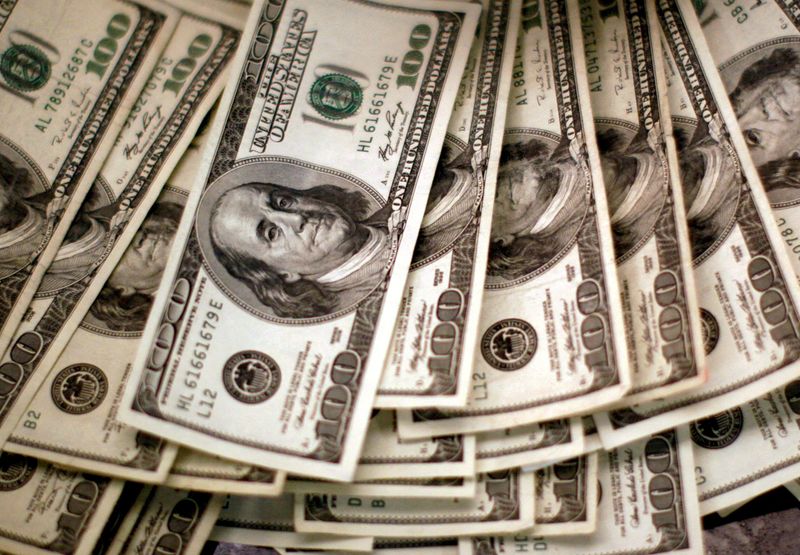

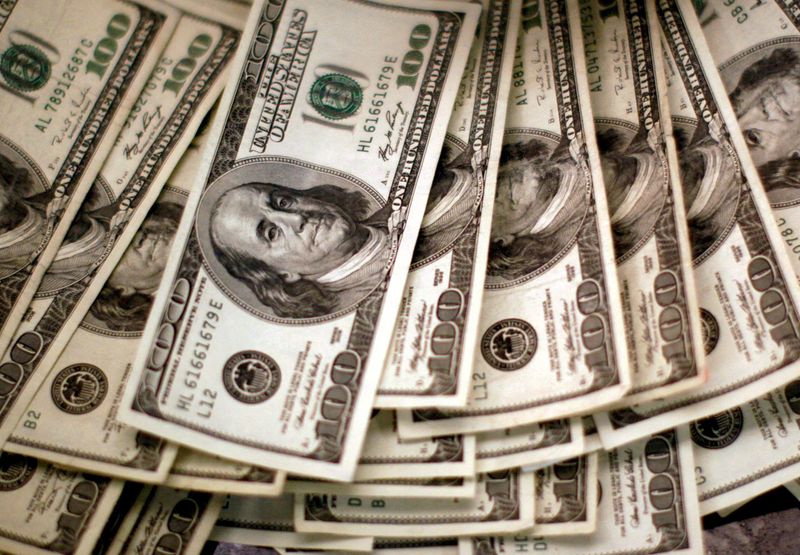
© Reuters. FILE PHOTO: Four thousand U.S. dollars are counted out by a banker counting currency at a bank in Westminster, Colorado November 3, 2009. REUTERS/Rick Wilking/File Photo
By Karen Brettell and Samuel Indyk
NEW YORK/LONDON (Reuters) – The dollar is set to end 2023 with its first loss since 2020 against the euro and a basket of currencies on expectations the U.S. Federal Reserve will begin cutting rates next year as inflation moderates.
As we look ahead to 2024, we’re keeping an eye on when the Fed starts cutting rates and whether the first reduction is to prevent over-tightening due to falling inflation or because the U.S. economy is slowing down rapidly.
The markets are already anticipating aggressive cuts and are debating how much further the dollar will drop.
“We’ve already weakened quite a bit in anticipation of a Fed cut cycle to come,” said Brad Bechtel, global head of FX at Jefferies in New York.
The dollar’s decline accelerated after the Fed adopted an unexpectedly dovish tone and forecast 75 basis points in rate reductions for 2024 at its December policy meeting.
Market expectations for even more aggressive cuts suggest that the first cut may come in March, with a total of 154 basis points in cuts expected by year-end.
The Fed’s approach contrasts with other major central banks, such as the European Central Bank (ECB) and Bank of England (BoE), which have indicated that they will hold rates higher for longer.
But “I do think they will capitulate. European growth is just struggling too much and inflation’s coming down relatively fast… same in the U.K. in many ways,” said Bechtel. “If all three central banks are cutting, it’s going to be very hard for the dollar to weaken significantly.”
Against a basket of currencies, the greenback was little changed on Friday at 101.18, rising from a five-month trough of 100.61 reached on Thursday. It is on track to lose 2.23% this year.
The euro gained 0.07% to $1.1069, hovering just below a five-month peak of $1.11395 reached on Thursday. It is heading for a 3.31% gain for the year, its first positive year since 2020.
“Markets are looking for a cut earlier in the U.S. and are less certain that the European Central Bank will cut as quickly, so that’s why the dollar is very soft,” said Niels Christensen, chief analyst at Nordea.
“We also have positive risk appetite which is another negative for the dollar. Going into 2024, the soft dollar will be a theme towards the March central bank meetings,” Christensen added.
Policymakers at the ECB and the BoE did not signal any imminent rate cuts at their policy meetings this month, but traders are pricing in 161 bps of cuts by the ECB next year, with the probability of two cuts by April. The BofE is also expected to cut rates by 148 bps in 2024.