


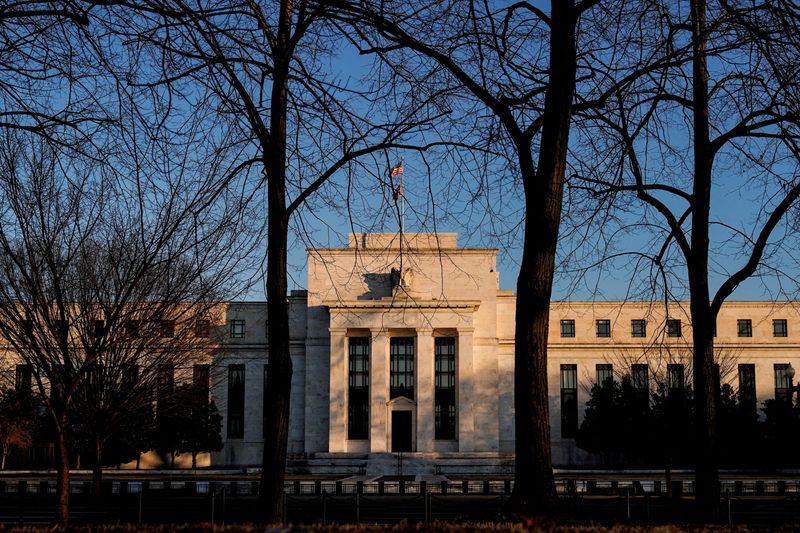
 © Reuters. FILE PHOTO: The Federal Reserve building is seen in Washington, U.S., January 26, 2022. REUTERS/Joshua Roberts/File Photo
By Yoruk Bahceli
(Reuters) – Brace yourselves: markets are indicating that interest rates are likely to remain high for years to come, disappointing borrowers who were hoping for relief from increasing rates.
Even with potential rate decreases in 2024, money market pricing shows that the era of near-zero interest rates experienced after the financial crisis is unlikely to return anytime soon. The combination of inflationary pressures and elevated government spending is a strong indication of this trend.
This could spell more trouble for public and private borrowers who secured loans at lower rates in the past and have yet to feel the full impact of the consecutive central bank rate hikes over the last two years.
While there has been hope for substantial rate cuts next year, thanks to decreasing inflation and a more accommodative approach from the U.S. Federal Reserve, it seems these hopes might be dashed.
Market expectations suggest that rates will likely drop by at least 1.5 percentage points in the United States and Europe, providing a boost to bond and equity markets. However, the Fed is expected to cut its key rate to around 3.75% by the end of 2024, only to slightly decrease to around 3% by the end of 2026, and then start rising again to around 3.5% thereafter, according to money market pricing.
This stands in stark contrast to the near-zero rates that lasted for most of the decade following the global financial crisis, gradually rising to 2.25%-2.50% in 2018.
Market players anticipate European Central Bank rates to be around 2% by the end of 2026, down from the current 4%. This reflects a reduction, but does not signal a return to the unorthodox experiment with negative rates seen from 2014 to 2022.
“It’s just normalizing policy. It’s not going into easy monetary policy,” Mike Riddell, senior portfolio manager at Allianz (ETR:) Global Investors, said.
While expectations hint at a rising ‘neutral’ interest rate, some argue that the neutral rate has not necessarily increased. This divide contributes to the ongoing debate about the movement of the neutral rate and its implications for economic growth.
Higher inflation risks on the back of geopolitical tensions and reshoring, looser fiscal policy, and potential improvements in productivity from the likes of AI are among factors that may be lifting the neutral rate, often dubbed ‘R-star’.
While this scenario is subject to debate, market expectations currently exceed the Fed’s estimate for long-term interest rates, with several policymakers estimating it to be above 3%.
In the euro area,